
www.auto-innovations.net
23
'26
Written on Modified on
Electric trucks improve fleet sustainability
Coca-Cola Canada Bottling expands electric delivery fleet with Volvo trucks to reduce emissions and support reliable urban distribution operations.
www.volvotrucks.com
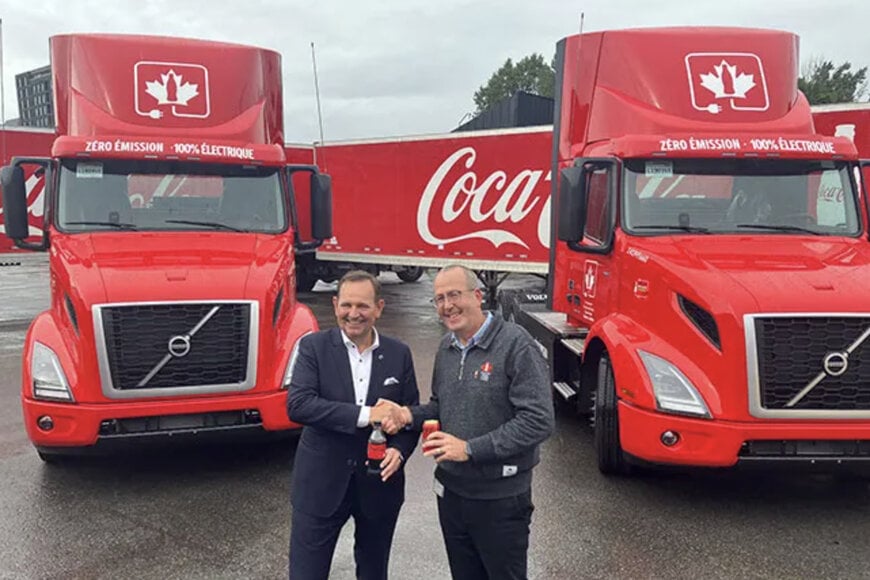
Coca-Cola Canada Bottling Limited operates a nationwide distribution network supplying beverages across urban and regional markets. The company faces increasing pressure to reduce carbon emissions while maintaining high-frequency delivery operations and service reliability.
Traditional diesel fleets contribute significantly to operational emissions, particularly in urban delivery routes with predictable daily cycles. The company’s objective was to transition toward low-emission transport solutions without compromising delivery performance, route efficiency, or operational continuity.
To address these challenges, Coke Canada Bottling selected battery-electric trucks from Volvo Trucks North America, building on earlier pilot deployments to scale electrification across multiple regions.
From pilot programme to multi-region deployment
The electrification strategy began with a pilot project in Montreal in 2023, allowing the company to evaluate vehicle performance, charging requirements, and operational integration. Following validated results, the company expanded deployment to Quebec City and Vancouver.
Seven additional electric trucks were introduced, increasing the total electric fleet to nearly 40 vehicles, including vans, yard tractors, and heavy-duty trucks. The vehicles are deployed on local and regional routes, where predictable distances and frequent returns to distribution centres support efficient battery-electric operation.
Infrastructure deployment accompanied the vehicle rollout. Charging systems were installed at key distribution sites, enabling daily operations with dedicated high-capacity chargers configured for multiple vehicles.
Why electric trucks were selected
The chosen solution is based on the Volvo VNR Electric platform, designed specifically for urban and regional freight distribution. The selection was driven by operational and technical compatibility with the company’s logistics model.
The trucks offer a range of up to 440 km per charge, enabling multiple daily delivery cycles from distribution centres to retail locations. This range aligns with predictable route structures, eliminating the need for mid-day charging in most cases.
Battery-electric drivetrains provide zero tailpipe emissions, directly supporting corporate sustainability targets. At the same time, the vehicles maintain the required payload capacity and operational reliability for beverage distribution, where delivery schedules are tightly managed.
Deployment and operational integration
The rollout followed a structured approach combining vehicle deployment with charging infrastructure installation.
In Quebec City, a 180 kW charging system with multiple dispensers supports fleet operations, while in Vancouver, additional high-capacity chargers were installed to accommodate higher fleet density. This ensures that vehicles can be recharged efficiently between delivery cycles or overnight.
The collaboration between Coke Canada Bottling and Volvo Trucks enabled a gradual scaling approach, using operational data from earlier deployments to optimise fleet utilisation and infrastructure planning.
Results: Emissions reduction and operational continuity
The transition to electric trucks delivers measurable and operational benefits:
- Expansion to nearly 40 electric vehicles across Canada
- Ability to complete multiple daily delivery routes on a single charge
- Integration of zero-emission transport into routine logistics operations
- Reduced dependence on fossil fuels in urban distribution
While specific emission reduction figures are not disclosed, the replacement of diesel trucks with battery-electric vehicles directly lowers greenhouse gas emissions and supports long-term sustainability targets.
Operationally, the use of predictable routes ensures high vehicle utilisation without compromising delivery schedules, demonstrating that electric trucks can meet the performance requirements of high-frequency distribution networks.
Conclusion
Coke Canada Bottling’s deployment of electric trucks illustrates how fleet electrification can be scaled from pilot projects to nationwide operations. By aligning vehicle capabilities with route predictability and investing in charging infrastructure, the company has integrated electric mobility into daily logistics while advancing its emissions reduction strategy.
Edited by an industrial journalist Sucithra Mani with AI assistance.
www.volvotrucks.com
Operationally, the use of predictable routes ensures high vehicle utilisation without compromising delivery schedules, demonstrating that electric trucks can meet the performance requirements of high-frequency distribution networks.
Conclusion
Coke Canada Bottling’s deployment of electric trucks illustrates how fleet electrification can be scaled from pilot projects to nationwide operations. By aligning vehicle capabilities with route predictability and investing in charging infrastructure, the company has integrated electric mobility into daily logistics while advancing its emissions reduction strategy.
Edited by an industrial journalist Sucithra Mani with AI assistance.
www.volvotrucks.com
