
www.auto-innovations.net
21
'26
Written on Modified on
RC Car Exceeds 400 km/h with Onshape
The PTC cloud-designed Mach Reaper sets a new Guinness World Record.
www.ptc.com
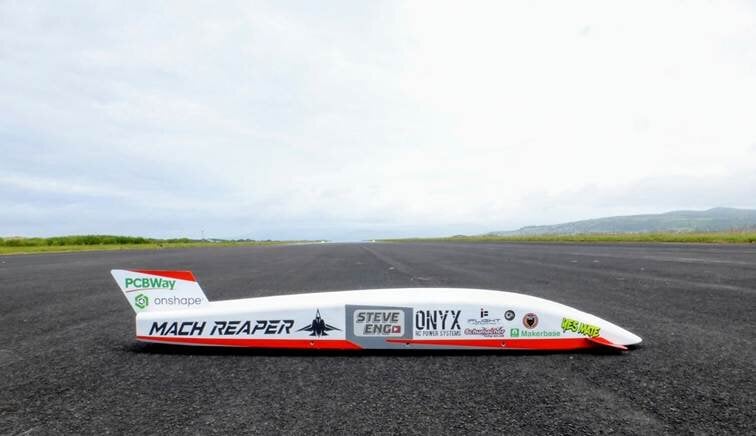
British mechanical engineer Stephen Wallis has set a new Guinness World Record by breaking the 400 km/h barrier with a radio-controlled (RC) car. Designed and developed in just eight months using Onshape, PTC's cloud-native CAD platform, the vehicle named "Mach Reaper" was clocked at 403 km/h (250.67 mph) at the Llanbedr airfield in Wales in June 2026. A few weeks later, the prototype even reached an unofficial speed of 413 km/h, making Wallis the first person to achieve such a milestone in this discipline.
Cloud Simulation and Aerodynamic Design
At speeds exceeding 400 km/h, the slightest aerodynamic disturbance or mechanical failure becomes critical. To design the Mach Reaper's forty-plus parts, the engineer relied on Onshape's modeling tools. The use of specialized aerodynamic profiling add-ons helped refine the bodywork, while finite element analysis (FEA) was employed to simulate extreme loads on the suspension system and the aluminum wheel structure. This digital validation maximized vehicle performance without risking structural failure at ultra-high speeds.
Hybrid Manufacturing and External Collaboration
The manufacturing process combined agile production methods to meet an eight-month deadline. While the majority of components were produced in-house via 3D printing, critical machined aluminum and carbon fiber parts were outsourced. Onshape's cloud architecture greatly simplified sharing 3D models with machining partners, accelerating design iterations. Buoyed by this success, Stephen Wallis is already working on a new prototype aimed at breaking the 483 km/h (300 mph) barrier.
Additional Context: Mechanical Challenges Beyond 400 km/h
This section details technical specifications and competitive benchmarking not included in the original report.
In the field of extreme speed RC vehicles (Speed Runs), centrifugal force and aerodynamic lift become the primary engineering challenges. At over 400 km/h, traditional rubber tires experience centrifugal expansion (ballooning) that inevitably leads to their disintegration. Designers must use solid machined aluminum or carbon composite wheels, whose resistance to extreme rotational G-forces must be rigorously validated via finite element analysis (FEA) to prevent shattering. Moreover, aerodynamic balance must be perfect: excessive downforce would overload the electric motors and crush the suspension, while poorly managed lift would cause the car to immediately take off (blowover).
Edited by industrial journalist Lekshman Ramdas, with AI assistance.
www.ptc.com
