
www.auto-innovations.net
24
'26
Written on Modified on
Automated driving improves urban bus operations
MAN Truck & Bus deploys an automated electric bus with ADASTEC in Munich to address driver shortages and improve efficiency in public transport.
www.man.eu
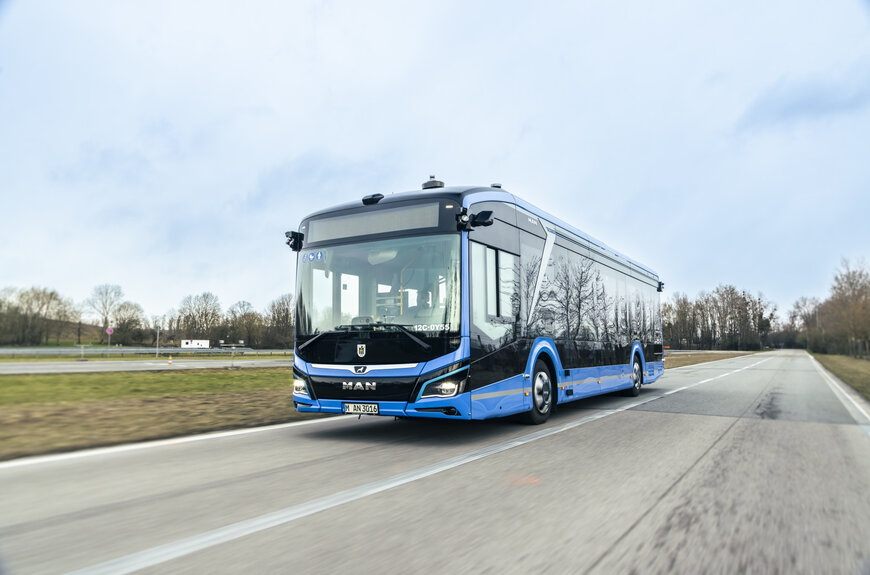
Urban public transport systems are under increasing pressure to maintain service reliability while coping with driver shortages and growing passenger demand. At the same time, operators are expected to improve safety, reduce emissions, and optimise operational efficiency.
To respond to these challenges, MAN Truck & Bus, together with Münchner Verkehrsgesellschaft (MVG), initiated a pilot deployment of an automated electric bus in Munich. The objective is to evaluate how automated driving can stabilise operations and improve service flexibility within an existing public transport network.
Technical solution and deployment
The solution is based on an electric city bus equipped with an Automated Driving System developed in collaboration with ADASTEC. The system integrates multiple sensing technologies, including LiDAR, radar, cameras, and satellite positioning, enabling the vehicle to perceive its surroundings and execute driving functions autonomously.
Implementation follows a staged validation process. Initial testing is conducted at MAN’s facilities, where specific driving manoeuvres such as docking at bus stops are refined. This phase focuses on system calibration and data collection. The next stage involves operation on public roads without passengers, allowing validation under real traffic conditions. A pilot phase with selected users is scheduled to follow, providing further operational feedback and supporting system optimisation.
Technology selection rationale
The choice of automated driving technology is linked to its ability to address structural and operational constraints in public transport. By enabling the vehicle to steer, accelerate, and brake independently under supervision, the system reduces reliance on driver availability while maintaining operational continuity.
In addition, automation introduces a consistent driving profile, which can contribute to improved safety and more predictable vehicle behaviour in complex urban environments. The integration into an existing electric bus platform also supports gradual deployment without requiring entirely new infrastructure or vehicle concepts.
Operational benefits and expected outcomes
As the project is still in its pilot phase, quantified performance indicators are not yet available. However, the technical validation carried out so far indicates clear operational advantages. Automated control enables more consistent vehicle operation, while continuous system monitoring reduces the likelihood of human error.
From an organisational perspective, the technology offers a potential response to driver shortages by supporting service continuity. At the same time, data collected during operation can be used to further optimise routes, driving behaviour, and energy efficiency.
Integration into a broader mobility framework
The deployment is part of the MINGA research initiative, which brings together public authorities, industry partners, and research institutions to evaluate automated mobility solutions in real-world conditions. The project aims to address not only technical feasibility but also regulatory, economic, and operational considerations associated with integrating autonomous systems into existing transport networks.
Conclusion
The automated electric bus pilot in Munich demonstrates how combining electrification with automation can address key challenges in urban mobility. By focusing on operational reliability, safety, and scalability, the project provides a structured pathway toward the integration of autonomous public transport systems.
Edited by an industrial journalist Sucithra Mani with AI assistance.
www.mantruckandbus.com
