
www.auto-innovations.net
30
'26
Written on Modified on
Deployment of Electric Long-Combination Trucks in Automotive Supply Chains
Logistics provider Elflein integrates MAN battery-electric tractor units into continuous automotive production routes to maximize cargo volume and lower operational emissions.
www.man.eu
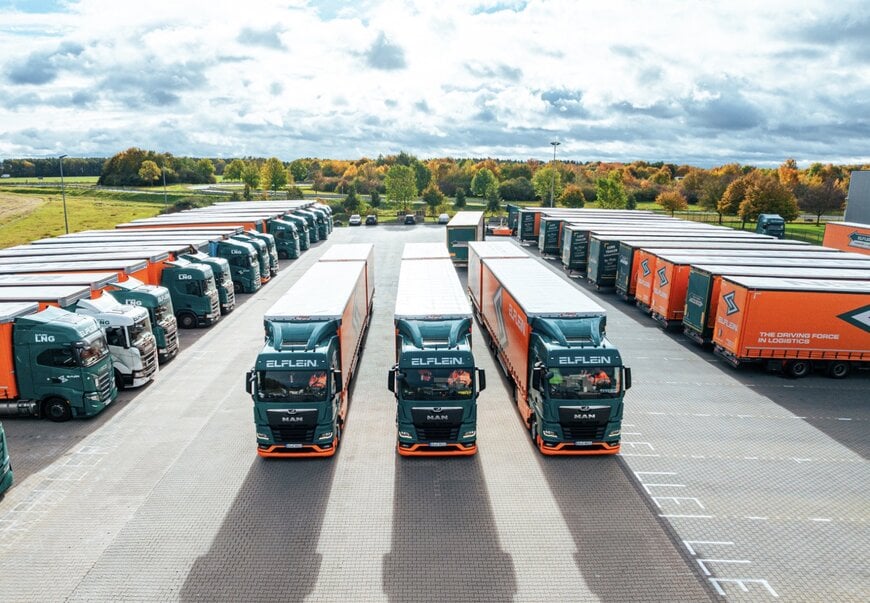
Logistics provider Elflein and commercial vehicle manufacturer MAN Truck & Bus have collaborated to deploy fully electric tractor units configured as long-combination vehicles. This deployment integrates high-capacity electric trucks into a continuous automotive logistics network to maintain high-speed production supply chains while reducing fossil fuel dependency.
Operational Challenges in Automotive Logistics
Elflein, a transport and logistics provider operating 11 transport locations and a fleet of 500 tractor units, handles over 1,500 transports daily. A primary operational challenge for the company involves servicing high-speed production supply chains for the automotive sector without disrupting just-in-time delivery schedules. To transition away from diesel fleets, the company required a heavy goods transport solution that could match the payload and volumetric capacity of traditional long-haul trucks while maintaining a continuous 24-hour operation cycle across extended distances.
Technical Configuration of the Transport Vehicles
To meet these capacity requirements, Elflein selected MAN eTGX electric tractor units paired with Fliegl SZS 320 MegaRunner Twin 200 semi-trailers and TPS 180 Mega-E trailers with sliding curtains. This 25.25-meter-long vehicle configuration provides a total transport volume of approximately 159 cubic meters, divided between the 101.5-cubic-meter semi-trailer and the 57.5-cubic-meter trailer. The combination supports a payload of 21.3 tons, operating at a maximum permissible gross combination weight of 42 tons.
The tractor units are equipped with six high-voltage batteries, delivering a gross capacity of 534 kWh and a usable capacity of 480 kWh. This energy storage configuration allows the vehicles to achieve a range of up to 500 kilometers between charging cycles, accommodating the specific distances required by the automotive manufacturer's fixed transport routes.
Route Deployment and Commercial Electric Vehicle Infrastructure
The electric long-combination trucks operate on a fixed circular route between an automotive manufacturing facility in Leipzig and Schierling, near Regensburg. The vehicles run continuously in two shifts, covering a total distance of 740 kilometers daily regardless of weather conditions.
To support continuous operation without extended disruption, Elflein utilizes the Hermsdorf interchange at the A4/A9 motorway as a strategic transshipment point. This location facilitates synchronized driver changes and houses two 300 kW charging stations. The infrastructure is capable of delivering up to 500 amperes (A) of direct current (DC), achieving a maximum charging capacity of 375 kW to rapidly replenish the batteries during shift transitions.
Quantifiable Results and Operational Impact
During daily operations on the Leipzig-Schierling route, the electric tractor units demonstrate a measured energy consumption of approximately 1.02 kWh per kilometer. By successfully maintaining the required 159-cubic-meter transport volume on a continuous rotation, the deployment proves that battery-electric drivetrains can handle the rigorous demands of industrial automotive logistics.
"We are combining the all-electric drive with a transport volume of around 159 cubic meters and reliably integrating this combination into a high-speed production supply chain," stated Manuel Greb, who is responsible for vehicle procurement and innovation at Elflein.
The adoption of these high-capacity electric vehicles directly addresses the need for energy efficiency in fleet management, lowering the total cost of ownership (TCO) while advancing decarbonization efforts within the commercial logistics sector.
Edited by Aishwarya Mambet, Induportals Editor, with AI assistance.
www.man.com
