
www.auto-innovations.net
05
'25
Written on Modified on
ams OSRAM cut CO2 for smart auto LED lighting
ams OSRAM and DP Patterning demonstrate a technology using single-layer flexible PCBs and the LED driver to enable intelligent automotive lighting while achieving up to a 98% CO2 reduction in manufacturing.
ams-osram.com
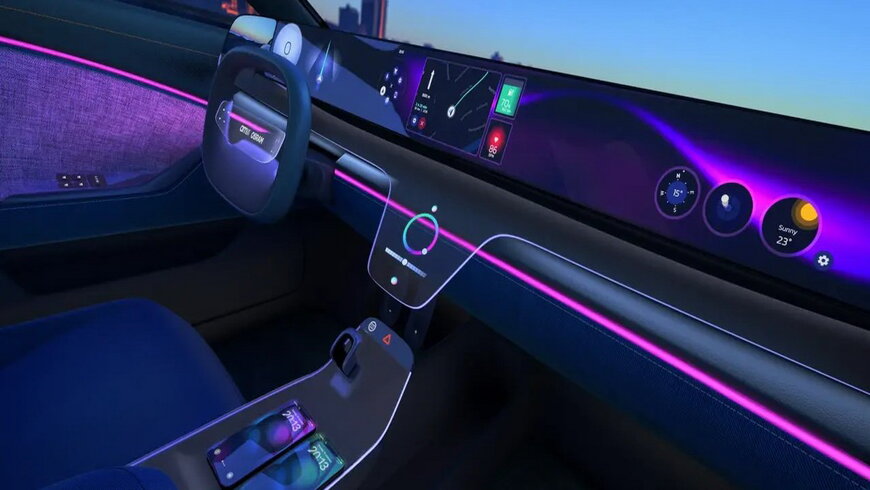
A jointly developed demonstrator from ams OSRAM and DP Patterning points to where automotive lighting networks are heading: single-layer flexible printed circuit boards (FPCBs) instead of complex multilayer designs — and, in the structuring step of production, up to 98% less CO₂ than chemical wet etching, according to a Fraunhofer Life Cycle Assessment (LCA). The demonstrator showcases conceptual possibilities by combining DP Patterning’s dry PCB manufacturing process with the AS1163 LED driver from ams OSRAM, which can be used easily for Flex PCB applications in interior and exterior lighting as well as smart surfaces.
The LED driver AS1163 from ams OSRAM does use the Open System Protocol (OSP) for communication. Together with an optimized integrated circuit (IC) pinout it opens up new design freedom, reduces cost and — in combination with the chemical-free dry process from Swedish technology partner DP Patterning — shows the potential for more sustainable solutions in the future.
The OSP platform connects LEDs, sensors, and actuators inside the car via a simple, continuous line, allowing hundreds of light points to be individually controlled. The Stand Alone Intelligent Driver (SAID) AS1163 enables low- or mid power LEDs to behave as if they were directly connected to an OSP network; additional local microcontrollers are no longer required. As a result, flexible — even single-layer — PCBs become the tool of choice for slim, space-saving lighting modules.
Compared to conventional electronic circuit technologies that use etching baths and silver printing, DP Patterning uses a unique and patented method, Dry Phase Patterning (DPP) — a dry chemical-free process. Think of it as a precise dry cut through a metal‑coated film. No water, no hazardous chemicals. What remains are dry, recyclable metal residuals — no chemical wastewater. Additionally, this reduces energy demand and the level of effort required. In the structuring step, DPP reduces the CO₂ footprint by up to 98% compared to wet etching, according to the Fraunhofer LCA.
For vehicle interiors this means more design freedom for creating ambient lighting and smart surfaces. Delicate light lines along edges or broad, curved light segments can be integrated flatter, lighter and more easily. Society and the environment benefit too: energy demand drops and no contaminated wastewater is produced; supply chains can be shortened as manufacturing can be done in‑house or near‑shored.
www.ams-osram.com
The LED driver AS1163 from ams OSRAM does use the Open System Protocol (OSP) for communication. Together with an optimized integrated circuit (IC) pinout it opens up new design freedom, reduces cost and — in combination with the chemical-free dry process from Swedish technology partner DP Patterning — shows the potential for more sustainable solutions in the future.
The OSP platform connects LEDs, sensors, and actuators inside the car via a simple, continuous line, allowing hundreds of light points to be individually controlled. The Stand Alone Intelligent Driver (SAID) AS1163 enables low- or mid power LEDs to behave as if they were directly connected to an OSP network; additional local microcontrollers are no longer required. As a result, flexible — even single-layer — PCBs become the tool of choice for slim, space-saving lighting modules.
Compared to conventional electronic circuit technologies that use etching baths and silver printing, DP Patterning uses a unique and patented method, Dry Phase Patterning (DPP) — a dry chemical-free process. Think of it as a precise dry cut through a metal‑coated film. No water, no hazardous chemicals. What remains are dry, recyclable metal residuals — no chemical wastewater. Additionally, this reduces energy demand and the level of effort required. In the structuring step, DPP reduces the CO₂ footprint by up to 98% compared to wet etching, according to the Fraunhofer LCA.
For vehicle interiors this means more design freedom for creating ambient lighting and smart surfaces. Delicate light lines along edges or broad, curved light segments can be integrated flatter, lighter and more easily. Society and the environment benefit too: energy demand drops and no contaminated wastewater is produced; supply chains can be shortened as manufacturing can be done in‑house or near‑shored.
www.ams-osram.com
