
www.auto-innovations.net
31
'25
Written on Modified on
In-vehicle computing for Smart Policing operations
High-performance embedded computing enables Spanish law enforcement agencies to deploy Smart Patrol units capable of real-time video analytics, secure data access, and rapid field response.
www.sintrones.com
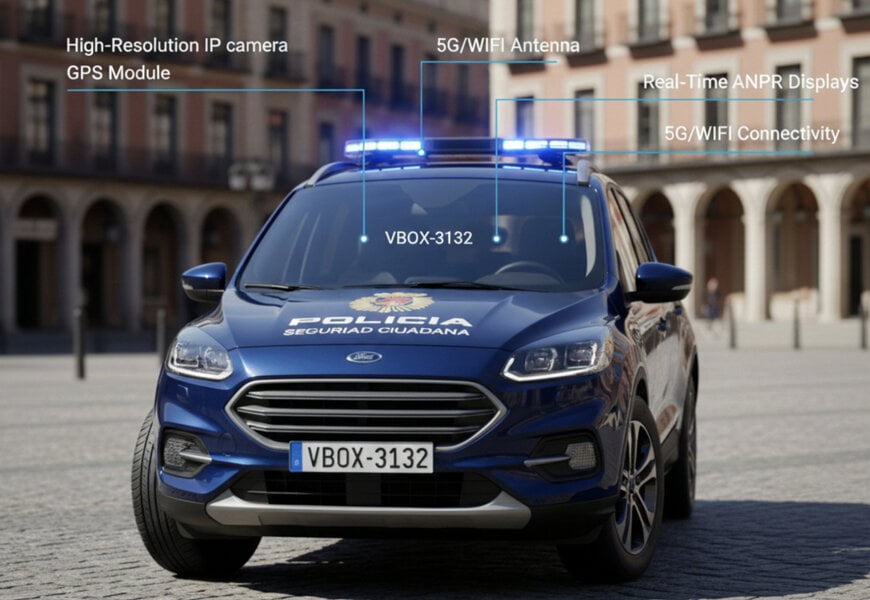
Spanish law enforcement agencies are modernizing their vehicle fleets with Smart Patrol units that operate as mobile command centers. These vehicles require robust in-vehicle computing platforms capable of simultaneously handling real-time video surveillance, Automated Number Plate Recognition (ANPR), and secure access to national police databases, while operating within strict power and thermal constraints.
Operational context and requirements
Smart Patrol vehicles are no longer limited to routine patrolling. They must process high-definition video streams, run ANPR algorithms, manage GPS tracking, and perform rapid database queries directly from the field. This creates a demanding operational environment in which computing systems must deliver high processing performance without compromising reliability or vehicle power stability.
A key challenge identified by the agency was that conventional in-vehicle computers struggled to sustain multiple high-bandwidth applications. Issues such as latency, thermal throttling, and excessive power draw reduced system responsiveness and limited the effectiveness of real-time policing tasks.
Infrastructure complexity inside patrol vehicles
Another constraint was the physical integration of hardware within the vehicle. The use of multiple cameras, displays, and sensors often resulted in complex wiring layouts that increased installation time and reduced system robustness. Electrical noise, voltage fluctuations, and power surges typical of automotive environments further increased the risk of system instability.
To support a scalable Smart Policing strategy, the agency required a rugged in-vehicle computer with a wide power input range, high electromagnetic compatibility, and compliance with European automotive safety standards, while simplifying the overall hardware architecture.
High-performance in-vehicle computing platform
The selected solution was the VBOX-3132 in-vehicle computer, deployed as the central processing unit for the Smart Patrol fleet. Based on an Intel processor architecture, the platform delivers approximately 1.3× higher computing performance compared to previous-generation systems used in the fleet.
From a system design perspective, the VBOX-3132 provides dual HDMI outputs to support independent displays for navigation, video monitoring, or command interfaces. Four RJ45 LAN ports enable direct, stable connections to multiple IP cameras, forming the backbone of an integrated video and ANPR system without the need for additional network hardware.
Operational impact and measurable outcomes
Following deployment, the agency reported a significant improvement in operational efficiency. The rich I/O configuration of the in-vehicle computer reduced wiring complexity by approximately 40 percent, shortening vehicle commissioning times and simplifying maintenance.
High-speed 5G connectivity further enhanced field operations by enabling faster background checks and data synchronization with central systems. This combination of processing performance, connectivity, and system integration directly improved response times, evidence integrity, and situational awareness for officers in the field.
Technical positioning
The Smart Patrol deployment demonstrates how modern in-vehicle computing platforms can support data-intensive law enforcement applications without compromising reliability or power efficiency. By consolidating video processing, network connectivity, and display management into a single ruggedized system, agencies can implement scalable Smart Policing infrastructures aligned with real-time operational demands and public safety objectives.
www.sintrones.com
