
www.auto-innovations.net
16
'26
Written on Modified on
Connected Warning Lights for Roadside Safety
ams OSRAM supports Spain’s regulatory shift to connected V16 warning lights and automatic incident reporting.
ams-osram.com
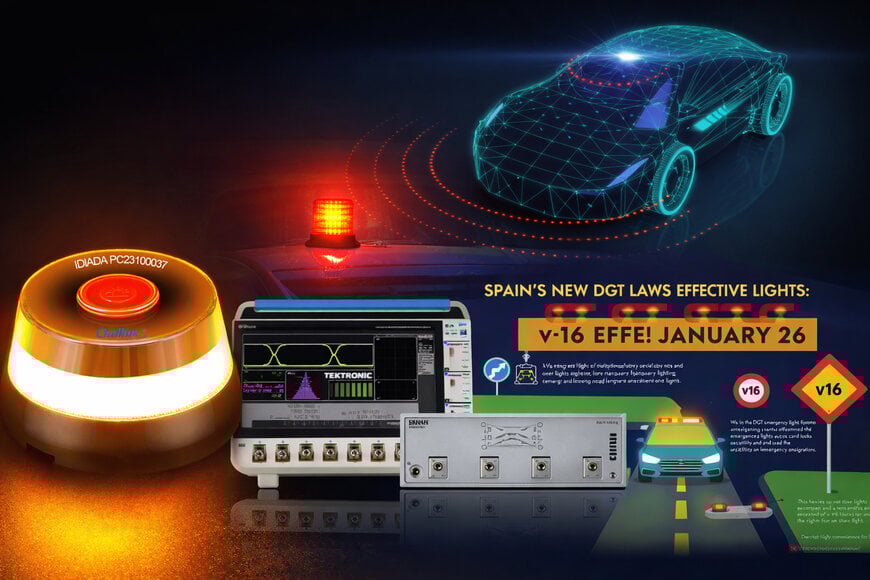
Spain has mandated the use of connected V16 warning lights to replace traditional warning triangles on high-speed roads, aiming to reduce secondary accidents and improve response times through real-time location data.
Regulatory change and technical rationale
From the beginning of 2026, drivers on Spanish motorways and expressways must use certified V16 warning lights that automatically communicate with traffic authorities when activated. The regulation, defined by the Spanish traffic authority Dirección General de Tráfico, is intended to address the risks associated with leaving a vehicle to place a warning triangle, particularly in low-visibility conditions and high-speed environments.
The V16 standard specifies a 360-degree visible warning signal and mandatory connectivity. When activated, the device transmits its geolocation at regular intervals to a central traffic management platform. This allows incidents to be integrated into the national traffic information system, forming part of a broader automotive data ecosystem in which roadside events are digitally reported and processed in near real time.
Connected light operation and data transmission
Connected V16 lights supplied by ams OSRAM use high-intensity LED emitters designed to be visible at distances of up to 1,000 meters under defined conditions. Magnetic mounting enables placement on the vehicle roof without requiring occupants to exit the vehicle.
A built-in communication module automatically sends location data to the DGT platform at fixed intervals—every 100 seconds in this implementation—once the device is switched on. This mechanism ensures that emergency services and traffic control centers receive continuous confirmation of the incident location until the situation is resolved. The approach reduces reliance on manual emergency calls and supports faster, more targeted deployment of assistance.
Application areas and safety impact
The primary application area for connected V16 lights is roadside breakdown and accident signaling on high-speed roads, where secondary collisions are a documented risk. By combining optical warning with automated digital reporting, the system links physical road safety devices with centralized traffic management infrastructure. This integration reflects a shift toward digitally supported incident handling rather than purely visual signaling.
Comparison with the German context
In contrast to Spain, V16 warning lights are not currently approved for use in Germany. Nevertheless, accident data indicate similar safety challenges. According to a study by VUFO GmbH, more than 300 accidents with personal injury occur annually in Germany as a result of previous roadside breakdowns or accidents, with higher incidence on expressways and during dusk or nighttime conditions.
German regulations continue to require warning triangles, but approved auxiliary warning lights can be used in addition to them. These devices enhance visibility but lack mandatory connectivity, meaning incident detection and reporting remain dependent on manual processes rather than automated data exchange within a digital supply chain for traffic information.
Outlook for connected roadside safety
Spain’s adoption of connected V16 lights illustrates how regulatory frameworks can accelerate the integration of IoT-based safety devices into national traffic systems. By standardizing both optical performance and data transmission, the approach provides a reference model for other countries evaluating how connected technologies can reduce secondary accidents and improve emergency response efficiency without increasing driver exposure at the roadside.
www.ams-osram.com
