
www.auto-innovations.net
22
'26
Written on Modified on
Megawatt Charging Powers Mercedes-Benz Trucks Epic Endurance Run
A pair of Mercedes-Benz eActros 600 trucks completes a demanding long-haul journey from Germany to Sweden, successfully demonstrating megawatt charging under real-world conditions.
www.daimlertruck.com
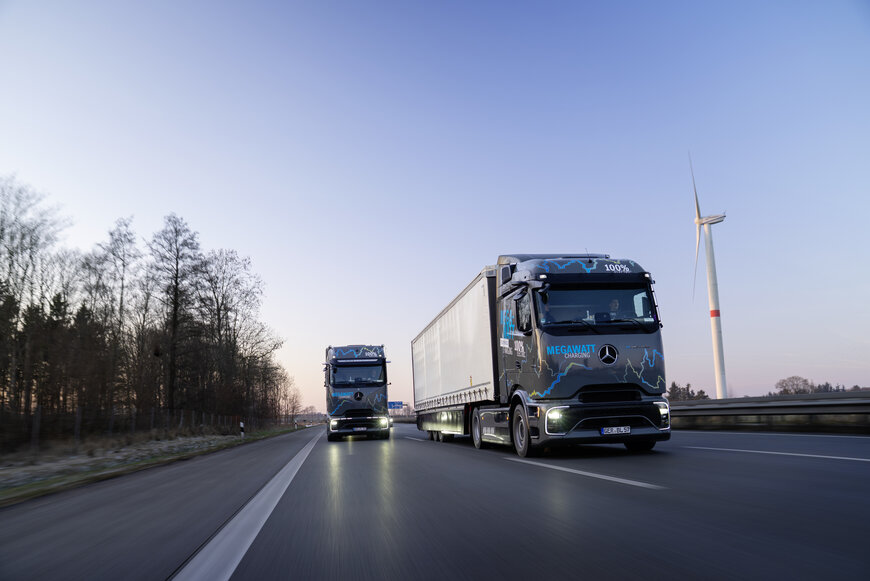
Mercedes-Benz Trucks has conducted an extensive field trial to assess megawatt-level charging for its battery-electric long-haul truck, the eActros 600, under real-world conditions across major European freight corridors. The objective of the test was to evaluate the compatibility of the eActros 600 with emerging high-power charging infrastructure and to gather operational data that could accelerate the readiness of heavy-duty electrification for long-distance transport.
Field Trial Overview and Purpose
Two eActros 600 trucks equipped with interfaces for the Megawatt Charging System (MCS) standard were driven approximately 2,400 kilometres from the Mercedes-Benz plant in Wörth am Rhein, Germany, through the Netherlands, Belgium and Denmark to Linköping in southern Sweden. The route was selected to mirror typical long-haul operations and to test charging interoperability across both public and private MCS-enabled charging sites designed specifically for heavy-duty vehicles. The exercise sought to assess a range of factors critical to long-haul electrification, including charging power curves, average charging performance, thermal management under high currents, and usability of charging infrastructure in varied conditions, including winter environments.
Megawatt Charging Versus Conventional Systems
The eActros 600 trial focused on the Megawatt Charging System (MCS), a standard developed for heavy-duty electric vehicles that supports charging capacities up to 1,000 kW. This high-power capability represents a significant advancement over the more widely deployed Combined Charging System (CCS) technology, which typically operates at lower peak power levels. By enabling rapid replenishment of battery capacity, MCS charging can reduce dwell times during scheduled breaks and support higher daily vehicle utilisation in long-haul logistics. Internal simulations referenced by Mercedes-Benz Trucks indicate that MCS could charge the eActros 600 from 20 percent to 80 percent in approximately 30 minutes, compared with longer durations using current standard fast chargers. These performance characteristics are intended to align charging events with legally mandated driver rest periods, which is critical for operational efficiency in long-distance freight transport.
The development of a harmonised international charging standard, led by the CharIN organisation and supported by multiple truck manufacturers, underpins the broader effort to scale a pan-European fast-charging network for heavy-duty vehicles. Uniform technical interfaces aim to reduce fragmentation and facilitate interoperability across infrastructure providers and vehicle brands—a key differentiator against proprietary or region-limited solutions.
Vehicle Specifications and Operational Context
The eActros 600 is configured with three lithium iron phosphate (LFP) battery packs, delivering a nominal total capacity of around 621 kWh. LFP chemistry allows the usable portion of the battery to exceed 95 percent of installed capacity, which supports longer range and longer service life compared with some alternative cell technologies. The vehicle is engineered for typical European long-haul loads, with a combined gross train weight of up to 44 tons and a realistic operational range of around 500 kilometres on a full charge under common conditions. These design characteristics enable daily distances in excess of 1,000 kilometres when combined with intermediate charging during driver breaks, subject to the availability of high-power charging infrastructure.
Implications for Long-Distance Electric Freight
The Mercedes-Benz Trucks field trial underscores the importance of high-power charging standards and robust infrastructure in enabling battery-electric heavy-duty transport to compete with conventional internal combustion operations. By validating MCS compatibility and gathering real-world performance data, the programme addresses technical hurdles related to multi-vendor charging interoperability and thermal stresses at high current levels. Broad availability of MCS infrastructure remains limited in Europe; however, coordinated efforts among manufacturers and infrastructure developers are advancing deployment, which could improve economic viability for fleet operators seeking to reduce emissions without compromising logistics efficiency.
www.daimlertruck.com
