
www.auto-innovations.net
31
'26
Written on Modified on
UWB-based system enables real-time vehicle proximity detection
Hyundai Motor Company and Kia Corporation introduce Vision Pulse, a UWB-based safety technology for precise, real-time detection of vehicles, pedestrians, and obstacles.
www.hyundaimotorgroup.com
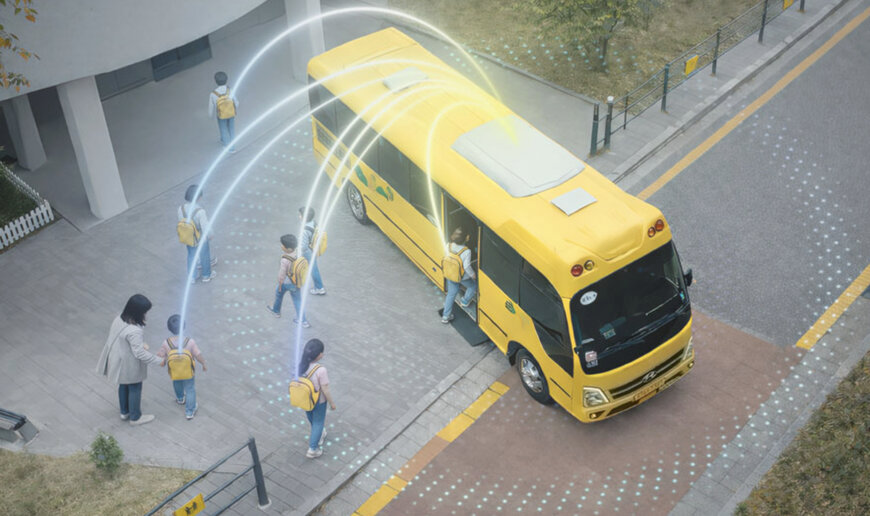
Hyundai Motor Company and Kia Corporation have developed Vision Pulse, a driver safety technology based on ultra-wideband (UWB) communication that enables real-time, high-precision localization of surrounding objects to support collision avoidance in complex environments.
Technology background and relevance
Increasing traffic density in urban areas and the coexistence of vehicles, bicycles, and pedestrians place growing demands on proximity detection systems. Conventional blind-spot and collision-warning technologies typically rely on fixed infrastructure, radar, LiDAR, or network-based communication, which can limit positional accuracy, latency, or cost efficiency. Vision Pulse addresses these constraints by using UWB radio signals to determine relative positions with centimeter-level precision and minimal communication delay.
System architecture and operating principle
Vision Pulse uses UWB modules installed in the vehicle to transmit and receive radio signals. When nearby objects—such as other vehicles, cyclists, or pedestrians—are equipped with compatible UWB devices, including selected smartphones, wearables, or tracking tags, the system calculates their positions by measuring signal time-of-flight between modules.
Based on continuous position updates, the system identifies potential collision scenarios and generates alerts to the driver. Hyundai Motor and Kia state that vehicles equipped with their Digital Key 2 system already contain the required UWB hardware, allowing Vision Pulse functionality without additional sensors. Vehicles without this feature can be upgraded through the integration of supplementary UWB modules.
Performance characteristics and technical capabilities
UWB operates in the GHz frequency range, providing low susceptibility to interference and strong diffraction and penetration characteristics in dense environments. According to Hyundai Motor and Kia, Vision Pulse can detect objects within a radius of up to 100 meters, with a positional accuracy of approximately 10 centimeters.
The system maintains detection accuracy above 99 percent under low-light or adverse weather conditions. Communication latency ranges from 1 to 5 milliseconds, enabling near-real-time processing of proximity data. Proprietary algorithms support simultaneous tracking and position prediction of multiple moving objects, including those traveling at higher relative speeds.
Hardware efficiency and sensor strategy
By leveraging UWB modules that are already integrated into many vehicles for digital key functionality, Vision Pulse reduces dependence on dedicated sensing hardware such as radar or LiDAR. This approach lowers system complexity and supports cost-efficient deployment, particularly in urban and mixed-traffic environments where precise short-range localization is critical.
Application areas beyond driver assistance
In addition to on-road vehicle safety, Hyundai Motor and Kia identify further application potential for Vision Pulse in industrial and public environments. In industrial mobility scenarios, such as warehouses and logistics facilities, the system can help prevent collisions between vehicles and personnel. In emergency and disaster-response situations, UWB-based localization could assist in identifying the position of individuals trapped under debris.
Validation and pilot deployments
Vision Pulse is currently being evaluated in live operational environments. Since 2025, pilot trials have been conducted at Kia’s PBV Conversion Center in Hwaseong, South Korea, focusing on collision prevention between forklifts and workers. Additional trials are planned in collaboration with the Busan Port Authority to assess performance in port terminals and logistics zones.
Development status
Vision Pulse is classified as an advanced pre-development technology. Hyundai Motor Company and Kia Corporation state that its potential integration into series-production vehicles is under evaluation and has not yet been finalized.
www.hyundaimotorgroup.com
