
www.auto-innovations.net
04
'26
Written on Modified on
Bridgestone Deploys Driver-in-the-Loop Simulation for Tyre Development
Bridgestone installed a Driver-in-the-Loop simulator at its Rome R&D centre to improve digital tyre development efficiency, reduce prototypes and accelerate collaboration with vehicle manufacturers.
www.bridgestone.com
Tyre manufacturers face growing pressure to shorten development cycles while improving performance, sustainability, and compatibility with increasingly complex vehicle platforms.
For a global tyre producer such as Bridgestone, traditional development methods relying heavily on physical testing and prototypes can limit the number of tyre specifications evaluated during the design phase. Physical testing also requires significant material consumption and time.
To address these constraints, Bridgestone sought to expand its digital tyre development capabilities. The objective was to evaluate tyre performance earlier in the engineering process, reduce prototype requirements, and accelerate collaboration with vehicle manufacturers developing new vehicle platforms.
Deploying Driver-in-the-Loop Simulation
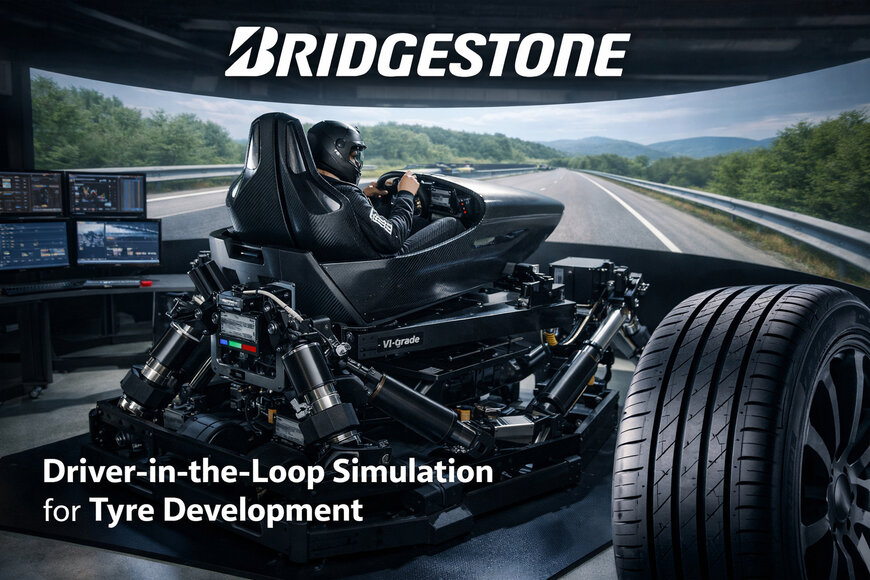
To support these goals, Bridgestone installed a Driver-in-the-Loop (DiL) driving simulator at its R&D centre near Rome, Italy. The system is based on the VI‑grade DiM500 Driver‑in‑the‑Loop Simulator, which allows engineers to test tyre behaviour in a fully virtual environment.
The simulator integrates high-fidelity tyre models with real driver input, enabling engineers to combine objective simulation data with subjective driver feedback. This approach helps development teams evaluate handling characteristics and vehicle dynamics before physical prototypes are produced.
Mattia Giustiniano, R&D Senior Vice President at Bridgestone West, explained the role of the system in the company’s development ecosystem: “By integrating the driver into the digital development cycle, this investment adds a crucial new piece to our evolving ecosystem.”
Realistic Simulation Environment
The DiL system uses a large mobile platform capable of five metres of motion, combined with a carbon-fibre cockpit designed to reproduce the physical sensations experienced during real-world driving.
This motion range allows the simulator to replicate forces comparable to those encountered in physical tests, providing a realistic environment for evaluating tyre behaviour under dynamic driving conditions.
By combining simulation results with historical testing data and artificial intelligence tools, Bridgestone engineers can analyse a much wider range of tyre specifications than would be feasible using traditional prototype testing alone.
Supporting Parallel Vehicle and Tyre Development
The simulator also enables tyres and vehicles to be developed in parallel with automotive manufacturers. This approach supports earlier collaboration with vehicle engineering teams and allows tyres to be tailored to specific vehicle platforms at an earlier stage of the design process.
While physical testing remains part of Bridgestone’s validation process, the simulator allows it to be reserved mainly for the final verification stages.
Reducing Prototypes and Environmental Impact
One of the main drivers behind the investment was the reduction of physical tyre prototypes required during development.
According to Bridgestone, the introduction of the Driver-in-the-Loop simulator is expected to eliminate up to 12,000 experimental tyres per year. This contributes to a measurable reduction in material consumption and waste generated during development activities.
The system also complements Bridgestone’s Virtual Tyre Development (VTD) programme, which already enables reductions of up to 60% in raw material use and CO₂ emissions during the development phase of original equipment tyres.
Expanding Simulation Capabilities
The simulator currently focuses primarily on dry handling evaluations, an essential parameter for vehicle dynamics and tyre performance. Development work is underway to extend the system’s capabilities to additional performance conditions.
By combining driver-based simulation, AI-supported modelling, and targeted physical testing, Bridgestone aims to improve development efficiency while responding to the evolving requirements of vehicle manufacturers and end users.
www.bridgestone.com
