
www.auto-innovations.net
20
'26
Written on Modified on
Hydrogen Fuel Cell Heavy-Duty Fleet Deployment for Timber Logistics
Hyundai Motor Company initiates South America’s first hydrogen-powered freight operation to decarbonize the regional automotive data ecosystem and supply chain.
www.hyundaimotorgroup.com
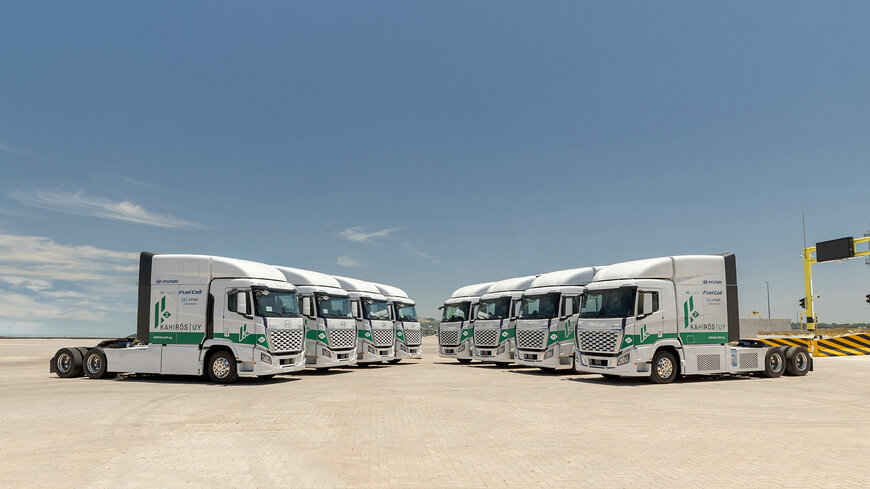
Hyundai Motor Company has deployed a fleet of eight XCIENT Fuel Cell Class-8 heavy-duty trucks in Uruguay to service the national timber industry. This initiative marks the first commercial application of hydrogen-based heavy-duty transport in South America, integrating zero-tailpipe-emission vehicles into the regional digital supply chain for raw materials.
Integration with Renewable Energy Infrastructure
The deployment is a central component of the Kahirós Project, a consortium-led initiative focused on the decarbonization of logistics through green hydrogen. This project leverages Uruguay’s high renewable energy penetration, which reached 99% of total electricity generation in 2024.
The technical infrastructure supporting the fleet includes a 4.8 MW solar park and a dedicated electrolysis plant. This facility is engineered to produce 77 tons of green hydrogen annually. By utilizing local renewable resources, the project creates a closed-loop energy cycle where the carbon footprint of the fuel production and vehicle operation is minimized. Operations for the hydrogen production site are scheduled to commence in November 2026.
Technical Specifications and Operational Parameters
The XCIENT Fuel Cell trucks utilized in this fleet are Class-8 tractor variants with a gross combined weight (GCW) rating of up to 82,000 lbs. The powertrain and energy storage systems are designed for high-utilization freight environments:
- Propulsion: A 350 kW (469 hp) electric motor generating 2,237 Nm of torque.
- Fuel Cell System: Dual 90 kW fuel cell stacks providing a total system output of 180 kW.
- Energy Storage: A 72 kWh battery pack complements 10 hydrogen tanks with a combined capacity of 68 kg.
- Performance: The configuration provides an operational range of approximately 720 kilometers (450 miles) under optimal conditions.
Six units will maintain regular haulage schedules, projected to cover nearly one million kilometers collectively per year. The remaining two units serve as redundant capacity and platforms for evaluating further service expansions.
Strategic Impact on Global Hydrogen Logistics
The Kahirós Project involves a $40 million investment from Santander Group, with additional support from the International Finance Corporation and the United Nations’ Renewable Energy Innovation Fund. This partnership between Hyundai Motor Company and local entities—including Ventus, Fraylog, and Fidocar — establishes a scalable model for hydrogen adoption in emerging markets.
This South American deployment follows established hydrogen logistics programs in other regions. In North America, a fleet of 63 XCIENT Fuel Cell trucks has exceeded 1.6 million cumulative kilometers since 2023. In Europe, 165 units operating across Switzerland, Germany, France, the Netherlands, and Austria have surpassed 20 million kilometers since 2020.
By implementing these heavy-duty vehicles in timber logistics, the project demonstrates the viability of hydrogen fuel cells for industries requiring high torque and long-range capabilities where battery-electric alternatives may face weight or charging time constraints. The project aims to position the region as a functional hub for hydrogen technology, supported by technical training provided by specialized After Sales teams to ensure maintenance standards align with global benchmarks.
Edited by Evgeny Churilov, Induportals Media - Adapted by AI.
www.hyundaimotorgroup.com
Strategic Impact on Global Hydrogen Logistics
The Kahirós Project involves a $40 million investment from Santander Group, with additional support from the International Finance Corporation and the United Nations’ Renewable Energy Innovation Fund. This partnership between Hyundai Motor Company and local entities—including Ventus, Fraylog, and Fidocar — establishes a scalable model for hydrogen adoption in emerging markets.
This South American deployment follows established hydrogen logistics programs in other regions. In North America, a fleet of 63 XCIENT Fuel Cell trucks has exceeded 1.6 million cumulative kilometers since 2023. In Europe, 165 units operating across Switzerland, Germany, France, the Netherlands, and Austria have surpassed 20 million kilometers since 2020.
By implementing these heavy-duty vehicles in timber logistics, the project demonstrates the viability of hydrogen fuel cells for industries requiring high torque and long-range capabilities where battery-electric alternatives may face weight or charging time constraints. The project aims to position the region as a functional hub for hydrogen technology, supported by technical training provided by specialized After Sales teams to ensure maintenance standards align with global benchmarks.
Edited by Evgeny Churilov, Induportals Media - Adapted by AI.
www.hyundaimotorgroup.com
