
www.auto-innovations.net
25
'26
Written on Modified on
Pixel-based digital lighting for compact automotive platforms
ams OSRAM integrates EVIYOS HD25 into the Audi Q3, enabling adaptive illumination and data-driven light communication in the compact vehicle segment.
ams-osram.com
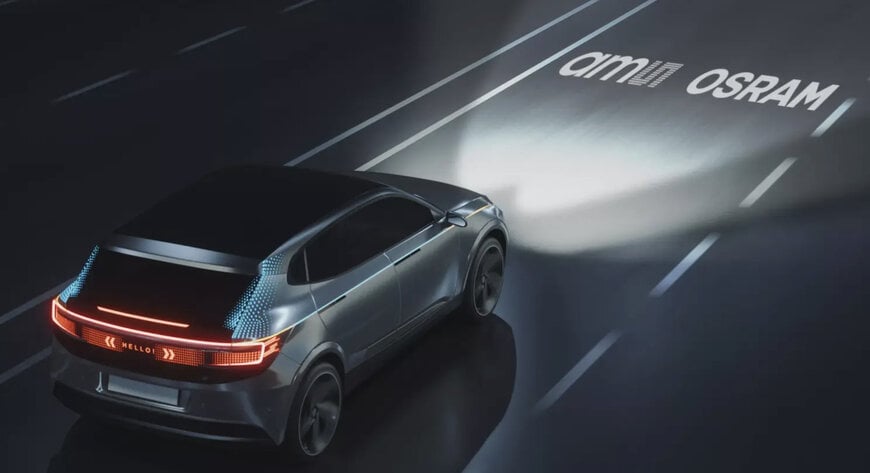
The integration of EVIYOS HD25 into the Audi Q3 introduces high-resolution, pixel-based automotive lighting to the compact segment. Developed by ams OSRAM and implemented in ZKW’s microZ module, the system enables adaptive light distribution and visual driver assistance through thousands of individually controllable pixels.
High-resolution lighting architecture
EVIYOS HD25 is a fully digital lighting solution featuring more than 25,000 individually addressable pixels. This architecture allows precise, real-time modulation of the light beam based on sensor inputs, vehicle dynamics, and environmental conditions.
The system supports both static and dynamic light projections, enabling context-dependent illumination patterns and visual communication between the vehicle and its surroundings. This represents a shift from conventional fixed light functions to software-controlled, adaptive lighting systems.
Integration into digital Matrix LED headlights
In the Audi Q3, the technology is implemented within digital Matrix LED headlights, introduced in this vehicle class for the first time. The microLED-based light source improves illumination performance and contrast, particularly under low-visibility conditions such as rain or fog.
The pixel-level control enables targeted high-beam distribution and precise glare reduction, contributing to improved visibility without affecting oncoming traffic.
Driver assistance through light projection
The system integrates with advanced driver assistance systems (ADAS), extending their functionality through visual feedback projected onto the road. Features include lane guidance, orientation lighting, and warnings from the lane change assistant when vehicles are detected in the blind spot.
Additional projections include lane departure indications and an ice warning symbol activated at speeds above 70 km/h. In construction zones, the system automatically adapts the light pattern from lane guidance to orientation lighting to support navigation in confined spaces.
Users can configure specific lighting functions via the vehicle interface, including activation or deactivation of lane-related projections and selection of predefined lighting scenarios for entry and exit sequences.
System-level relevance in automotive development
The deployment of EVIYOS HD25 in a series-production compact vehicle highlights the increasing role of intelligent lighting within the automotive data ecosystem. By combining sensing, processing, and actuation within the lighting system, the technology contributes to enhanced safety and human-machine interaction.
At the same time, pixel-based lighting architectures support scalability and software-defined functionality, aligning with broader trends in automotive development toward integrated, adaptive systems that extend beyond traditional illumination roles.
Edited by Maria Brueva, Induportals editor – adapted by AI.
www.ams-osram.com
