
www.auto-innovations.net
30
'26
Written on Modified on
Software-defined cockpit platform for connected vehicles
Hyundai Motor Group introduces Pleos Connect to enable scalable, AI-driven in-vehicle systems and accelerate its automotive data ecosystem strategy.
www.hyundaimotorgroup.com
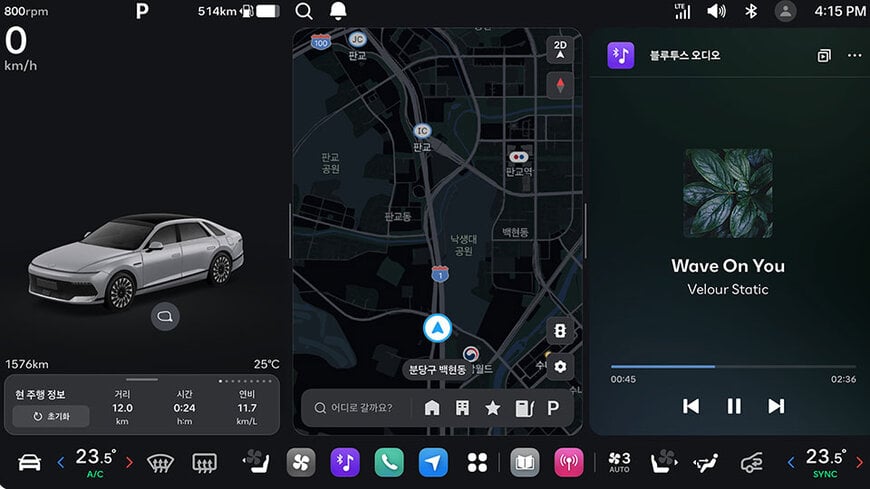
Hyundai Motor Group has introduced Pleos Connect, a next-generation infotainment platform designed to support software-defined vehicles and enable continuous feature upgrades through over-the-air updates across multiple vehicle segments.
Transition to a Software-Defined Vehicle Architecture
Pleos Connect represents a production-ready implementation of Hyundai Motor Group’s transition toward software-defined vehicle (SDV) architecture. Built as a scalable platform, the system integrates artificial intelligence, cloud connectivity, and modular software design to support long-term lifecycle updates.
The platform will first be deployed in the new GRANDEUR model in South Korea, followed by expansion into global markets, including European deployment in the IONIQ 3. The company targets installation in approximately 20 million vehicles across Hyundai Motor, Kia, and Genesis brands by 2030.
This rollout reflects a broader shift toward a digital supply chain in mobility, where software capabilities are continuously updated post-production rather than fixed at the point of manufacture.
Cockpit Architecture and Human-Machine Interface Design
Pleos Connect introduces a dual-display cockpit architecture combining a large central interface with a driver-focused slim display. The central display is segmented into three functional zones: driving information, application interface, and a persistent shortcut layer. This layout supports simultaneous execution of navigation, media, and third-party applications.
The system integrates both touchscreen and physical controls, including steering wheel buttons and dedicated hardware inputs below the display. This hybrid interface is intended to reduce driver distraction by maintaining access to critical functions without requiring full touchscreen interaction.
A gesture-based control system enables window management functions such as repositioning or closing applications using multi-touch inputs. These interaction models are derived from behavioral studies conducted across multiple global UX research centers.
Data-Driven Navigation System Enhancements
The navigation system within Pleos Connect has been redesigned using aggregated user interaction data to prioritize frequently used functions. Interface simplification includes reduced graphical complexity and increased reliance on icon-based navigation for improved readability.
A modular interface allows concurrent operation of navigation alongside other applications, while key route data—such as estimated time of arrival and full-route previews are displayed as dynamic overlays.
Real-time route optimization is supported through continuous data exchange between connected vehicles and cloud-based mapping services. This enables adaptive routing based on live traffic conditions and updated road information, aligning with broader trends in automotive data ecosystem development.
Integration of Large Language Model-Based Voice Control
At the core of the system is Gleo AI, a voice assistant based on a large language model architecture. The system supports natural language interaction for vehicle control, navigation, and information retrieval.
Key functional capabilities include contextual command interpretation, allowing ambiguous inputs such as location-based requests to be resolved using real-time driving context. The system also supports multi-intent processing, enabling execution of multiple commands within a single query.
Gleo AI extends beyond vehicle functions by integrating web-based information retrieval, including news and weather queries. It also incorporates zone-specific voice recognition, allowing seat-level command execution within the cabin.
Future development plans include personalization features based on driver behavior and expanded integration with third-party services.
Open Application Platform and Developer Ecosystem
Pleos Connect incorporates an open application environment through its App Market, enabling third-party service integration directly within the vehicle interface. Initial services include navigation, media streaming, and mobility-related applications, accessible without external device pairing.
The platform is supported by a developer framework, Pleos Playground, which provides APIs and software tools for external developers to build and deploy applications. This approach aligns with industry movement toward platform-based mobility ecosystems, where vehicle functionality is extended through continuous software contributions.
Planned expansion includes additional categories such as gaming, in-vehicle entertainment, and vehicle management services, reflecting increasing convergence between consumer digital platforms and automotive systems.
Positioning Within Industry Context
The introduction of Pleos Connect places Hyundai Motor Group alongside other automotive manufacturers adopting SDV frameworks, where differentiation is increasingly defined by software capability, update frequency, and ecosystem integration.
Comparable systems from other manufacturers typically benchmark performance based on update latency, application ecosystem scale, and human-machine interface efficiency. Pleos Connect’s integration of LLM-based voice control and open developer access represents a convergence of these benchmarks within a single platform.
Outlook for AI-Defined Vehicle Development
Pleos Connect serves as a foundational layer for Hyundai Motor Group’s longer-term objective of transitioning from software-defined vehicles to AI-defined vehicles (AIDVs). This evolution emphasizes adaptive, personalized vehicle behavior driven by continuous data input and machine learning models.
By combining scalable software architecture, real-time data integration, and AI-driven interaction, the platform establishes a framework for future mobility systems where vehicle functionality evolves dynamically throughout its operational lifecycle.
The deployment strategy and technical architecture indicate a shift toward vehicles functioning as continuously updated computing platforms within a connected mobility infrastructure.
Edited by an industrial journalist Sucithra Mani with AI assistance.
www.hyundaimotorgroup.com
