
www.auto-innovations.net
10
'26
Written on Modified on
On-Sensor Radar Solutions For Mainstream Vehicle Platforms
Integrated automotive radar system-on-chip solutions from NXP Semiconductors optimize advanced driver assistance systems through localized perception processing.
www.nxp.com
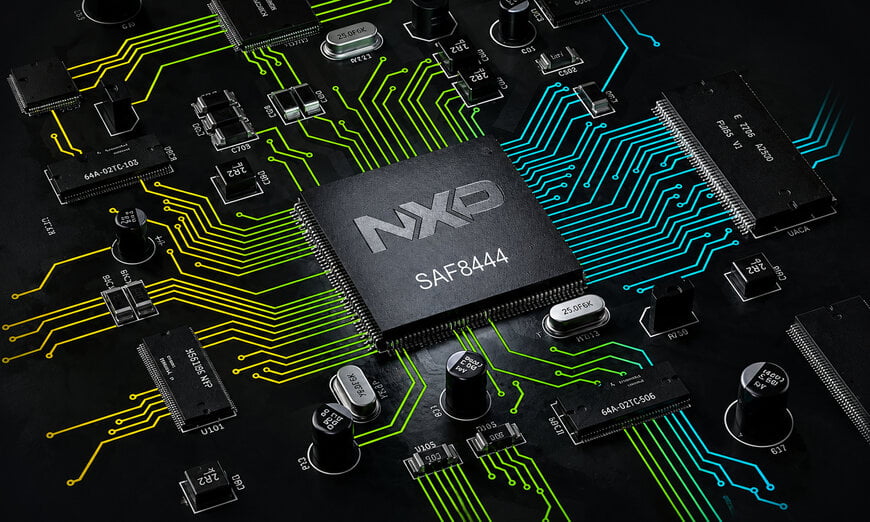
Automobile manufacturers and Tier 1 suppliers face increasing pressure to balance processing performance, strict regulatory compliance, and system manufacturing costs. Tightening safety standards, such as the Euro NCAP 2030 requirements, mandate robust real-life field performance under diverse environmental conditions.
These include detecting obstructed pedestrians in low-light environments and maintaining high sensor reliability in all weather conditions. The SAF8444 automotive radar system-on-chip (SoC) addresses these challenges by enabling perception-level intelligence directly at the radar sensor node.
This localized approach allows original equipment manufacturers (OEMs) to scale compliant capabilities across diverse worldwide vehicle lines. Furthermore, moving processing burdens directly onto the chip helps democratize advanced L2 and L2+ vehicle automation, making it economically viable for entry-level lines and aggressively priced economy class car models.
Integrated Compute Core Systems and Embedded Signal Acceleration
Manufactured using 28nm RFCMOS radar one-chip technology, the sensor operates across the 76–81 GHz automotive radar frequency band. The hardware architecture provides concurrent support for short-, medium-, and long-range radar sensing configurations.
This structural versatility optimizes the microchip for mainstream advanced driver assistance functions, specifically adaptive cruise control, autonomous emergency braking, blind spot detection, and park assist utilities. To execute compute-intensive automotive radar processing locally, the device integrates a heterogeneous multi-core processor infrastructure.
This processing system combines an Arm Cortex-A53 applications processor, an Arm Cortex-M7 real-time compute core, and a proprietary Single Processing Toolbox (SPT) radar accelerator with digital signal processor (DSP) support. The system further incorporates a powerful dual-threaded radar accelerator engineered for real-time interference mitigation, which enables execution of advanced anti-jamming algorithms to maintain reliable operation in congested radio frequency environments.
Perceptual Data Fusion and Automotive Enablement Ecosystems
Meeting elevated international vehicle safety criteria has traditionally required adding extensive central compute resources, which drives up bill-of-materials costs, thermal load profiles, and overall vehicle architectural complexity. The SAF8444 breaks this design trade-off by enabling intelligence at the radar sensor itself, allowing camera and radar data streams to be managed with lower overall platform complexity.
Fusing complementary sensor metrics at the network edge dramatically reduces power consumption and the vehicle's reliance on centralized ADAS compute blocks. The single-chip architecture also simplifies thermal management requirements for customers, facilitating easier vehicle integration into space-constrained lines, which is particularly attractive for adoption in electric vehicle (EV) platforms.
To accelerate development cycles for lead customers during pre-production, the platform is supported by an enablement ecosystem that provides software development kits (SDKs), safety frameworks, and security components. NXP complements this on-chip processing node with companion in-vehicle networking utilities, power management integrated circuits (PMICs), and edge-AI algorithms designed for highly accurate angle estimation.
Additional Context: This section details technical specifications and competitive benchmarking not included in the original product announcement
The performance parameters of the SAF8444 automotive radar one-chip SoC establish distinct efficiency variations when evaluated against traditional centralized computing architectures. Standard configurations typically route unmanaged sensor streams directly to a heavy, high-power central domain controller, which increases installation weight, cabling complexity, and overall system thermal loads.
By contrast, the 28nm RFCMOS architecture integrates target detection, anti-jamming mitigation, and multi-range tracking directly on the sensor node itself. This edge-processing methodology eliminates the massive data throughput requirements typically routed to a central processor, dropping the total bill of materials and offering a scalable alternative to centralized ADAS architectures.
Edited by Sucithra Mani, Induportals editor – adapted by AI.
www.nxp.com
