
www.auto-innovations.net
03
'26
Written on Modified on
Single-Chip Power Management Architecture for Vehicle Braking Application
Allegro MicroSystems has introduced a power management integrated circuit that combines power regulation and wheel-speed sensing for next-generation automotive brake-by-wire applications.
www.allegromicro.com
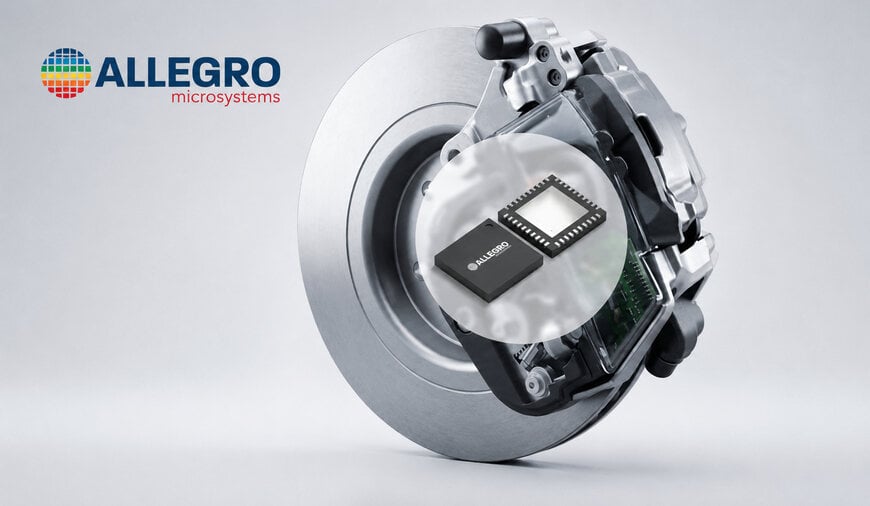
Allegro MicroSystems has introduced the A81415, an ASIL-D-certified power management integrated circuit (PMIC) that combines power management and wheel-speed sensor decoding in a single device for electromechanical braking (EMB) systems. The solution targets automotive brake-by-wire applications, where functional safety, compact electronics, and reliable wheel-speed data are essential for vehicle control.
Integrated Power and Sensing for Brake-by-Wire Systems
Brake-by-wire technology is becoming a key element of software-defined vehicle architectures by replacing conventional hydraulic braking with electronically controlled electromechanical systems. Electronics located at each wheel must withstand vibration, temperature variations, and electrical transients while maintaining fail-operational functionality and compliance with automotive functional safety requirements.
Conventional brake-by-wire designs typically require separate safety PMICs, wheel-speed decoder ICs, and multiple discrete power components. This increases printed circuit board complexity, occupies additional installation space, and introduces more potential failure points in safety-critical corner modules.
The A81415 integrates these functions into a single device by combining a wheel-speed sensor interface, a buck-boost pre-regulator, five low-dropout regulators, and a single-inductor power architecture without requiring external switching components. According to Allegro, this integration removes up to nine external components, reduces semiconductor bill-of-material costs by up to USD 4 per vehicle, and frees more than 50% of usable PCB area within the brake caliper electronics.
Wheel-Speed Data Processing and Functional Safety
The integrated wheel-speed sensor interface supports standard 2-level, 2-level pulse width modulation (PWM), and 3-level AK communication protocols, including high-resolution variants. Sensor data are decoded internally and transmitted through a Serial Peripheral Interface (SPI), eliminating the need for a dedicated decoder integrated circuit.
Processing wheel-speed signals within the PMIC reduces communication latency in the braking control loop while lowering microcontroller workload. The regulated low-noise power rails are designed to supply wheel-speed sensing and angle-sensing components used in electromechanical brake actuators, helping maintain signal integrity throughout the braking control chain.
The device is qualified to AEC-Q100 automotive standards and incorporates dual watchdog functions together with integrated fault-monitoring mechanisms to support ASIL-D functional safety requirements without requiring additional external protection circuitry.
Scalable Power Architecture for 12 V and 48 V Vehicles
The PMIC is manufactured using Allegro's automotive Grade-0 process technology and is designed for operation in both existing 12 V electrical systems and emerging 48 V vehicle architectures. When combined with the APM81815 pre-regulator and compatible 48 V gate drivers, the platform provides a modular migration path for Tier 1 suppliers developing next-generation brake-by-wire corner modules while minimizing redesign effort.
Peter Wells, Business Line Director, High Performance Power at Allegro MicroSystems, stated that integrating wheel-speed sensing and power management into a single device provides a scalable platform for future intelligent chassis systems by combining sensing and power electronics within the wheel module.
Additional Context: Technical Specifications and Competitive Benchmarking
Automotive PMICs for safety-critical chassis applications are widely available from semiconductor suppliers including Infineon, NXP, STMicroelectronics, and Allegro. Most ASIL-D-capable PMIC solutions integrate multiple voltage regulators, watchdog functions, diagnostic monitoring, and safety supervision for applications such as braking, steering, and ADAS controllers. However, these platforms generally require a separate wheel-speed sensor interface or decoder device.
The A81415 differentiates itself by integrating wheel-speed signal decoding directly into the PMIC while supporting multiple automotive wheel-speed communication protocols. Its combination of integrated sensing, five LDO regulators, buck-boost power conversion, single-inductor architecture, AEC-Q100 qualification, and ASIL-D functional safety reduces external component count and PCB footprint compared with conventional multi-chip implementations used in brake-by-wire systems.
Edited by Sucithra Mani, Induportals editor – adapted by AI.
www.allegromicro.com
