
www.auto-innovations.net
07
'26
Written on Modified on
Precision Microdispensing for Automated Battery Assembly
Dürr introduces the EcoMeter XS to solve micro-volume application challenges in high-viscosity battery assembly and electronics manufacturing.
www.durr.com
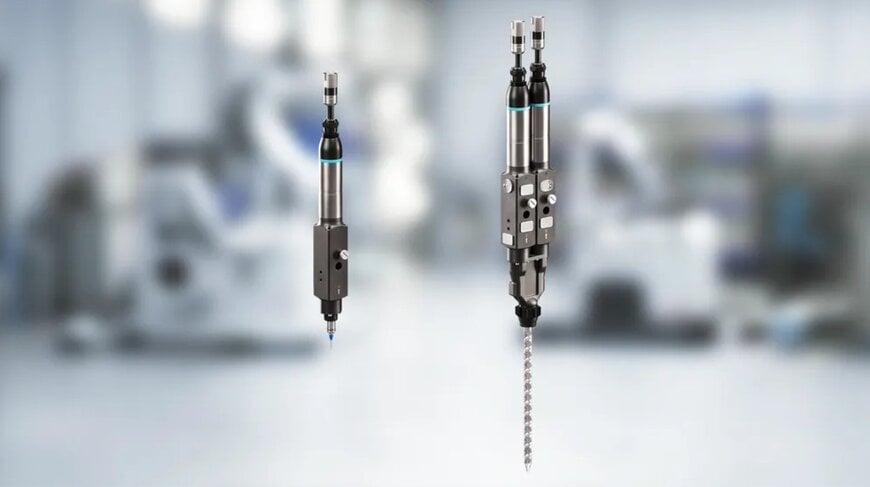
Automated assembly in electronics and e-mobility production increasingly demands the deposition of miniature material volumes without compromising cycle times or dosing repeatability. Dürr addresses this manufacturing bottleneck with the EcoMeter XS, an automated microdispensing unit engineered to apply minute quantities of high-viscosity adhesives, sealants, potting compounds, and thermal interface materials across cleanroom and industrial production lines.
Industrial Challenges in Micro-Volume Material Deposition
In high-throughput battery pack fabrication, power electronics assembly, and electric motor construction, joining components and managing thermal dissipation require extreme spatial and volumetric precision. Conventional high-volume piston dosing units face mechanical limitations when metering sub-milliliter volumes, frequently resulting in over-application, thermal insulation inconsistencies, or mechanical strain on delicate substrates.
For instance, cylindrical battery cell packaging requires exact thermal bridging between the cell terminal faces and the associated cooling plate. Depositing volumes as small as 0.1 cubic centimeters ensures required heat dissipation without excess material displacement, which could otherwise foul adjacent electrical contacts or compromise module dimensions.
Operating Principles and Volumetric Flow Control
The EcoMeter XS applies a continuous metering principle that decouples volume delivery from the stroke limitations of traditional reciprocating pistons. By eliminating the mechanical recharge cycle inherent to conventional piston dispensers, the unit maintains unbroken process continuity and reduces overall takt time.
The microdispensing architecture supports dynamic volumetric flow rates spanning 0.00005 cm³/s to 1 cm³/s. Material feed can be integrated directly from standard commercial cartridges or bulk hobbock supply pumps. A centralized dosing and process control system manages feed pressures and volumetric output, maintaining stable deposition profiles across changing media viscosities and fluctuating thermal conditions.
Kinematic Integration and End-Effector Payload Reduction
Managing payload weight at the robotic wrist is a key engineering priority when designing high-speed, compact assembly cells. Traditional dosing heads often exceed the payload envelope of compact collaborative robots or light-duty Cartesian gantries, requiring larger automation cells that expand factory floor footprints.
Depending on configuration, the EcoMeter XS maintains an overall weight between 0.8 kg and 1.6 kg. This mass profile permits direct end-of-arm mounting on small payload industrial robots, collaborative articulated arms, and high-acceleration multi-axis gantries. The reduced mechanical inertia facilitates higher path velocities, tighter trajectory tracking on complex three-dimensional contours, and easier integration into dense production machines.
Modular System Configurations and Manufacturing Workflows
Dürr designed the system with modular mechanical and fluidic interfaces to accommodate varying 1K and 2K formulation characteristics, including abrasive thermal gap fillers, structural polyurethanes, silicones, and anaerobic bonding agents.
Key operational deployment environments include:
- Electric motor manufacturing, specifically rotor magnet retention bonding and stator wire staking.
- Power electronics packaging, covering small-volume potting, encapsulation, and planar component sealing.
- Cylindrical and prismatic battery manufacturing, notably micro-spot thermal paste application and structural cell-to-pack joining.
- Precision automated gasketing, delivering continuous micro-bead liquid seals for sensor enclosures and control units.
Portfolio Integration
The addition of the EcoMeter XS extends Dürr’s existing fluid handling portfolio, complementing established systems like the EcoShot Meter series and EcoMeter SP piston dispensers. By bridging the micro-dosing domain with its continuous flow architecture, the platform enables manufacturing engineers to specify automated material application systems across the spectrum from microliter deposits to high-volume continuous adhesive beads.
Additional Context
This section details technical specifications and competitive benchmarking not included in the original product announcement.
The transition from modular battery packs to Cell-to-Pack (CTP) and Cell-to-Body (CTB) architectures has heightened demand for low-viscosity and high-viscosity thermal interface material (TIM) dispensing at tight tolerances. Industrial dispensers handling these applications typically employ either continuous progressive cavity pumps (PCP), volumetric gear pumps, or precision micro-pistons.
Comparative Technology Characteristics
In the 0.00005 to 1 cm³/s flow regime, progressive cavity systems—such as those pioneered by manufacturers like ViscoTec—serve as the established technical reference for continuous, pulsation-free dosing of abrasive or shear-sensitive pastes. Standard high-viscosity industrial microdispensers generally achieve continuous flow repeatability within plus-or-minus 1%, matching the operational profile required for battery thermal bridge applications.
Robotic Payload Alignment
With an end-effector weight ranging from 0.8 kg to 1.6 kg, the EcoMeter XS aligns with the ISO 9283 payload parameters of lightweight industrial articulated robots (typically 3 kg to 5 kg payload classes). This mass range allows integration into standard small-footprint assembly enclosures without requiring heavy-duty material-handling robots.
Edited by Evgeny Churilov, Induportals Media - Adapted by AI.
www.durr.com
The addition of the EcoMeter XS extends Dürr’s existing fluid handling portfolio, complementing established systems like the EcoShot Meter series and EcoMeter SP piston dispensers. By bridging the micro-dosing domain with its continuous flow architecture, the platform enables manufacturing engineers to specify automated material application systems across the spectrum from microliter deposits to high-volume continuous adhesive beads.
Additional Context
This section details technical specifications and competitive benchmarking not included in the original product announcement.
The transition from modular battery packs to Cell-to-Pack (CTP) and Cell-to-Body (CTB) architectures has heightened demand for low-viscosity and high-viscosity thermal interface material (TIM) dispensing at tight tolerances. Industrial dispensers handling these applications typically employ either continuous progressive cavity pumps (PCP), volumetric gear pumps, or precision micro-pistons.
Comparative Technology Characteristics
In the 0.00005 to 1 cm³/s flow regime, progressive cavity systems—such as those pioneered by manufacturers like ViscoTec—serve as the established technical reference for continuous, pulsation-free dosing of abrasive or shear-sensitive pastes. Standard high-viscosity industrial microdispensers generally achieve continuous flow repeatability within plus-or-minus 1%, matching the operational profile required for battery thermal bridge applications.
Robotic Payload Alignment
With an end-effector weight ranging from 0.8 kg to 1.6 kg, the EcoMeter XS aligns with the ISO 9283 payload parameters of lightweight industrial articulated robots (typically 3 kg to 5 kg payload classes). This mass range allows integration into standard small-footprint assembly enclosures without requiring heavy-duty material-handling robots.
Edited by Evgeny Churilov, Induportals Media - Adapted by AI.
www.durr.com
