
www.auto-innovations.net
25
'26
Written on Modified on
Controller-Native 3D Vision Guidance for Collaborative Industrial Robots
Teradyne Robotics subsidiary Universal Robots integrates Inbolt’s artificial intelligence localization software directly onto its seventh-generation platform to eliminate external industrial PCs.
www.teradyne.com
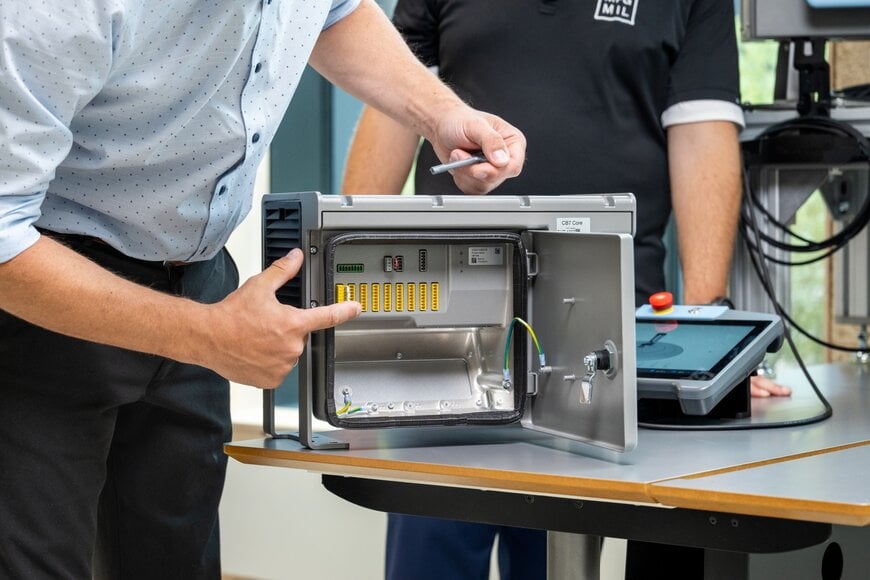
Universal Robots, a division of Teradyne Robotics, and Inbolt announced at SPS 2026 in Nuremberg (24 to 26 November) the native integration of Inbolt Standard, an AI-powered 3D vision guidance software, into the Universal Robots Gen 7 robot platform. Running directly on the CB7 Core controller, the system enables collaborative industrial robots to locate components from CAD files and dynamically adjust taught paths on every cycle across automotive, electronics, and data center hardware manufacturing.
Embedded Architecture and Hardware Connectivity
Following the launch of the Gen 7 platform in September, Inbolt is among the first UR+ partners to execute an artificial intelligence application directly on the CB7 Core controller. Licensing Inbolt Standard to run natively on the robot’s primary processor removes the external industrial PC previously required for 3D vision guidance, reducing hardware footprint and simplifying installation, deployment, and system support.
Hardware integration is supported by the Gen 7 tool flange, which incorporates dedicated power connectors and a 1 Gb Ethernet port. An Orbbec 3D camera connects directly to the tool flange, routing power and data signals internally through the robot arm rather than along external cables. Anders Billesø Beck, Vice President of AI Robotics Products at Universal Robots, stated: "Gen 7 is our platform for physical AI, giving partners the compute, connectivity and tools to develop AI applications and deploy them directly on the robot. Inbolt Standard is a clear example of what that brings to the factory floor in terms of usability and reduced integration time."
Software-Defined Part Localization and Industrial Use Cases
By mounting a 3D camera on the robot wrist to recognize and locate components against their CAD files on each cycle, the system replaces custom mechanical jigs and fixtures with software-defined path adjustments. Product changeovers shift from physical tooling projects to software updates. A single program can switch between more than 80 part references, and plant engineering teams can retrain the system locally when introducing new components.
Inbolt Standard targets stationary applications where parts arrive in a repeatable orientation, ranging from single components to layered racks and trays. In automotive assembly, primary use cases include screwdriving, bolt run-down, de-racking, machine tending, and layered depalletizing. In high-mix electronics and data center hardware production—where trays, enclosures, and server chassis frequently vary in position—the software supports tray and rack loading as well as fastening and torquing operations.
Universal Robots and Inbolt have collaborated since 2022, with vision-guided robot cells operating in production facilities across Europe and North America. At a Stellantis engine-tightening station, deploying Inbolt guidance reduced tightening failures by 91% while requiring 0.5 seconds of vision processing per engine. Rudy Cohen, co-founder and CEO of Inbolt, noted that executing vision guidance directly on the robot allows manufacturers deploying collaborative robots across multiple stations and plants to standardize the capability on every cell from day one rather than engineering dedicated fixtures for each part.
On-Controller Training, Sensing Accuracy, and Platform Compatibility
System configuration and part training are handled by Inbolt Studio, which operates as a URCap on PolyScope X, while real-time part localization executes on the CB7 Core processor. Training is performed locally on the controller using the component's CAD file in under 10 minutes, eliminating the need for image datasets, manual labeling, or external cloud data transfer. Inbolt commands are embedded directly into the PolyScope X program tree and execute like standard URScript instructions.
On fixed parts, the system achieves a repeatability of 0.5 to 0.7 mm. The Orbbec camera utilizes active infrared depth sensing, enabling consistent localization across bright, dim, or dark factory lighting conditions. Inbolt Standard runs natively on Universal Robots g-Series models—specifically the UR10g-1750, UR17g-1300, and UR18g-950—running PolyScope X 10.13 or later. The software is also compatible with e-Series and UR Series robots equipped with a CB7 controller, though these configurations require an external cable to connect the camera.
Additional Context
This section details technical specifications and competitive benchmarking not included in the original news release.
In the 3D robot vision market, third-party guidance platforms such as Pickit 3D, Mech-Mind, and Photoneo typically rely on a dedicated external industrial PC (IPC) to process point-cloud data and communicate coordinates to the robot controller via Ethernet/IP or TCP/IP. While external IPC architectures offer scalable GPU compute for complex random bin-picking of unstructured parts, they add cabinet space, external cabling, and multi-vendor commissioning overhead. By contrast, running Inbolt Standard natively on the CB7 Core controller aligns with the footprint of OEM-integrated vision systems such as FANUC iRVision, which also executes directly on the robot controller without an external PC.
Benchmarking performance metrics, Inbolt’s reported 0.5 to 0.7 mm repeatability and 0.5-second cycle processing time are well suited for semi-structured assembly, fastening, and machine tending, where tolerances are tighter than standard depalletizing but less demanding than sub-0.1 mm high-precision laser metrology. Furthermore, CAD-based local training under 10 minutes differentiates the workflow from deep-learning vision systems that require hundreds of labeled sample images and cloud-based GPU training before deployment.
Edited by Aishwarya Mambet, Induportals Editor, with AI assistance.
www.universal-robots.com
