
www.auto-innovations.net
21
'24
Written on Modified on
TOSHIBA, SOJITZ AND CBMM UNVEIL AN ULTRA-FAST CHARGING ELECTRIC BUS PROTOTYPE
The prototype is powered by next-generation lithium-ion batteries with niobium-titanium oxide anodes.
www.global.toshiba
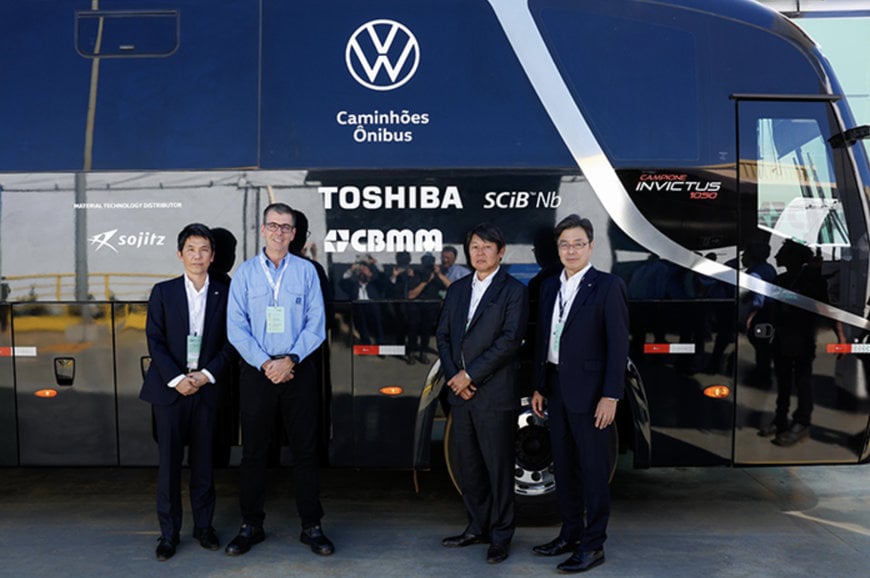
Toshiba, Sojitz and CBMM unveiled the prototype of an ultra-fast charging electric bus powered by next-generation lithium-ion batteries with NTO anodes at CBMM’s industrial plant in Araxá, Brazil. (From left, Toshihiko Takaoka, VP of Toshiba's Battery Division; Ricardo Lima, CEO of CBMM; Koichi Yamaguchi, President & CEO for the Americas of Sojitz Corp.; Yutaka Sata, CTO of Toshiba.)
Toshiba Corporation and Sojitz Corporation of Japan, and Brazil’s CBMM, the world’s leading producer of niobium, have completed development of a next-generation lithium-ion battery that uses niobium titanium oxide (NTO) in the anode. They today held an opening ceremony and unveiled a prototype E-bus powered with the new battery, which realizes an ultra-fast charge time of around 10 minutes and delivers high energy density. The bus has started testing and demonstration operations at CBMM’s industrial plant in Araxá, Brazil.
This marks the world’s first operation of a prototype e-vehicle powered by a lithium-ion battery with NTO anodes, further paving the way to battery commercialization. The three companies will continue to work together to maximize the use of their respective technologies and knowledge, toward launching the next-generation lithium-ion battery with NTO anode in the global market in Spring 2025.
The NTO battery-powered E-bus was developed by Volkswagen Truck & Bus, Brazil, a pioneer in the development and mass production of electric trucks in Latin America. The prototype will also be tested at CBMM’s industrial plant to provide invaluable data on the characteristics of the NTO battery and vehicle operation data, and support any adjustments needed for commercialization.
NTO has twice the theoretical volume density of the graphite-based anode generally used in lithium-ion batteries, which prompted the three companies to sign a joint agreement to explore its potential in June 2018. They subsequently signed a joint development agreement in September 2021 that extended their collaboration to mass production processes of next-generation batteries, mainly targeting application in commercial e-vehicles. In August 2023, the three companies entered into a broad joint sales and marketing agreement that covered building a supply chain and promoting sales and marketing activities, and subsequently, in May this year, at a ceremony attended by representatives of the Brazilian and Japanese governments, they signed a memorandum of understanding on strengthening the supply chain and business promotion.
www.global.toshiba
