
www.auto-innovations.net
25
'25
Written on Modified on
ZF Expands Steering System Capacity in China
Annual capacity rises to 600,000 AKC units and 380,000 SbW systems, advancing China’s intelligent chassis innovation, autonomous driving, and global demand for high-performance dynamics.
www.zf.com
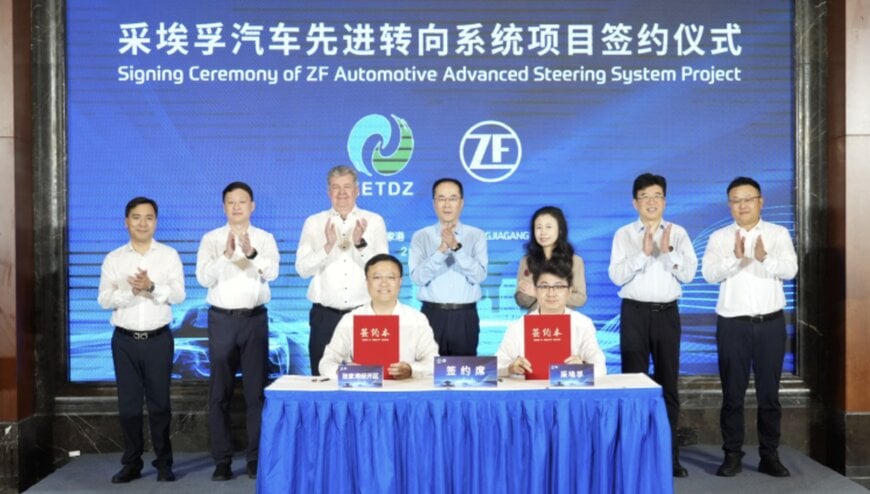
On September 22, ZF AP signed an investment agreement with Zhangjiagang Economic Development Zone, announcing the expansion of its localised intelligent chassis technologies in the city. Under the agreement, ZF plans to expand the product portfolio and production capacity of Active Kinematics Control (AKC) and Steer-by-Wire (SbW), in order to meet the growing demand for intelligent, high-performance driving experiences in domestic and international markets, and to support the accelerated transformation and upgrading of China’s automotive industry.
“Since ZF established its presence in Zhangjiagang in 2014, its continuous expansion and increased investments fully reflect ZF’s high recognition of Zhangjiagang’s business environment and also highlight Zhangjiagang’s important role in ZF’s global strategy. We believe that the SOP and the launch of new products will provide strong backing for ZF to expand its business and advance into a new phase of ‘led by China’,” said Han Wei, Secretary of the Zhangjiagang Municipal Party Committee. “It will also inject robust momentum into Zhangjiagang’s efforts to accelerate the development of a new energy vehicle and auto parts industrial cluster with an output value of hundreds of billions of yuan. The Zhangjiagang Municipal Party Committee and Municipal Government will continue to create a first-class business environment, fully serve as a steadfast supporter for enterprise development. We will join hands with ZF to jointly write a new chapter of Zhangjiagang.”
According to the agreement, ZF will utilise an existing plant space of approximately 6,900 square meters to increase the annual production capacity of AKC products from 400,000 to 600,000 sets, and that of SbW systems from the current level to 380,000 sets. The SbW project is scheduled to achieve official SOP in the first quarter of 2026. Previously, ZF’s second-generation localised AKC was officially put into mass production at the Zhangjiagang campus in July 2024, and is currently providing supporting services to numerous domestic vehicle manufacturers.
Following the signing ceremony, Zhangjiagang campus unveiled its three new intelligent chassis systems, including an integrated brake control system, a rear-wheel steering system, and a steer-by-wire system.
Amid the trend of “software-defined vehicles”, ZF’s SbW technology achieved SOP at its Zhangjiagang campus in the first quarter of 2025, paving the way for Level 3 and above autonomous driving. This technology has been applied to the NIO ET9. Through cooperation with Mercedes-Benz, SbW technology has entered the European market.
ZF’s steer-by-wire technology achieves a revolutionary "soft decoupling" between the steering wheel and the wheels by completely replacing the traditional mechanical connection with electronic signals. This offers groundbreaking advantages: it provides unprecedented flexibility for vehicle design, freeing up cabin space and enhancing crash safety. Furthermore, through freely programmable steering feel and gear ratios, it can seamlessly adapt to various driving modes — from comfort to sporty. As a key cornerstone for enabling high-level autonomous driving, it provides core support for the precise, rapid, and intelligent execution of steering commands, ultimately significantly improving the vehicle’s dynamic performance, safety levels, and personalised experience.
AKC is widely used in mainstream premium vehicle models worldwide. In line with the technology innovation, the megatrends of electrification and consumers' pursuit of driving experience with new energy vehicles, ZF AKC has also been successively applied to the vehicle models of Chinese and international new energy brands such as SAIC MOTOR IM and Dongfeng M-Hero 917 and 817. According to different scenarios and working conditions, the second-generation AKC can achieve a unilateral steering angle output of up to +/-12 degrees and provide larger steering angles according to customer needs, significantly improving the dynamic performance of the vehicle chassis. Integrated with other chassis hardware and software technologies, it can effectively reduce the turning radius, greatly improve manoeuvrability and stability. This system also enables innovative and practical features, such as “crab walking” in narrow spaces and parallel parking. Up to now, the cumulative global sales volume of ZF’s AKC is expected to exceed 2.4 million sets.
As a global “lighthouse factory” and the largest production base of ZF Group in the Asia-Pacific region, the Zhangjiagang campus has a total investment of 2.7 billion RMB. Since its establishment in March 2014, it has successively built four plants specialising in braking, passive safety, electronic steering, and chassis components, gathering ZF’s cutting-edge technologies in multiple fields, including AKC, SbW, IBC, DP-EPS, and lightweight and intelligent chassis systems, and passive safety systems.
Ahead of the ceremony, ZF and Zhangjiagang Economic and Technological Development Zone co-hosted a sharing session themed “Partner with ZF, Advance with Zhangjiagang”, focusing on cooperation opportunities in the new-energy vehicle industry. Around 550 representatives and 30 group executives from 220 ZF suppliers attended the event.
www.zf.com
