
www.auto-innovations.net
08
'26
Written on Modified on
AI DSP Integration for ADAS SoC Performance
BOS Semiconductors and Ceva cooperate on AI-enabled sensor processing for advanced driver assistance systems.
www.ceva-ip.com
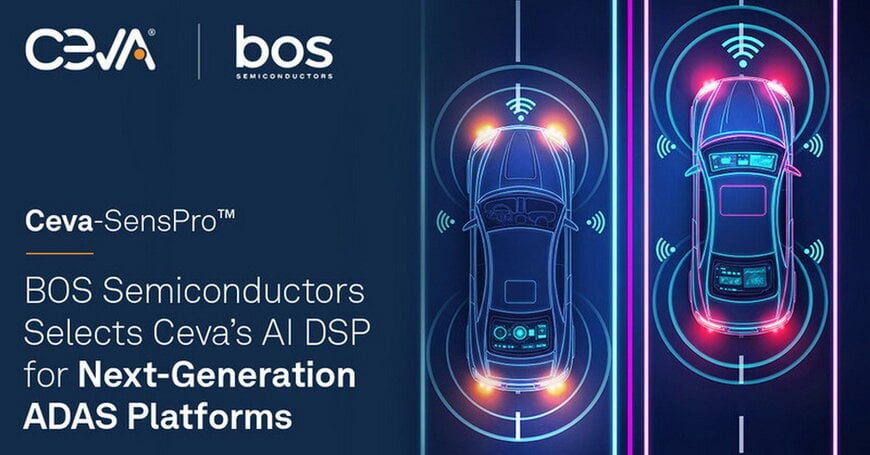
BOS Semiconductors has selected Ceva’s SensPro AI Digital Signal Processor (DSP) architecture to power critical sensing workloads in its upcoming Eagle-A advanced driver assistance systems (ADAS) System-on-Chip (SoC). The integration targets improved real-time perception and efficient handling of raw sensor data for autonomous driving applications, addressing key performance and latency challenges faced by automotive chip developers.
Sensor Fusion and Real-Time Processing in Next-Generation ADAS
The Eagle-A SoC, developed by BOS Semiconductors, is positioned as a comprehensive compute platform for next-generation ADAS and autonomous driving. It combines a high-end neural processing unit (NPU), central processing unit (CPU), and graphics processing unit (GPU) with dedicated interfaces for camera, LiDAR, and radar sensors. BOS’s implementation of SensPro AI DSP technology specifically enhances pre-processing of LiDAR and radar data, reducing perception pipeline latency by efficiently transforming raw sensor inputs into usable information for higher-level algorithms.
The use of SensPro for sensor pre-processing differentiates BOS’s approach from competitors relying solely on general-purpose compute cores or NPUs for all ADAS functions. By offloading dedicated tasks to a DSP optimized for intensive signal processing, the platform can achieve improved performance per watt and more deterministic real-time behavior—key metrics in safety-critical automotive systems.
Scalability Through Chiplet Architecture
A key architectural decision in Eagle-A is its compatibility with chiplet-based scaling. SensPro AI DSP is integrated in a system that can operate alongside BOS’s Eagle-N AI accelerator in multi-die configurations connected via industry standard interfaces such as UCIe and PCIe. This modularity enables automotive manufacturers to tailor compute capacity and resource allocation based on application requirements, from basic driver assistance to more advanced autonomous functions. The chiplet strategy positions Eagle-A to serve a broader range of use cases, extending potential deployment beyond automotive into edge-AI domains like robotics and drones.
Performance and Automotive Requirements
SensPro AI DSP’s optimization for sensor processing and AI inference is designed to deliver performance advantages under the stringent power and safety constraints of automotive environments. Its role in Eagle-A accelerates low-level data transformation tasks that precede high-level neural processing workloads, enabling faster and more efficient perception. This is particularly important in systems where millisecond-level responsiveness and functional safety compliance are critical for real-time decision-making.
Strategic Impact for BOS and Ceva
For BOS Semiconductors, licensing SensPro contributes to differentiated product performance in a competitive ADAS SoC market segment. The integration supports the company’s narrative of delivering high domain-level compute performance, safety, and scalability. For Ceva, the collaboration reinforces its positioning in the expanding automotive AI market, where the demand for specialized AI DSPs complements existing NPU and general-purpose compute solutions by adding dedicated sensing acceleration.
The adoption of Ceva’s SensPro AI DSP in BOS Semiconductors’ Eagle-A ADAS SoC reflects an industry trend toward heterogeneous compute architectures that combine specialized processors to meet the performance, efficiency, and real-time requirements of advanced driver assistance and autonomous driving systems. By offloading specific sensing tasks to an optimized DSP and enabling scalable chiplet configurations, BOS aims to deliver flexible and high-performance platforms suitable for diverse automotive and edge-AI applications.
www.ceva-ip.com
