
www.auto-innovations.net
22
'26
Written on Modified on
Valeo Industrialises Dual Thor Compute on NVIDIA Hyperion
Valeo develops automotive-grade Level 4 compute platforms utilizing dual NVIDIA DRIVE AGX Thor processors to accelerate software-defined vehicle deployments.
www.valeo.com
Global vehicle manufacturers face systemic engineering hurdles as automotive electrical and electronic architectures migrate from decentralized electronic control units (ECUs) toward centralized, high-performance compute domains. Achieving Level 4 autonomous driving across passenger vehicles, commercial heavy-duty trucking, and purpose-built robotaxis requires immense neural network throughput alongside strict hardware fault tolerance. Traditionally, Tier-1 suppliers have integrated disparate processing nodes for perception, trajectory planning, and safety supervision, creating high system latency, excessive harness mass, and complex thermal management demands. Successfully scaling software-defined vehicles (SDVs) requires unified, automotive-grade centralized compute engines engineered to execute multimodal foundation models while maintaining rigorous functional safety fail-operational redundancies.
Dual Thor Compute Architecture for Level 4 Autonomy
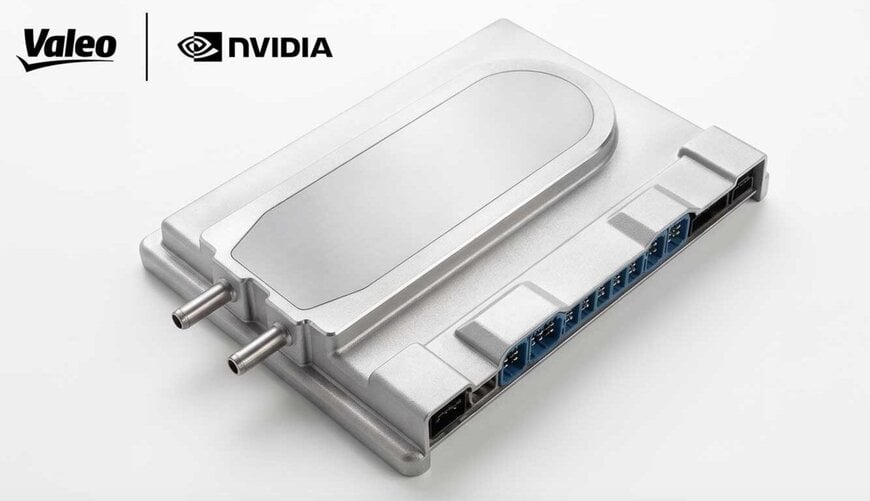
To resolve centralized processing and redundancy bottlenecks, Valeo announced it will develop and industrialize automotive-grade, high-performance compute platforms built on the NVIDIA Hyperion reference architecture. The platform combines Valeo’s automotive system integration, thermal packaging, and manufacturing capabilities with NVIDIA’s centralized computing and sensor baseline.
The compute platform integrates a dual NVIDIA DRIVE AGX Thor architecture, providing the artificial intelligence compute density and redundant processing paths required for commercial Level 4 driverless operations. The modular, unified hardware layer is tailored to serve multiple operational domains—including private passenger vehicles, autonomous commercial transport, and driverless robotaxi fleets. By standardizing automated driving functions onto a single centralized compute assembly, automotive original equipment manufacturers (OEMs) can streamline feature integration, reduce bill-of-materials complexity, and shorten development cycles.
Functional Safety Framework and Industrialization
Converting high-power processing silicon into road-ready hardware requires meeting demanding automotive environmental and safety standards. Valeo will leverage its industrialization footprint and functional safety engineering to adapt the reference design into production platforms aligned with specific OEM chassis packaging and power envelopes.
The compute architecture incorporates the NVIDIA Halos safety framework to enforce continuous system health monitoring and fault containment across hardware and software layers. By combining automotive-grade enclosure engineering, vibration isolation, and liquid cooling with Halos diagnostics, the platform delivers the deterministic fail-operational behavior necessary to safely handle sensor dropouts, bus interruptions, or localized processor faults during driverless mission profiles.
Additional Context
This section details technical specifications and competitive benchmarking not included in the original product announcement.
In centralized automotive compute architectures governed by ISO 26262 functional safety and ISO 21434 cybersecurity standards, achieving Level 4 fail-operational status demands diverse redundancy across power supplies, microcontroller watchdogs, and neural network pipelines to prevent single points of failure. The NVIDIA DRIVE AGX Thor system-on-chip utilizes the Blackwell GPU microarchitecture paired with Arm Neoverse V3AE high-performance automotive CPU cores. Built-in hardware isolation allows the system to partition safety-critical ADAS perception and path planning (rated up to ASIL D) from non-critical digital cockpit services and in-cabin generative AI assistants running simultaneously on the same silicon fabric.
Within the Tier-1 high-performance compute and autonomous driving domain, Valeo’s platform benchmarks directly against domain controllers developed by Continental, Bosch, Aptiv, and ZF. While competing architectures often deploy heterogeneous multi-chip arrays pairing Qualcomm Snapdragon Ride platforms or custom ASICs with external safety host MCUs, Valeo's integration of the Hyperion reference specification provides native support for high-bandwidth sensor suites—including high-resolution gigabit multimedia serial link (GMSL) cameras, imaging radars, and long-range LiDAR sensors. By integrating direct-to-chip liquid cooling and production-scale surface-mount manufacturing, Valeo provides automakers with an industrialized gateway to deploy dual Thor processing power without bearing the high non-recurring engineering costs of custom motherboard and thermal design.
Edited by Romila DSilva, Induportals Editor, with AI assistance.
www.valeo.com
