
www.auto-innovations.net
22
'26
Written on Modified on
High-Voltage Film Capacitors for Automotive EMI Suppression
TDK Corporation releases B3201 series Y1 film capacitors to suppress common-mode electromagnetic interference in high-voltage automotive systems.
www.tdk.com
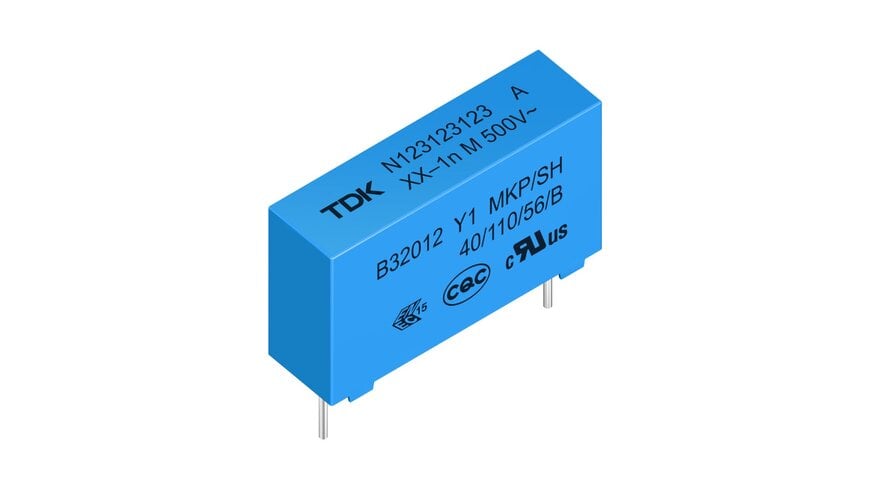
Power electronic systems deployed in electric vehicles, fast-charging infrastructure, and industrial drives operate with increasingly high DC-link voltages and fast-switching wide-bandgap semiconductors. These operating environments generate severe common-mode electromagnetic interference (EMI) that must be filtered to chassis ground without compromising galvanic isolation or operator safety under extreme thermal stress.
TDK Corporation introduced the compact B3201*A5/B5/C5 series of Y1 safety capacitors, engineered to suppress high-frequency line-to-ground noise across electric mobility platforms, industrial frequency converters, and renewable energy storage systems. Built on metallized polypropylene film technology, the components deliver high dielectric endurance rated for 500 V (AC) and up to 1500 V (DC) under AEC-Q200 Rev. E qualification standards.
Dielectric Self-Healing and Line-to-Ground Isolation Mechanics
Class Y safety capacitors are installed directly in line-to-ground configurations, where component failure presents a direct hazard of electric shock or grounding loss. In the B3201 series, TDK employs a metallized polypropylene (MKP) film dielectric. Under high-voltage electrical breakdown or localized dielectric puncture, the vapor-thin metal coating surrounding the fault point evaporates within microseconds. This self-healing mechanism isolates the breakdown site, maintaining overall electrical insulation without creating a permanent short circuit.
The capacitor elements are housed in a rigid plastic case sealed with flame-retardant epoxy resin conforming to UL 94 V-0 flammability ratings. This mechanical construction shields the internal polypropylene winding from environmental degradation, enabling the series to satisfy rigorous temperature-humidity-bias (THB) testing at +85 °C, 85 percent relative humidity, and 500 V (AC) for 500 hours.
Technical Specifications and Lead Spacing Options
The B3201*A5/B5/C5 series spans a capacitance spectrum of 0.47 nF to 33 nF divided across two primary form factors:
- The B32012 type covers capacitance ratings from 0.47 nF up to 10 nF with a 15 mm lead spacing, beginning at case dimensions of 5.0 x 10.5 x 18.0 mm.
- The B32013 type extends capacitance values from 5.6 nF to 33 nF utilizing a 22.5 mm lead spacing, with dimensions starting at 6.0 x 15.0 x 26.5 mm.
Continuous electrical ratings allow sustained operation at 500 V (AC) and 1500 V (DC) at ambient temperatures up to +110 °C. Between +110 °C and the maximum rated threshold of +125 °C, operating voltage must be derated linearly by 1.5 percent per degree Celsius, with total cumulative operation at this elevated temperature limit constrained to a maximum of 1,000 hours.
Terminations feature parallel wire leads suitable for wave and selective through-hole PCB assembly, supplied in bulk untaped formats or taped ammo-pack and reel packaging configurations. The series carries global international safety certifications, including ENEC approvals under IEC/EN 60384-14, UL certification via UL 60384-14, CSA E60384-14 compliance, and CQC certification under GB/T 6346.14.
Real-World Industrial and Automotive Applications
Modern high-voltage vehicle electrical systems (xEV) generate significant dV/dt transient noise due to the steep switching slopes of silicon carbide (SiC) and gallium nitride (GaN) power stages. The compact footprint of the B3201 family allows hardware engineers to place Y1 line-to-ground filters directly adjacent to power module inputs within on-board chargers (OBC) and DC-DC converters, minimizing stray inductance loops.
Within DC fast-charging stations, photovoltaic central inverters, and utility-scale energy storage systems (ESS), the components provide primary common-mode noise suppression on high-voltage AC mains lines. The AEC-Q200 Rev. E qualification confirms structural resilience against automotive thermal shock, cyclic vibration, and mechanical substrate flexing.
Additional Context:
This section details technical specifications and competitive benchmarking not included in the original product announcement.
Safety capacitors are governed by the international standard IEC 60384-14, which establishes test classes based on line connection topology and peak impulse voltage withstand capability. Class Y1 defines the most stringent safety designation for line-to-ground placement, requiring certified components to withstand an 8 kV peak impulse test waveform (1.2/50 μs) without dielectric rupture.
Historically, Class Y1 filtering has relied heavily on single-layer radial ceramic disc capacitors, such as the Vishay AY1 series, or dedicated multilayer ceramic chips (MLCCs). While ceramic disc capacitors provide peak pulse withstand ratings often exceeding 10 kV and operating ranges up to +125 °C, ceramic dielectrics (typically Class II ferroelectric materials) experience capacitance loss under DC/AC voltage bias and feature limited maximum capacitance values, generally capping out below 4.7 nF in standard sizes due to physical dimension and leakage current constraints.
By leveraging metallized polypropylene film, the TDK B3201 series delivers capacitance values up to 33 nF in a boxed form factor. MKP dielectrics exhibit an exceptionally low dissipation factor (tan δ) and stable capacitance across varying voltages, preventing the saturation-related filter degradation seen in high-dielectric-constant ceramics. In comparison with traditional standard Y2 film capacitors, which are restricted to rated voltages of 300 V (AC) with 5 kV impulse withstand thresholds, the B3201 series addresses higher 500 V (AC) line voltages and provides the 8 kV pulse margin mandated by Class Y1 safety protocols.
Edited by Natania Lyngdoh, Induportals editor, with AI assistance.
www.tdk-electronics.tdk.com
