
AI-Enhanced Soft Switching for Inverter Efficiency
Porsche Engineering introduces an AI-driven control approach to reduce inverter switching losses and improve electric vehicle efficiency.
www.porsche.com

The Porsche Engineering Control Center with AI-assisted soft switching is a software-centric approach aimed at reducing switching losses in power transistors within electric vehicle inverters, with potential applications for electric powertrain efficiency and range optimization in automotive engineering. This technology leverages real-time artificial intelligence to control transistor switching, enabling measurable reductions in energy loss and supporting more compact inverter designs.
Why Inverter Switching Losses Still Matter
Inverters convert direct current from an electric vehicle’s battery into alternating current for the motor. Traditional “hard switching” of power transistors introduces switching losses because there are transient periods when both voltage and current are present across a transistor, producing undesired power dissipation. Such losses limit overall inverter efficiency and ultimately reduce vehicle range. In electric powertrains where range and thermal management are critical design constraints, minimizing these losses can yield quantifiable benefits.
Soft switching seeks to mitigate these losses by controlling transistor transition timing to align with conditions that minimize the concurrent presence of voltage and current. Implementing soft switching is technically complex because optimal switching points depend on dynamic operating conditions such as load, torque, and temperature. Porsche Engineering’s innovation lies in using AI to address this real-time variability.
AI-Driven Control Mechanism
The new control strategy integrates an auxiliary resonant converter topology—known as Auxiliary Resonant Commutated Pole (ARCP)—around the inverter’s power transistors. Instead of static switching thresholds, a pre-trained AI algorithm ingests multiple real-time signals (for example, electrical load and motor torque) and computes optimal switching instances in fractions of a second. This enables Zero Voltage Switching (ZVS), wherein transistor transitions occur when the voltage across the device is near zero, limiting switching energy loss.
Two classes of AI models are under investigation: recursive neural networks, valued for prediction accuracy, and reinforcement learning, which may offer faster computation under stringent real-time constraints.
Measured Impacts and Engineering Applications
Simulation results from Porsche Engineering indicate that AI-based soft switching can reduce switching losses in power transistors by approximately 70 to 95 percent.
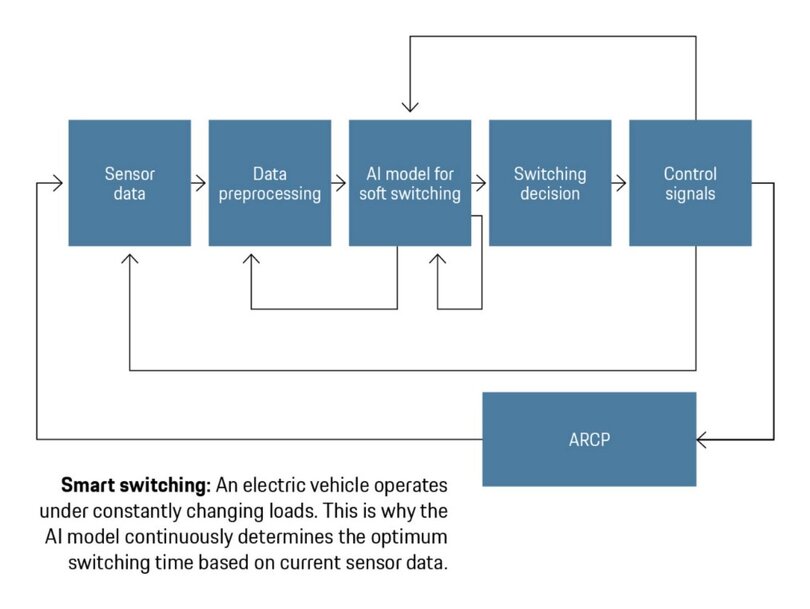
The net system effects include:
- Range improvements in the high single-digit percentage range, depending on driving conditions.
- Reduced heat generation within the inverter, lowering cooling demands and enabling more compact thermal management hardware.
- Omission of certain passive filter components, simplifying printed circuit board (PCB) layouts.
- Decrease in inverter module volume by 20 to 50 percent, which supports packaging efficiency.
- Reduced mechanical stress on transistors, potentially extending component service life.
These factors are relevant in automotive engineering domains where inverter efficiency, thermal design, and packaging are design drivers for electric vehicles. The software-centric nature of the solution means it could be integrated into existing inverter control units via library modules without substantial hardware modification, making it suitable for incorporation in both new designs and mid-life updates of electric vehicles.
Positioning AI-Controlled Soft Switching in Automotive Power Electronics
Although soft switching concepts such as ZVS and ARCP are known in power electronics, their application under variable driving conditions has been limited by control complexity. The use of a real-time AI controller addresses this limitation by predicting optimal switching behavior under dynamic loads, which is a technical departure from conventional fixed-logic strategies. This positions the Porsche Engineering Control Center with AI within the broader shift toward model-based and AI-augmented control in automotive power electronics, contributing to digital supply chain and automotive data ecosystem trends without reliance on proprietary hardware upgrades.
The technology is currently in an advanced development stage and is planned for delivery to OEMs and Tier-1 suppliers as a software solution once fully matured, with integration envisioned as part of software updates or new system roll-outs.
www.porsche.com
