
www.auto-innovations.net
14
'26
Written on Modified on
Integrated In-Cabin and Road Awareness Systems
HARMAN introduces production-ready vehicle intelligence to support holistic safety monitoring inside the cabin and beyond the vehicle for OEM deployment at scale.
www.harman.com
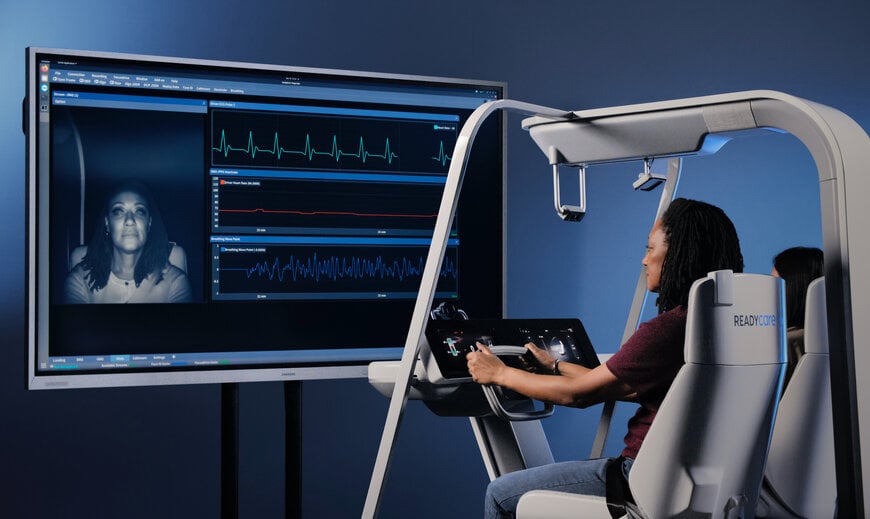
HARMAN has expanded its automotive safety portfolio with production-ready systems that combine in-cabin sensing, connected road awareness, and vehicle-grade connectivity to support advanced driver-assistance and NCAP-oriented safety strategies across multiple vehicle platforms.
Holistic awareness as a safety enabler
As vehicle safety requirements evolve toward higher levels of driver and occupant awareness, OEMs increasingly require systems that integrate human-state monitoring with external hazard intelligence. HARMAN has introduced new capabilities across its Ready Care and Ready Aware platforms to address this need through a unified software and hardware approach. The systems are designed to operate on existing vehicle architectures while enabling continuous upgrades through connectivity, forming part of a scalable automotive data ecosystem.
In-cabin intelligence with physiological and positional sensing
Ready Care focuses on in-cabin monitoring using advanced driver and occupant sensing. The latest generation introduces single-heartbeat detection, enabling more granular vital-sign measurement compared with averaged heart-rate methods. This allows the system to identify changes in driver physiological state with higher temporal resolution, supporting earlier detection of fatigue or stress.
Enhanced occupant-position monitoring improves spatial accuracy for seating posture and location, which can be used to support airbag deployment logic and adaptive restraint systems. These functions operate on existing OEM-installed sensors and compute platforms, reducing integration complexity while aligning with current NCAP driver monitoring and occupant protection assessment criteria.
Connected road awareness without additional sensors
Ready Aware extends safety coverage beyond the vehicle by using a vehicle-to-network (V2N) architecture over 4G and 5G connectivity. Rather than relying on new onboard perception hardware, the system processes cloud-based data to generate contextual alerts for road hazards and complex intersections.
A machine-learning-based Confidence Engine evaluates incoming data and suppresses low-confidence events, reducing false alerts and limiting driver distraction. Unlike crowd-confirmation models, the system does not require manual driver interaction, supporting consistent alert behavior across fleets and regions. This approach enables OEMs to deploy connected safety functions within existing electronic architectures while supporting digital supply chain scalability.
Connectivity as the enabling layer
These safety functions are supported by Ready Connect, HARMAN’s telematics control unit platform. Ready Connect provides short-range, long-range, and satellite communication within a unified connectivity architecture, enabling real-time data exchange between the vehicle and external services. This connectivity layer allows applications such as Ready Aware to deliver time-critical safety information while supporting global deployment across regulatory environments and vehicle classes.
Relevance for OEM safety roadmaps
By combining in-cabin sensing, connected awareness, and vehicle-grade connectivity, HARMAN’s updated portfolio addresses key technical challenges in deploying integrated safety systems at scale. The approach supports incremental feature rollout, alignment with NCAP requirements, and long-term software evolution, offering OEMs a practical pathway to implement holistic vehicle awareness without extensive hardware redesign.
www.harman.com
