
www.auto-innovations.net
30
'26
Written on Modified on
Quiet Tire Technology Reduces Vehicle Noise
Continental develops advanced tire design to lower rolling noise for improved comfort and reduced environmental impact.
www.continental.com
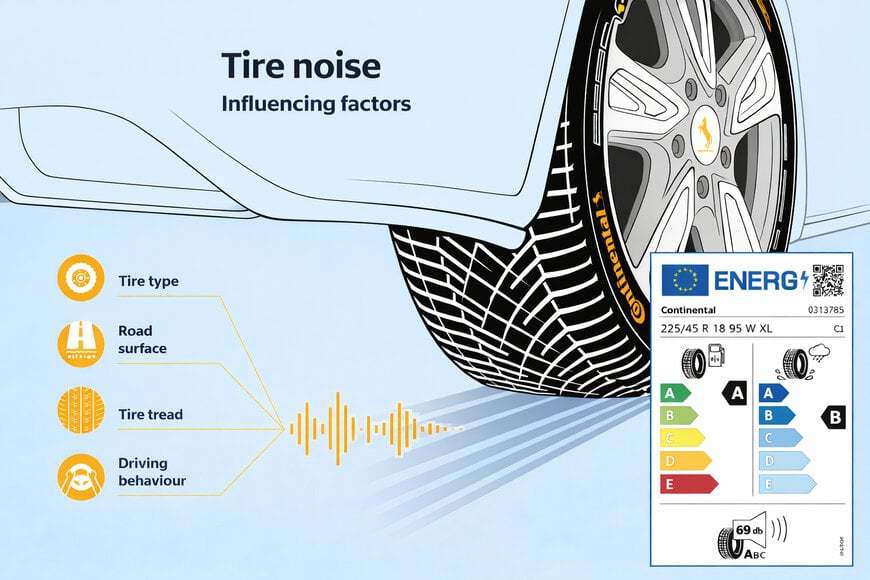
Continental, a major global tire manufacturer serving automotive OEMs and aftermarket customers, has updated its tire portfolio with technologies aimed at cutting rolling noise, addressing both comfort and environmental noise emission challenges in passenger and commercial vehicles.
Addressing Noise and Comfort Challenges
Vehicle tire noise—from the interaction between tire and road surface—is a significant contributor to overall traffic noise levels inside and outside the vehicle. As automakers increasingly prioritize cabin comfort and urban noise reduction, demand for tires with lower rolling noise has grown. Continental’s latest solution combines optimized tread design with internal noise-damping technology to reduce unwanted sound without compromising core tire performance.
Enhanced Tread Design and ContiSilent Technology
The solution consists of two core elements. The first is a specialized tread pattern engineered to reduce rolling noise at the source by altering block spacing and angles so that sound frequencies partially cancel each other, similar to noise-cancelling headphones.
The second component is ContiSilent, an internal noise-absorbing layer made of polyurethane foam bonded to the inner surface of the tire tread. This layer absorbs vibrations within the tire cavity, significantly lowering the level of noise transmitted into the vehicle cabin. According to Continental, this technology can reduce the components of rolling noise perceived inside the vehicle by up to 9 dB(A), a reduction that the human ear interprets as substantially quieter.
Why Continental Selected This Approach
Continental chose this combination of tread optimization and internal damping to balance noise reduction with uncompromised safety and performance. The internal foam layer does not alter braking, handling, mileage, load capacity, or speed ratings, ensuring that quieter operation does not come at the expense of essential tire characteristics.
Achillefs Tsotras, head of Continental’s Tire-Vehicle Interaction department, said that “noise, especially traffic noise, is a major burden for people and the environment. With our tire technologies, we are actively reducing rolling noise without compromising safety.”
Deployment and Support
Rather than a single site installation, Continental integrated the quiet-noise technologies across its production lines and tire families where appropriate. ContiSilent is applied during manufacture, with the foam layer added after primary tire construction and compatible with standard rims and tire mounting processes.
Benefits and Results
Although specific numerical performance data from field deployments were not released in the press material, the quantitative reduction in perceived noise—up to 9 dB(A)—represents a measurable improvement in interior cabin acoustics. This contributes to enhanced passenger comfort and helps automakers meet increasing customer expectations for noise, vibration, and harshness (NVH) performance. Additionally, reduced external rolling noise supports broader goals of urban noise mitigation and environmental quality improvement.
Conclusion
Continental’s quiet-noise tire technologies respond directly to operational challenges in the automotive sector by lowering both interior and exterior tire noise while preserving essential performance. By integrating advanced tread design and internal sound damping, the company provides tire solutions that support comfort, safety, and environmental targets valued by vehicle manufacturers and end customers alike.
www.continental.com
