
www.auto-innovations.net
10
'26
Written on Modified on
Infineon SiC Power Devices Used in Toyota EV
Silicon carbide MOSFETs support higher efficiency power conversion in electric vehicle charging and auxiliary power systems.
www.infineon.com
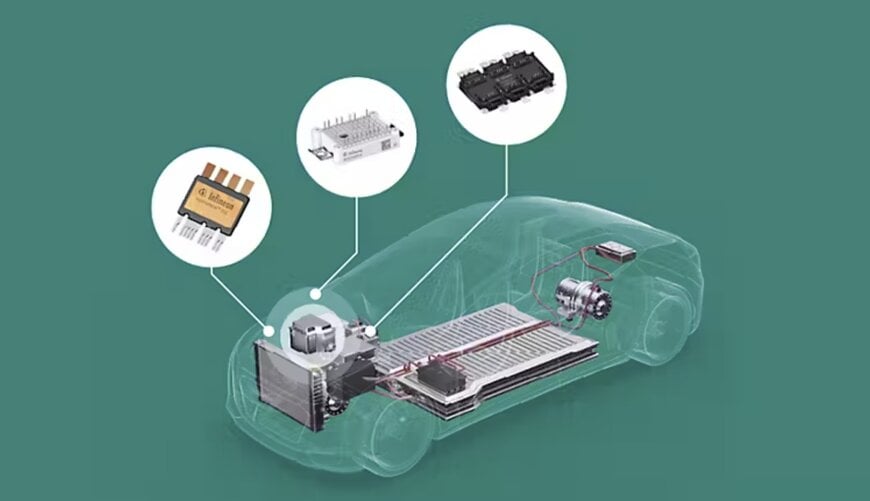
Silicon carbide power semiconductors are being deployed in electric vehicle power conversion systems to improve efficiency and thermal performance. In this context, Infineon Technologies has supplied CoolSiC™ MOSFETs for integration into the on-board charger and DC/DC converter of Toyota Motor Corporation’s new bZ4X battery electric vehicle.
SiC devices in vehicle power conversion stages
The components are used in two key subsystems of the vehicle’s power architecture: the on-board charger (OBC), which converts AC grid power to DC for battery charging, and the DC/DC converter, which steps down high-voltage battery output to supply low-voltage vehicle electronics. These stages are central to overall electric vehicle energy efficiency and are closely tied to driving range and charging performance.
Silicon carbide (SiC) MOSFETs are selected in these positions because the material supports higher breakdown voltages, lower switching losses, and improved thermal conductivity compared with conventional silicon devices. These characteristics enable higher switching frequencies and reduced energy dissipation, which can translate into smaller passive components and improved system-level efficiency in EV power electronics.
Device structure aimed at reducing losses
Infineon’s CoolSiC™ MOSFETs use a trench gate structure designed to lower normalized on-resistance. Reduced on-resistance directly lowers conduction losses during current flow, while switching losses are influenced by device capacitances and switching speed. Together, these parameters determine heat generation and cooling requirements in compact automotive power modules.
Optimized parasitic capacitances and a defined gate threshold voltage allow the devices to operate with a unipolar gate drive scheme. This simplifies gate driver design compared with more complex bipolar drive approaches and can reduce the number of supporting components in the gate drive stage. For automotive designers, this affects PCB area, system complexity, and electromagnetic behavior in high-frequency switching environments.
Implications for efficiency and system density
Lower conduction and switching losses contribute to higher conversion efficiency in both the OBC and DC/DC converter. In practical terms, improved efficiency reduces heat generation, which can allow for smaller heatsinks or higher power density within the same thermal envelope. In electric vehicles, incremental efficiency gains in these subsystems influence overall energy consumption, which is linked to driving range per charge.
High thermal robustness of SiC devices also supports operation at elevated junction temperatures compared with standard silicon MOSFETs. This can simplify thermal management strategies in densely packaged automotive power electronics, where space and airflow are constrained.
Role in the automotive data ecosystem shift to electrification
The adoption of SiC-based power semiconductors reflects a broader transition within the automotive data ecosystem and power electronics supply chain toward wide bandgap materials. As EV architectures move to higher voltage platforms and faster charging capabilities, semiconductor performance in switching efficiency and thermal handling becomes a primary design constraint.
By deploying CoolSiC™ MOSFETs in series-production vehicle subsystems, Infineon Technologies expands the use of SiC devices beyond niche or high-performance EV segments into mainstream electric vehicle platforms such as the Toyota bZ4X.
www.infineon.com
