
www.auto-innovations.net
01
'26
Written on Modified on
Digital and Energy Solutions for Future Paint Shops
Dürr presents integrated process, software, and application technologies at Open House 2026 to improve efficiency, flexibility, and sustainability in automotive paint shops.
www.durr.com
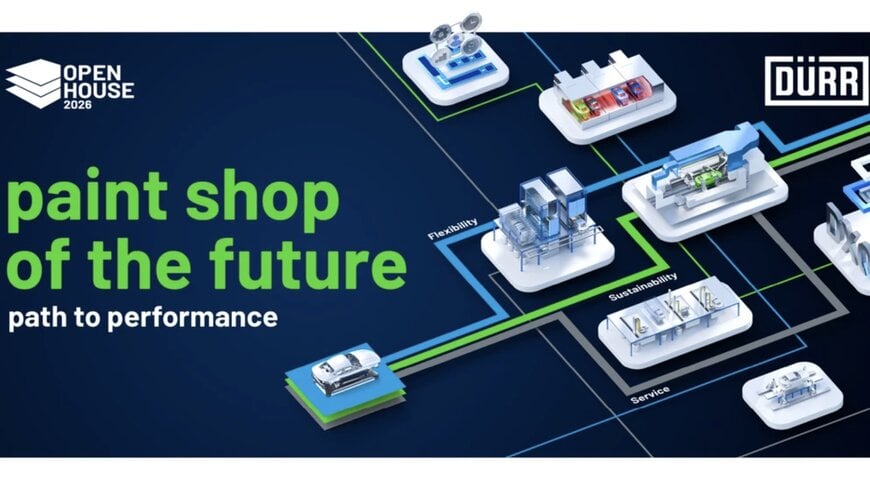
From April 21 to 23, 2026, Dürr will host its Open House event, showcasing technologies aimed at optimizing paint shop operations across the automotive industry. The event, held virtually and across global locations, focuses on improving plant performance through integrated energy management, digital control, and process innovations.
Holistic optimization of paint shop operations
Paint shops are among the most energy- and cost-intensive areas in automotive manufacturing. Dürr’s approach addresses the entire process chain—from system planning to operation—highlighting how early-stage design decisions influence energy consumption, layout efficiency, and lifecycle costs.
A central concept is the integration of process steps and utilities into a unified system. By aligning planning, equipment, and interfaces, operators can reduce space requirements, optimize workflows, and improve overall plant efficiency.
Integrated energy management for reduced consumption
The EcoQPower concept introduces a system-level approach to energy use in paint shops. Instead of treating heating and cooling processes independently, the system captures and redistributes thermal energy across the plant.
This closed-loop energy model is particularly relevant for electrified paint shops, where energy flows can be managed more precisely. By reusing heat within the system, energy consumption can be reduced by up to 25%, contributing to lower operating costs and reduced CO₂ emissions.
Digital supply chain and plant control systems
Digitalization plays a key role in improving plant performance. Dürr’s control and analytics platforms provide centralized monitoring and management of paint shop operations. These systems integrate process data across the plant, enabling real-time control and performance analysis.
By applying data-driven insights, operators can identify inefficiencies, reduce downtime, and improve overall equipment effectiveness. Such platforms also support predictive maintenance strategies, helping to prevent unplanned interruptions in production.
Process innovations for automotive coating
Several process technologies focus on improving efficiency and reducing material consumption. Advances in dip coating systems enable more flexible plant layouts by eliminating additional mechanical components and simplifying installation.
In drying processes—typically the most energy-intensive stage—new systems apply heat more selectively, reducing unnecessary energy use. Centralized heating combined with precise temperature control improves energy efficiency while maintaining coating quality.
Booth design has also been optimized through modular configurations and high air recirculation rates. These systems significantly reduce energy demand compared to conventional wet separation processes by minimizing airflow requirements and heat losses.
Application technology and flexibility
Improvements in application equipment enhance both efficiency and customization. Advanced atomizers reduce overspray, lowering material consumption and enabling more compact booth designs.
New robotic systems provide improved accessibility and precision, supporting flexible production scenarios. In addition, digital paint application technologies enable high-resolution customization directly on vehicle bodies, eliminating the need for masking in certain processes and expanding design possibilities.
Global project execution and lifecycle efficiency
Beyond equipment and processes, the company emphasizes project execution capabilities for large-scale, international installations. Coordinated management of logistics, regulatory requirements, and site operations is critical for delivering complex paint shop projects on schedule and within budget.
Toward sustainable and flexible paint shop systems
The technologies presented reflect a broader shift toward integrated, data-driven, and energy-efficient manufacturing systems. By combining process innovation, digital control, and energy optimization, paint shops can achieve higher flexibility and reduced environmental impact while maintaining productivity.
This systems-level approach supports long-term competitiveness in automotive manufacturing, where efficiency, sustainability, and adaptability are increasingly interconnected.
Edited by Romila DSilva, Induportals Editor, with AI assistance.
www.durr.com
