
www.auto-innovations.net
05
'26
Written on Modified on
High-Speed Alignment for Automotive MLCC Stacking
Basler provides telecentric optics and liquid lens autofocus solutions to ensure precise alignment, stable focus and high throughput in automotive MLCC production.
www.baslerweb.com
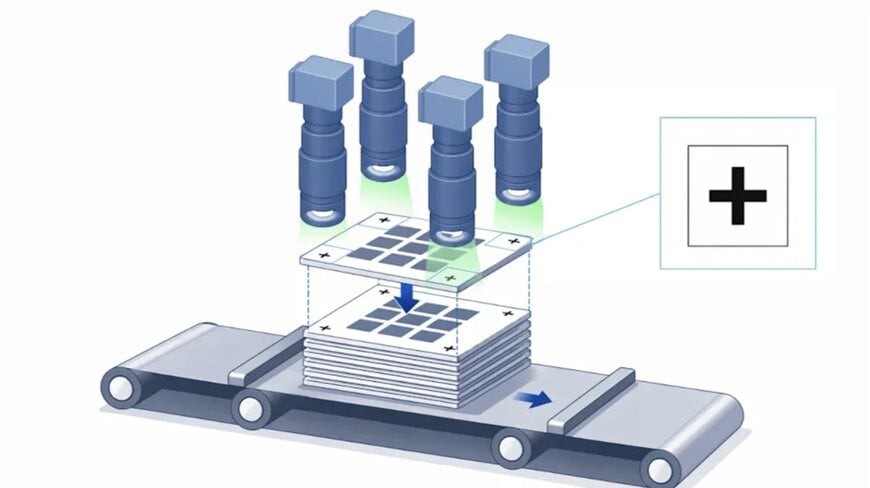
MLCC layer stacking illustration: Continuous build-up shifts the top surface, requiring real-time refocus.
Optical Requirements for Automotive MLCC Inspection
Automotive MLCC stacking requires imaging with minimal distortion and stable dynamic focusing to ensure reliable alignment as stack height increases. Micron-level misalignment can result in uneven internal stress during thermal expansion, reducing safety margins and increasing the risk of short circuits or cracks. To ensure long-term reliability, inspection systems must utilize two essential optical capabilities: distortion-free imaging and dynamic focus control.
Dimensional Accuracy Under Tight Tolerances
Standard lenses introduce perspective distortion as object height changes, causing alignment marks to appear at different magnifications across layers. This shifts edge positions and introduces bias in calculated center coordinates (ΔX, ΔY), which accumulates over successive layers and degrades stacking accuracy. Telecentric lenses eliminate this perspective distortion, ensuring consistent measurement across the entire stack height. While liquid lenses can introduce slight, predictable magnification variations due to changes in optical power, these can be managed through precise lens selection and system validation.
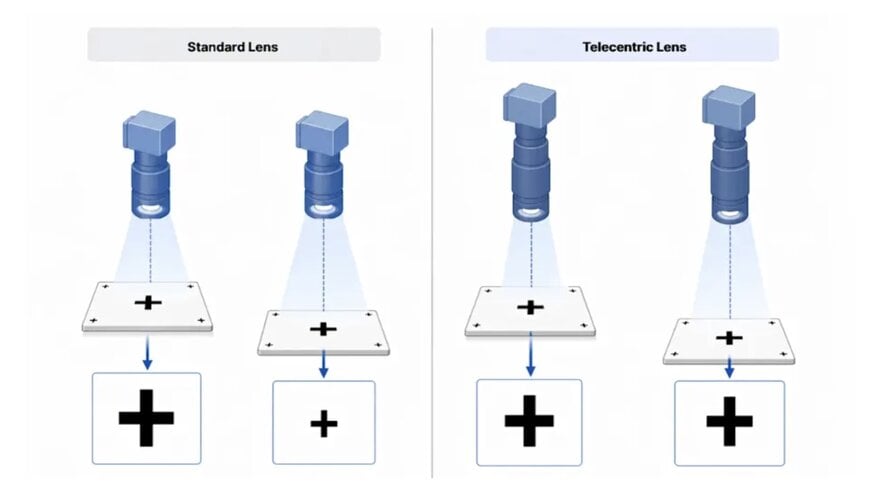
Alignment marks enlarge with stack height under standard lenses due to perspective. Telecentric optics maintain constant magnification, though liquid lenses may introduce slight variation.
Stable Focus Across High Layer Counts
As the stack builds, the focal plane shifts beyond the limited depth of field of conventional optics. Without dynamic focus adjustment, alignment marks at different heights lose clarity, reducing the stability of center detection. Mechanical refocusing methods are often insufficient due to vibration, settling time, and limited response speed. Liquid lens autofocus enables fast, non-mechanical focus adjustment in real time, maintaining image sharpness and supporting high-speed stacking processes without mechanical delays.
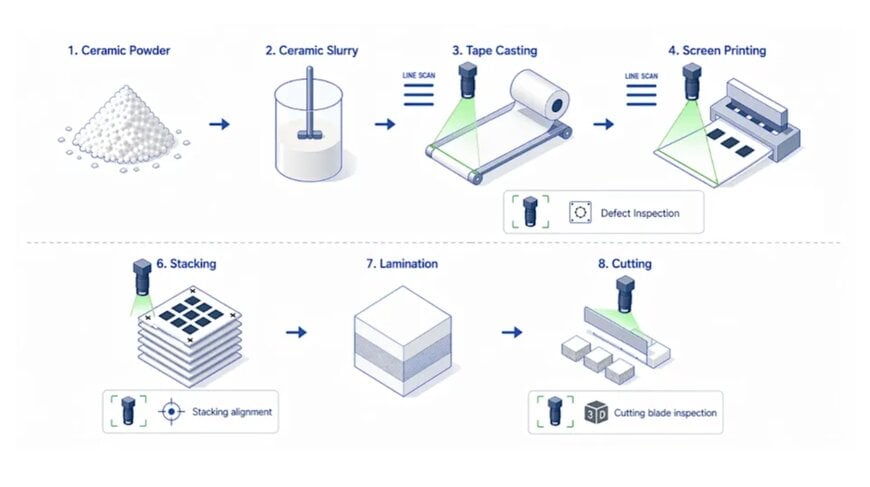
Vision inspection points across MLCC process: line scan for web inspection, alignment control in stacking, and blade chipping 3D inspection in cutting.
Integrated Liquid Lens Autofocus Solutions
To meet these challenges, Basler provides an integrated imaging solution that simplifies system architecture:
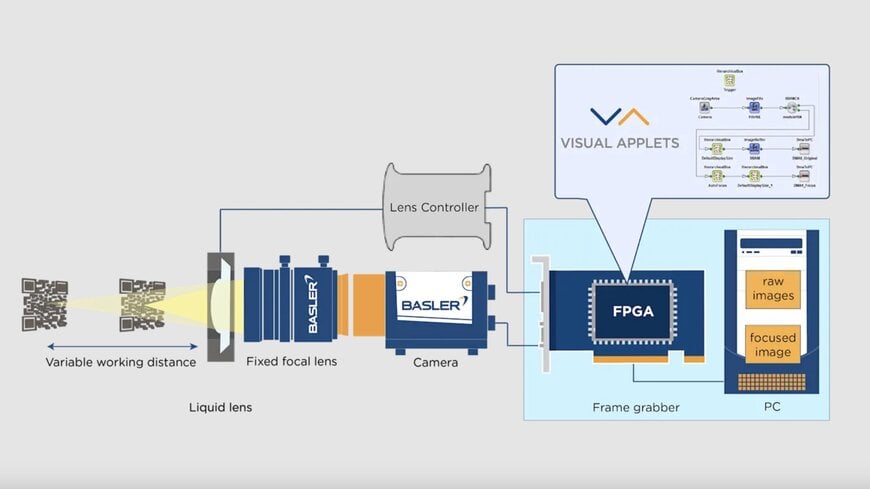
- Direct Control Integration: The liquid lens is controlled directly by the imaging module, reducing cabling complexity and the need for external controllers.
- Real-Time FPGA Processing: Autofocus algorithms run on the internal FPGA in a closed loop with image acquisition, delivering sharp alignment images at every cycle without latency.
- Optimized Performance: This approach ensures consistent image sharpness up to 1,000 layers, eliminating vibration-induced errors and increasing throughput by removing mechanical settling delays.
Additional Context
The increasing demand for higher capacitance in smaller automotive footprints (such as 0603 or 0402) has driven the industry toward much higher layer counts and thicker ceramic sheets. This shift makes the "Depth of Field" (DoF) a primary technical bottleneck. In traditional optics, a high-resolution image typically has a very shallow DoF, meaning only a few layers of the MLCC stack would be in focus at any given time.
Technically, the integration of liquid lenses—which use electrowetting technology to change the curvature of a fluid interface—allows the system to change focal length in milliseconds. By offloading the autofocus algorithm to the FPGA (Field Programmable Gate Array), the system can perform "Image Contrast Detection" at the hardware level. This allows the camera to calculate the optimal focus setpoint for each specific layer height nearly instantaneously. This closed-loop response is essential for maintaining the deterministic timing required in high-speed automotive production lines, where any delay in alignment verification directly translates to reduced units per hour (UPH).
Edited by Romila DSilva, Induportals Editor, with AI assistance.
The increasing demand for higher capacitance in smaller automotive footprints (such as 0603 or 0402) has driven the industry toward much higher layer counts and thicker ceramic sheets. This shift makes the "Depth of Field" (DoF) a primary technical bottleneck. In traditional optics, a high-resolution image typically has a very shallow DoF, meaning only a few layers of the MLCC stack would be in focus at any given time.
Technically, the integration of liquid lenses—which use electrowetting technology to change the curvature of a fluid interface—allows the system to change focal length in milliseconds. By offloading the autofocus algorithm to the FPGA (Field Programmable Gate Array), the system can perform "Image Contrast Detection" at the hardware level. This allows the camera to calculate the optimal focus setpoint for each specific layer height nearly instantaneously. This closed-loop response is essential for maintaining the deterministic timing required in high-speed automotive production lines, where any delay in alignment verification directly translates to reduced units per hour (UPH).
Edited by Romila DSilva, Induportals Editor, with AI assistance.
