
www.auto-innovations.net
01
'26
Written on Modified on
BASF Coatings future proofs Automotive Refinish
BASF Coatings supports customers in implementing robotics-enabled solutions for more consistent, scalable and future-ready repair operations.
www.basf.com
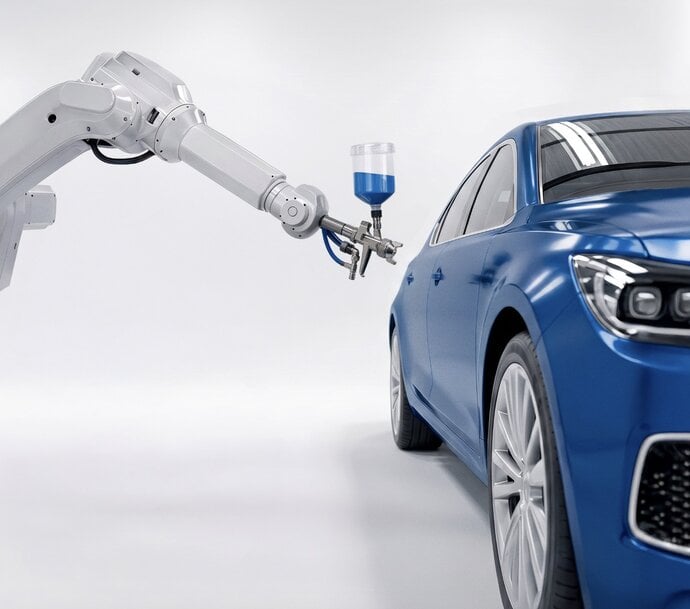
BASF Coatings is strengthening its role in robotics-enabled Automotive Refinish by combining coatings expertise, digital colour management and application process know-how. Through close collaboration with OEMs and automation partners, the company aims to help shape the future of automated paint application in body shops.
The implementation of robotics-enabled hardware architectures serves as a primary method for stabilizing process parameters within industrial collision repair and refinishing facilities. Manual paint application frequently introduces micro-scale film variations, excessive chemical overspray, and extended fluid curing intervals, which together impact material throughput and baseline quality control. To rectify these operational variables, comprehensive coating ecosystems are linking automated trajectory controls with unified color analytics databases, enabling body shops to execute consistent multi-layer liquid deployments across varied automotive structural configurations.
Software-Driven Atomization Dynamics and Multi-Layer Coating Control
Replicating factory-applied optical finishes on high-volume replacement panels requires precise control over pneumatic fluid atomization, atomizing air pressures, and spray-gun path velocities. The deployment of robotics-enabled refinish workflows addresses these technical challenges by translating digital styling metrics into precise, repeatable physical execution paths. The automated framework controls the continuous pneumatic output of high-volume low-pressure spray nozzles directly at the manipulator wrist, allowing facilities to achieve uniform material distribution over complex geometric vehicle contours.
To ensure long-term protective and structural performance, the fluid transport loop manages distinct chemical layers sequentially across raw or repaired substrates. By regulating spray overlap margins and maintaining fixed gun-to-panel distances, the hardware interface minimizes localized film build spikes, directly reducing overall chemical consumption per vehicle segment.
Scalable Process Models and Future Refinish Evolution
Modern automated refinishing setups are architecturally engineered to process full vehicle parts, optimizing turnaround schedules for standard fleet repairs. By establishing high-speed, repeatable application standards, commercial body shops can systematically process multiple sequential panels without encountering typical manual spray variations or paint thickness drifts. This systematic processing layout allows collision centers to expand their commercial capacity while providing automobile manufacturers with predictable refinish standards globally.
As automated application methods continue to mature, the underlying software logic is scaling to manage more delicate structural tasks, including localized spot blending and detailed interior masking. By replacing manual variables with verified, hardware-enforced fluid dynamics, collision repair operations can transition smoothly into fully connected, data-driven workspaces. This approach allows body shop managers to optimize material consumption and improve workforce utilization metrics across long operational horizons.
Additional Context
This section details technical specifications and competitive benchmarking not included in the original news release.
Industrial automotive refinishing is evaluated using specific performance criteria focused on total applied dry film thickness variance (measured in microns), Transfer Efficiency percentages, and positional repeatability tolerances. Manual refinish spray operations typically exhibit a high film thickness variance spanning plus or minus 25 µm across a single flat body panel, which can lead to premature coating delamination, solvent popping defects, or visible colour mismatches along adjacent doors and sills.
The BASF Coatings integration framework modifies this performance baseline by pairing the Refinity digital database with automated multi-axis articulation controls. While traditional manual high-volume low-pressure spray guns cap their overall Transfer Efficiency between 45 and 55 percent due to unregulated air-shaping turbulence, the automated spray paths calibrated under this system optimize fluid dynamics to push Transfer Efficiency past a 65 to 70 percent threshold. This reduction in environmental overspray lowers voc emission mass metrics while extending the service lifecycles of dry-filter particulate extraction walls inside modern spray booths.
A comparative evaluation with alternative automated refinishing concepts highlights distinct technical differences across this sector:
- PaintGo Intelligent Spray Painting Robot: The PaintGo platform utilizes a mobile track chassis and integrated lidar scanners to map vehicle bodies autonomously on site, executing standalone refinish repairs without prior programming. However, its control loop operates as an isolated mechanical asset that lacks a native link to an end-to-end cloud business ecosystem, leaving it without the real-time pigment matching and automated inventory tracking provided by the Refinity network.
- Maxi-Miser High-Precision Spray Systems: This architecture utilizes high-definition auxiliary turbine sprayers to achieve smooth paint atomization and precise thickness control. However, its manual deployment model relies entirely on human movement loops, preventing it from achieving the sub-millimeter positional repeatability and uniform layer stacking native to multi-axis articulated arm setups.
By controlling fluid viscosity parameters, atomizing air pressures, and continuous multi-layer film builds, the integrated system achieves a uniform dry film thickness baseline across complete panels. The system maintains a tight total paint layer thickness of 90 to 130 µm, comprising 20 µm of primer, 30 µm of basecoat, and 40 µm of protective clearcoat—with an internal variance of less than plus or minus 3 µm. This technical consistency ensures full compliance with original equipment manufacturer paint standards while eliminating common manual repair anomalies, setting an energy-efficient industrial standard for modern automated vehicle collision centers.
Edited by Romila DSilva, Induportals Editor, with AI assistance.
Edited by Romila DSilva, Induportals Editor, with AI assistance.
