
www.auto-innovations.net
02
'26
Written on Modified on
Drivetrain Electrification and Digital Platforms for Heavy Emergency Vehicles
ZF introduces integrated commercial vehicle drivetrains and cloud-based fleet management platforms to optimize emergency service operations and vehicle efficiency.
www.zf.com
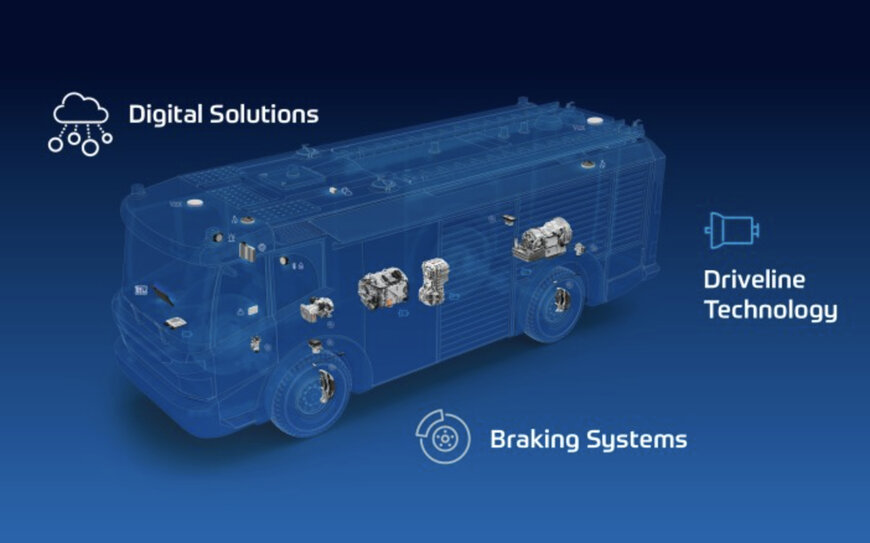
The development of specialized heavy-duty vehicle technologies and connected software platforms provides a coordinated approach to improving emergency response operations. These integrated propulsion, braking, and digital management systems serve special-purpose vehicle fleets and emergency services operating under extreme conditions.
Specialized Heavy Vehicle Propulsion and Braking Architectures
At the Interschutz exhibition in Hanover, specialized vehicle technologies designed to maintain high performance under heavy structural loads were showcased. For emission-free operations, an electric central drive system designated for heavy special-purpose vehicles delivers a continuous power output of 380 kilowatts. This compact electric drive integrates into existing internal combustion engine architectures, allowing fleet operators to transition to sustainable propulsion without redesigning vehicle chassis. For conventional combustion platforms, a seven-speed automatic transmission provides power management under frequent load changes at low speeds, while a lightweight transfer case optimized for all-wheel-drive configurations maximizes vehicle payload and reduces fuel consumption.
Vehicle deceleration and energy management are handled by a scalable compressed-air braking platform. This system manages intelligent brake force distribution for anti-lock braking and electronic stability control, integrating with modern automated driver assistance systems within the broader automotive data ecosystem. For hybrid and battery-electric platforms, the braking architecture supports energy recuperation, working alongside an oil-free scroll air compressor designed for medium- and heavy-duty fuel cell and battery-electric vehicles to ensure low-noise and maintenance-free pneumatic operation.
Automated Drivetrain Control and Cybersecurity Compliance
To maximize traction and driving stability without manual operator intervention, third-generation automatic drivetrain management fully automates differential locks based on real-time wheel slip and driving dynamics. The control hardware features advanced processing capabilities, expanded memory, and compatibility with Controller Area Network Flexible Data Rate, or CAN-FD, communication protocols to accelerate data processing speeds. Built to satisfy modern cybersecurity standards and long-term components availability requirements, the control module features elevated ingress protection ratings that permit external chassis mounting outside the vehicle cabin to withstand dust and moisture ingress.
Cloud-Based Fleet Connectivity and Centralized Data Management
Digital coordination across emergency service networks is facilitated through a modular, manufacturer-independent cloud platform designed to link vehicles, on-board equipment, field responders, and central command nodes. This digital ecosystem consolidates vehicle status tracking, mission documentation, resource mapping, and medical device management into a centralized interface. By expanding its software portfolio to include over twenty-five interconnected applications covering tactical command, routing, and fleet logistics, ZF establishes an integrated digital framework for emergency services, enabling seamless data sharing compatible with the logistics workflows of the modern digital supply chain.
Additional Context: This section details technical specifications and competitive benchmarking not included in the original product announcement
In the market for heavy-duty emergency and special-purpose vehicle drivetrains, continuous power delivery and thermal resilience form the primary benchmarks for technological evaluation. The 380-kilowatt continuous output of the electric central drive positions it as a direct competitor to specialized electric axles such as the Allison eGen Power series and systems from Dana TM4, which target similar medium- and heavy-duty commercial weight classes. While e-axle designs require a complete redesign of the rear suspension assembly, a central drive configuration allows bodybuilders to retain standard rigid or independent driven axles, lowering engineering hurdles for specialized vehicle integration.
For internal combustion powertrains, specialized automatic transmissions must withstand high torque spikes and frequent directional changes. The seven-speed architecture presented by ZF competes directly with Allison 3000 and 4000 Series transmissions, which have historically dominated the global fire apparatus and rescue vehicle sectors. The integration of advanced drivetrain management with CAN-FD interfaces allows for faster communication response times compared to older CAN-bus architectures, minimizing the time required to engage differential locks when a wheel loses traction on unstable terrain.
From a software perspective, cloud platforms for emergency services typically operate as closed, manufacturer-specific telematics solutions, such as those provided by apparatus manufacturers like Rosenbauer. The manufacturer-independent architecture of the digital ecosystem breaks these silos by aggregating data from diverse hardware brands. Integrating mechanical drivetrain diagnostics with tactical command and medical device tracking creates a comprehensive data layer. This approach mirrors the predictive maintenance and resource allocation strategies utilized in commercial transport networks, translating commercial logistics efficiency into critical emergency response operations.
Edited by Maria Brueva, Induportals editor – adapted by AI.
www.zf.com
