
www.auto-innovations.net
10
'26
Written on Modified on
Valeo and Calyos Partner on Advanced Two-Phase Chip Cooling Solutions
Joint agreement establishes cooperative development and industrialization of standalone passive thermal systems for mobility and computing infrastructure.
www.valeo.com
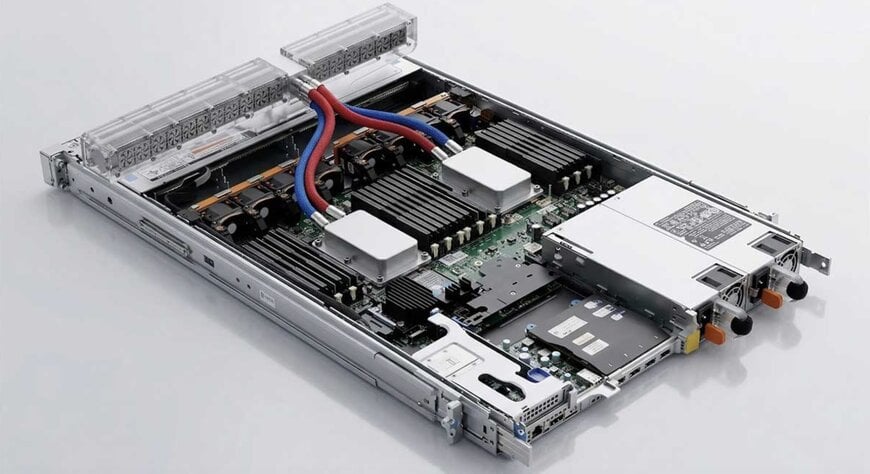
Valeo and Calyos have signed a Memorandum of Understanding (MoU) to develop and industrialize high-performance, standalone chip cooling systems. The partnership applies passive two-phase Loop Heat Pipe (LHP) technology to address rising thermal loads generated by electrification and Artificial Intelligence (AI) across the automotive and data center sectors.
Context of the Cooperation
The collaboration pairs the thermal systems engineering, high-volume production capacity, and global footprint of Valeo with the specialized loop heat pipe technology developed by Calyos. The agreement addresses the exponential growth of heat generation and computing power density found in Software-Defined Vehicles (SDVs), automotive power electronics, and AI-accelerated data processing facilities.
Cooperation is required to bridge advanced thermal innovation with large-scale industrial manufacturing. Combining these capabilities enables the transformation of specialized two-phase heat transfer designs into production-ready, globally accessible components that resolve modern power-delivery and heat-dissipation challenges.
Technical Solution and Responsibilities
The core technical solution relies on a passive advanced two-phase loop heat pipe system that operates entirely without active moving parts such as a fluid pump. The system manages high heat flux and density by utilizing the latent heat of vaporization to transfer thermal loads away from high-speed processors and localized hot spots.
Responsibilities are divided between the partners to leverage their specific expertise. Calyos provides the underlying Loop Heat Pipe technology, design knowledge, and innovation framework. Valeo is responsible for the system-level thermal engineering, validation of long-term reliability, and global high-volume production using a "local-for-local" manufacturing strategy.
The resulting compact, standalone "plug-and-play" modules function under lower internal dielectric fluid pressure than traditional options. This design choice simplifies vehicle or server architectures, reduces space requirements, and minimizes the physical risks associated with fluid leaks.
Deployment or Implementation
The integrated cooling solutions are slated for deployment in distinct vehicle and computing infrastructures:
- Power Electronics: The standalone systems provide autonomous thermal management for On-Board Chargers (OBC), inverters, and multi-functional "x-in-1" integrated automotive power electronics.
- Software-Defined Vehicles: The compact modules dissipate heat directly from centralized computing controllers and high-speed processors, eliminating the routing complexity of distributed vehicle liquid cooling loops.
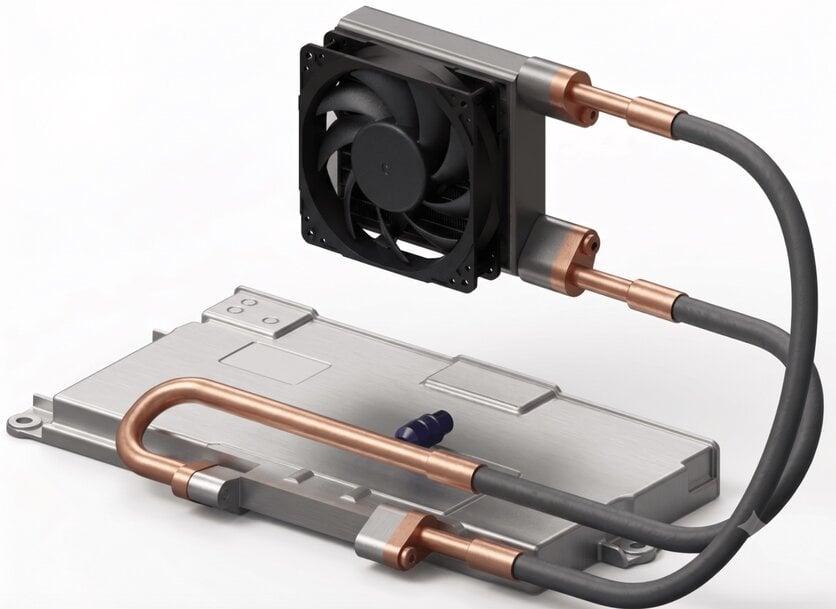
- Data Center Servers: The technology is formatted as standalone, individual two-phase air-cooled units that fit directly onto servers within a standard rack. This configuration permits facilities to upgrade power density via direct-to-chip cooling as a straightforward retrofit, without requiring an overhaul of the existing baseline building infrastructure.
The technology serves as a modular addition to an existing data center cooling product portfolio that includes rear door aluminum heat exchanger cooling modules (RDHx), single-phase and two-phase cooling distribution units (CDUs), and immersive cooling setups for edge data centers.
Additional Context
This section details technical specifications not included in the original news release.
Thermal management in high-density computing and industrial hardware has traditionally relied on conventional air cooling, single-phase liquid cold plates, or full immersion cooling systems. Traditional air-cooled heat sinks are constrained by the physical surface area available directly atop a processor, capping heat dissipation capabilities. Single-phase cold plate liquid systems require mechanical pumps to actively circulate water or dielectric fluids directly into the server chassis, which introduces moving points of failure, parasitic energy consumption, and high operational pressures that increase the risk of internal leakage. Immersion cooling yields high thermal performance but demands specialized fluid containment tanks and a complete redesign of facility infrastructure, resulting in high capital costs.
Flat loop heat pipe (FLHP) alternatives optimize heat transfer by relocating the primary heat exchange area away from the constrained space of the processor chip to unconstrained zones within the chassis. This passive mechanism uses vaporization and capillary action to move thermal energy across distances without mechanical assistance.
At a product performance level, passive loop heat pipe configurations demonstrate significantly higher heat transfer efficiencies than traditional methods. Testing indicates that loop heat pipe systems can achieve thermal resistances as low as 0.083 °C/W to 0.29 °C/W depending on the layout, permitting individual units to handle thermal loads exceeding 600 to 750 Watts without encountering thermal runaway. This represents a measured chip-level heat transfer efficiency increase of approximately 166% over standard air cooling products and 41% over single-phase pumped liquid cooling alternatives under comparable operating parameters, directly lowering facility Power Usage Effectiveness (PUE).
Edited by Romila DSilva, Induportals Editor, with AI assistance.
Valeo controller with 2-Phase passive cooling system
Additional Context
This section details technical specifications not included in the original news release.
Thermal management in high-density computing and industrial hardware has traditionally relied on conventional air cooling, single-phase liquid cold plates, or full immersion cooling systems. Traditional air-cooled heat sinks are constrained by the physical surface area available directly atop a processor, capping heat dissipation capabilities. Single-phase cold plate liquid systems require mechanical pumps to actively circulate water or dielectric fluids directly into the server chassis, which introduces moving points of failure, parasitic energy consumption, and high operational pressures that increase the risk of internal leakage. Immersion cooling yields high thermal performance but demands specialized fluid containment tanks and a complete redesign of facility infrastructure, resulting in high capital costs.
Flat loop heat pipe (FLHP) alternatives optimize heat transfer by relocating the primary heat exchange area away from the constrained space of the processor chip to unconstrained zones within the chassis. This passive mechanism uses vaporization and capillary action to move thermal energy across distances without mechanical assistance.
At a product performance level, passive loop heat pipe configurations demonstrate significantly higher heat transfer efficiencies than traditional methods. Testing indicates that loop heat pipe systems can achieve thermal resistances as low as 0.083 °C/W to 0.29 °C/W depending on the layout, permitting individual units to handle thermal loads exceeding 600 to 750 Watts without encountering thermal runaway. This represents a measured chip-level heat transfer efficiency increase of approximately 166% over standard air cooling products and 41% over single-phase pumped liquid cooling alternatives under comparable operating parameters, directly lowering facility Power Usage Effectiveness (PUE).
Edited by Romila DSilva, Induportals Editor, with AI assistance.
