
www.auto-innovations.net
17
'26
Written on Modified on
Atlas Copco Launches Common Control Platform for Automotive Assembly
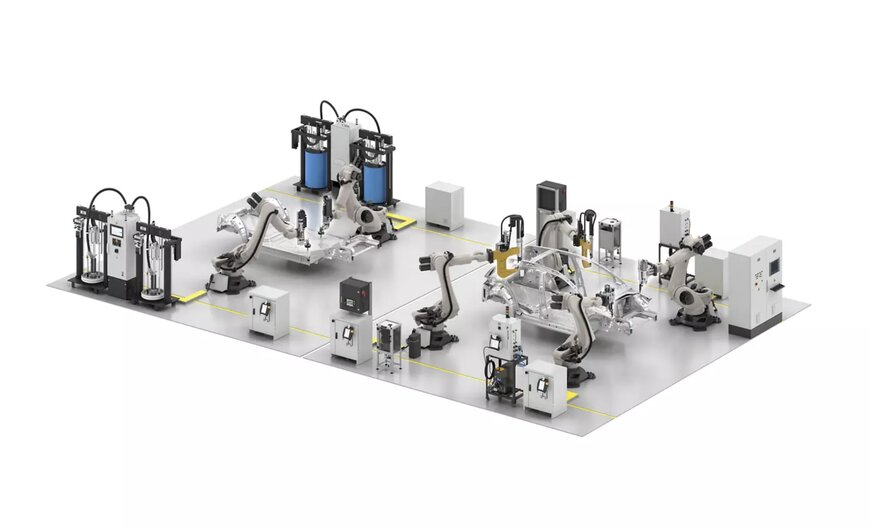
Consolidating multiple joining technologies with the Common Control Platform simplifies system architecture, reduces integration complexity, and ensures consistent performance across applications.
www.atlascopco.com

Atlas Copco has introduced its Common Control Platform to transform automated production lines for automotive manufacturers, particularly in electric vehicle (EV) and battery assembly, by unifying multiple assembly technologies within a single interface.
Operational Efficiency and Line Integration
For automotive original equipment manufacturers (OEMs) managing hundreds of systems across a production line, this platform directly addresses core production challenges, including the need for increased productivity to remain globally competitive, leaner production solutions with faster applications, and reduced floor space requirements. The unified control platform accelerates the deployment of new systems or line modifications while lowering required training. Additionally, centralised monitoring enables predictive maintenance and quicker fault identification to improve uptime and minimise downtime.
Standardisation and Unified HMI
To ensure stability across stations—critical for quality assurance in high-volume automotive production—the platform provides standardised control logic via a common motherboard. The system utilises a web-based, no-installation Human Machine Interface (HMI) featuring light and dark modes and intuitive navigation. This unified HMI delivers a consistent user experience across various Atlas Copco joining technologies, including Henrob self-pierce riveting and K-Flow flow drill fastening. It also unifies dispensing, potting, and bonding solutions from the SCA and Scheugenpflug product lines, alongside their respective machine vision portfolios, lowering user errors and reducing training time for operators.
Data Architecture and Connectivity
The transformation platform is built on a Common Data Model, which provides a unified data structure that enables seamless integration with Manufacturing Execution Systems (MES), data lakes, or customer-specific applications. Through the Atlas Copco ACDC Unify solution, the system delivers a single access point, an application programming interface (API), and a normalized data model across all controllers, thereby reducing engineering workloads and preventing integration errors.
By standardizing and structuring data directly at the source, this solution establishes a foundation for advanced analytics, such as the Atlas Copco ALTURE system, and allows for the integration of artificial intelligence and machine learning applications throughout the production ecosystem. It supports standard open interfaces, including OPC UA and MQTT, to simplify plant connectivity and provide a scalable base for comprehensive process traceability.
Industrial Cybersecurity Framework
Developed in accordance with the IEC 62443 series of international standards for the cybersecurity of Industrial Automation and Control Systems (IACS), the platform incorporates a modular security framework. It complies with the EU Machinery Regulation 2023/1230 by 2027 and supports the EU-wide NIS2 Directive (EU 2022/2555) for cybersecurity. Furthermore, the secure-by-design approach and standardised software stack support the EU Cyber Resilience Act (CRA) and the Radio Equipment Directive (RED). The platform implements secure communication protocols across devices, alongside centralised access control and user management, protecting production continuity and sensitive manufacturing data by reducing the surface for cyber threats.
Additional Context
This section details technical specifications not included in the original news release.
Industrial automated assembly lines for electric vehicle (EV) battery packs and automotive bodies require multiple distinct joining methodologies to handle mixed-material combinations, such as bonding aluminum components to ultra-high-strength steel frames. Self-pierce riveting involves cold-pressing a semi-tubular rivet into the material layers, causing the rivet to flare out within the bottom sheet without penetrating it, creating a robust mechanical interlock. Flow drill fastening uses a rotating fastener driven at high speed to locally heat and plasticize the metal sheets, forming a threaded hole into which the fastener is subsequently driven. Dispensing technology handles highly viscous structural adhesives or thermal interface materials used for cell-to-pack heat dissipation, which demands precise volumetric flow rate monitoring via closed-loop hydraulic dosing systems and real-time 3D machine vision inspection to detect bead discontinuities.
Standardizing data exchange across these heterogeneous joining processes relies on open communication architectures. OPC Unified Architecture provides an object-oriented information model that encapsulates complex machine states, variables, and alarms into semantic data structures, allowing seamless interoperability between different industrial fieldbuses and upper-level Manufacturing Execution Systems. MQTT operates on a lightweight publish-subscribe transport protocol optimized for high-latency or restricted network channels, allowing structured JSON payloads of manufacturing metrics to be pushed continuously to cloud-hosted data lakes for predictive quality analytics. On the security front, compliance with IEC 62443 requires a defense-in-depth approach, organizing the automated factory network into distinct security zones and conduits. This structural isolation restricts unauthorized lateral movement across the industrial network by enforcing role-based access control, cryptographic device authentication, and encrypted data transmission protocols.
Edited by Romila DSilva, Induportals Editor, with AI assistance.
www.atlascopco.com
