
www.auto-innovations.net
19
'26
Written on Modified on
Software-Defined Control Architectures for Commercial Vehicles and City Buses
ZF presents modular electronic architectures and active safety ecosystems for commercial vehicles ahead of IAA 2026.
www.zf.com
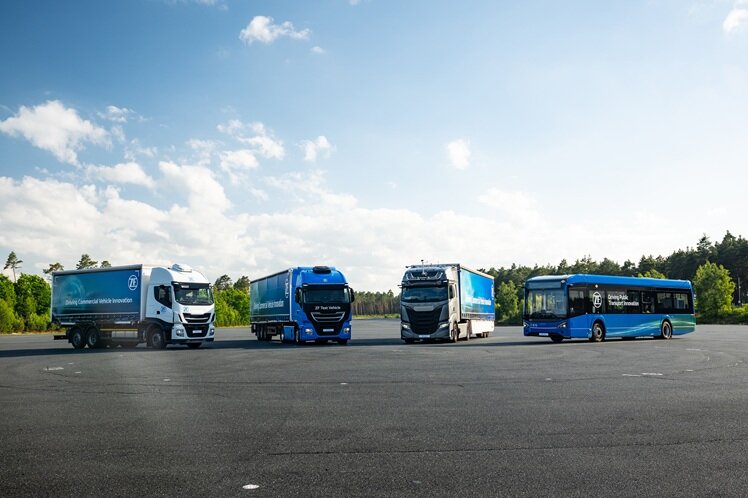
ZF has previewed its latest software-defined vehicle platforms for trucks and city buses ahead of the IAA Transportation 2026 exhibition. The showcased technologies integrate advanced driver assistance systems (ADAS), modular electric drivelines, and service-oriented electronic architectures to support the evolutionary transition of commercial fleets.
Electronic Architecture and Software Integration
The presented technology framework transitions commercial vehicles into upgradeable platforms through modular electrical/electronic (E/E) architectures. By separating hardware from software functionalities, OEMs can introduce continuous lifecycle improvements such as predictive maintenance algorithms and enhanced sensor processing. This structured approach allows fleets to deploy new software capabilities without requiring fundamental changes to the underlying mechanical or electrical hardware.
Integrated Safety and Urban Bus Systems
The platform consolidates steering, braking, and ADAS into a unified 360-degree safety ecosystem that encompasses both the truck and trailer. By fusing radar and camera data, the system eliminates blind spots and supports driver monitoring, reverse assistance, and emergency vehicle detection. For public transport applications, specific software integrations such as City Bus Assist optimize bus stop approaches, while the CDC Skyhook system continuously adjusts suspension damping to stabilize the chassis in dense urban environments.
Modular Driveline Electrification
To address the decarbonization of heavy transport, the architecture supports a scalable pathway from hybrid powertrains to fully electric driveline systems. This modularity allows manufacturers to electrify existing vehicle platforms incrementally, reducing initial development overhead while optimizing energy consumption and total cost of ownership across diverse operational profiles.
Additional Context: This section details technical specifications and regulatory standards not included in the original announcement
In the context of software-defined commercial vehicles (SdCV), the transition from traditional signal-based control to Service-Oriented Architectures (SOA) is a critical engineering hurdle. SOA utilizes middleware and standardized Application Programming Interfaces (APIs) to decouple specific functions—like the parking brake or automated wheel chocks—from the central ECU, allowing for seamless Vehicle-to-Infrastructure (V2I) communication in automated logistics yards. Furthermore, as commercial vehicles become increasingly software-dependent, manufacturers must comply with the UNECE R156 regulation, which mandates strict Software Update Management Systems (SUMS) starting in July 2026. ZF's architecture is engineered to support these over-the-air (OTA) updates compliantly, utilizing an ISO 24089-certified framework to ensure cyber-secure, audit-ready parameter changes for critical braking and chassis systems throughout the vehicle's lifecycle.
Edited by Lekshman Ramdas, Induportals editor – adapted by AI.
www.zf.com
