
www.auto-innovations.net
27
'26
Written on Modified on
Cementex Releases Insulated Battery Tools for Electric Vehicles
The double-insulated hand tools are designed for maintenance in the hybrid and electric vehicle stored energy sectors.
www.cementexusa.com
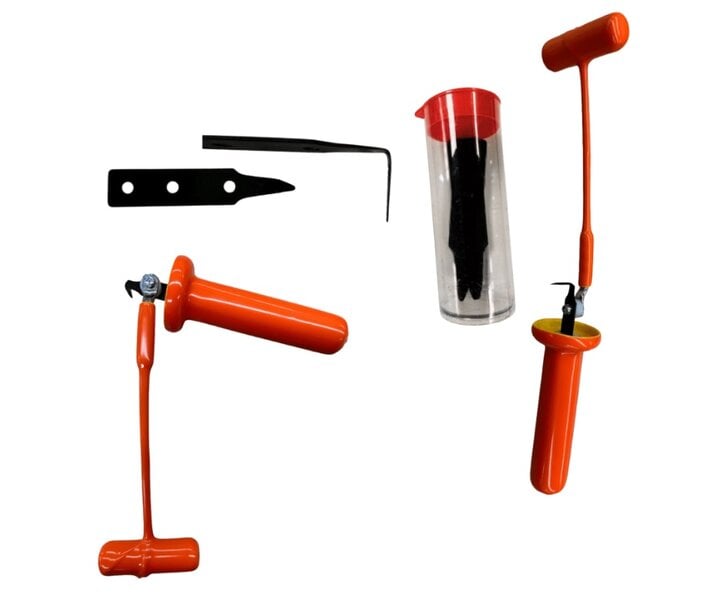
Cementex has introduced a new series of double-insulated hand tools, including Battery Openers and an EV Battery Seal Breaker, intended for technicians servicing high-voltage battery systems.
Design and Mechanical Features
The new tool portfolio is engineered to access enclosed battery compartments without damaging internal components during testing and maintenance procedures. The specific configurations include:
- Battery Lid Poppers: Available in multiple blade sizes to accommodate different battery enclosure dimensions and configurations.
- EV Battery Seal Breaker: Features a radiused, serrated blade designed to reduce cutting resistance when breaking seals on electric vehicle batteries. The tool operates via a pull-cable mechanism and includes three interchangeable blades to maintain cutting parameters over extended use.
- Valve Shroud Remover: Specifically dimensioned and configured for compatibility with Deka Unigy batteries to detach shrouds without component interference.
Electrical Ratings and Safety Standards
Manufactured in the United States using domestic and globally sourced materials, the tools integrate double insulation technology for high-voltage protection. Each unit is tested to 10,000 volts and certified for live-wire applications up to 1,000 VAC and 1,500 VDC. The equipment is manufactured in compliance with IEC 60900 and ASTM F1505 specifications. Utilizing these tools assists facilities and maintenance professionals in adhering to OSHA safety-related work practices, the NFPA 70E standard, and CSA-Z462 regulatory requirements.
Additional Context
This section details technical specifications and competitive benchmarking not included in the original product announcement.
In the high-voltage EV servicing market, tool insulation standards such as ASTM F1505 require dielectric testing up to 10,000 VAC to ensure a safe working threshold of 1,000 VAC. The Cementex tools differentiate themselves from competitors like Wiha and OEL by utilizing a proprietary two-layer composite coating: a yellow inner layer and an orange outer layer. This dual-color system acts as a built-in visual wear indicator; if the outer orange layer is compromised and the yellow layer becomes visible, the tool is no longer safe for live-wire use and must be retired. This safety feature addresses the stringent inspection protocols mandated by NFPA 70E and OSHA regulations for personnel operating within the limited approach boundary of energized systems.
Edited by Lekshman Ramdas, Induportals editor – adapted by AI.
Manufactured in the United States using domestic and globally sourced materials, the tools integrate double insulation technology for high-voltage protection. Each unit is tested to 10,000 volts and certified for live-wire applications up to 1,000 VAC and 1,500 VDC. The equipment is manufactured in compliance with IEC 60900 and ASTM F1505 specifications. Utilizing these tools assists facilities and maintenance professionals in adhering to OSHA safety-related work practices, the NFPA 70E standard, and CSA-Z462 regulatory requirements.
Additional Context
This section details technical specifications and competitive benchmarking not included in the original product announcement.
In the high-voltage EV servicing market, tool insulation standards such as ASTM F1505 require dielectric testing up to 10,000 VAC to ensure a safe working threshold of 1,000 VAC. The Cementex tools differentiate themselves from competitors like Wiha and OEL by utilizing a proprietary two-layer composite coating: a yellow inner layer and an orange outer layer. This dual-color system acts as a built-in visual wear indicator; if the outer orange layer is compromised and the yellow layer becomes visible, the tool is no longer safe for live-wire use and must be retired. This safety feature addresses the stringent inspection protocols mandated by NFPA 70E and OSHA regulations for personnel operating within the limited approach boundary of energized systems.
Edited by Lekshman Ramdas, Induportals editor – adapted by AI.
