
www.auto-innovations.net
17
'26
Written on Modified on
Heavy-Duty Commercial Vehicle Air Disc Brake Systems
ZF develops single-piston braking architecture engineered to lower particulate matter emissions and simplify fleet maintenance across global heavy-duty commercial vehicle platforms.
www.zf.com
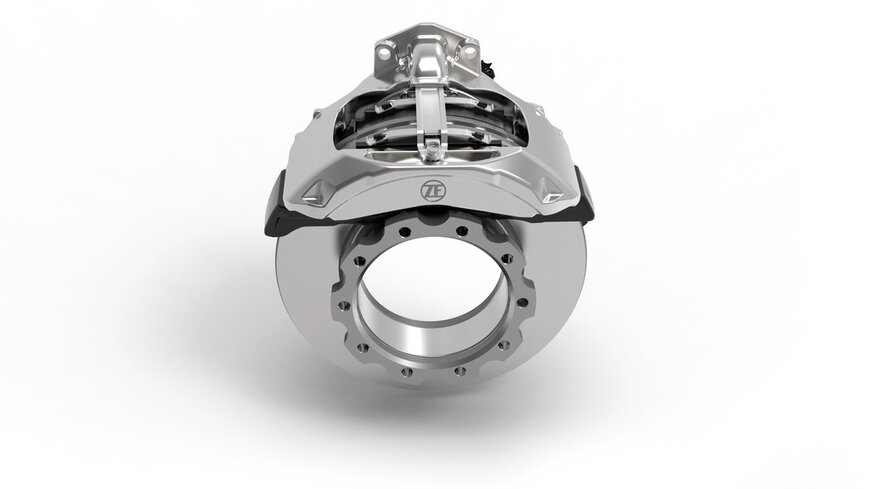
Single-piston air disc brake technology designed by ZF addresses forthcoming EURO 7 environmental standards for heavy-duty commercial vehicles. The modular system supplies up to 30,000 Nm of brake torque to meet the operational demands of long-haul freight, distribution, and construction transport.
Regulatory Compliance Through Particle Emission Reduction
Brake wear contributes significantly to non-exhaust road traffic emissions, an area targeted directly by the European Union under the EURO 7 regulatory framework. When paired with a specially coated rotor, the single-piston architecture cuts brake-particle emissions by up to 65 percent. This reduction enables original equipment manufacturers to fulfill strict particulate thresholds without compromising deceleration performance under heavy load cycles. The platform supports integration into conventional internal combustion, hybrid, and battery-electric heavy commercial vehicles, allowing manufacturers to standardize axle assemblies across varying powertrain configurations.
Mechanical Architecture and Wear Management
The mechanical layout relies on a single-piston mechanism that minimizes overall part count to maximize structural reliability and reduce chassis weight. A bi-directional mechanical adjuster maintains precise running clearance between the friction material and the rotor surface. This mechanism prevents overadjustment, mitigates localized thermal stress, and ensures uniform pad wear across the entire friction surface under severe duty cycles.
Fleet Maintenance and Diagnostic Integration
Operational availability is supported through a revised pad retention system and brake carrier geometry, which shortens service intervals during friction material replacement. For predictive maintenance, the unit accommodates a continuous wear sensor that functions on a plug-and-play basis without requiring mechanical calibration. Sealed against particulate ingress and environmental contamination, the sensor transmits real-time lining wear data directly to vehicle telematics units. Series production of the braking platform is scheduled to commence in 2027.
Additional Context
This section details technical specifications and competitive benchmarking not included in the original product announcement.
Heavy commercial vehicle air disc brakes (ADBs) operate under rigorous thermal and mechanical constraints, where standardized performance benchmarks include clamping force, thermal dissipation, mechanical efficiency, and mass optimization. In the commercial vehicle sector, single-piston floating caliper designs compete primarily with dual-piston floating caliper systems, such as the Knorr-Bremse ProTecS and Meritor ELSA series.
While dual-piston configurations distribute clamping pressure across larger friction pad areas to mitigate taper wear on wide-profile pads, single-piston architectures achieve comparable stability with fewer moving parts, reducing caliper weight and internal friction losses. A critical benchmark under EURO 7 testing procedures is the standardized cycle (PMP/UNECE framework) quantifying particulate matter mass (PM10 and PM2.5) and particle number (PN). The use of hard-faced or laser-clad coated rotors, as utilized in this system, forms an established benchmark alongside low-metallic or copper-free friction formulations to prevent surface micro-welding and limit non-exhaust particulate generation below conventional grey cast-iron baseline levels.
Edited by Evgeny Churilov, Induportals Media - Adapted by AI.
www.zf.com
