
www.auto-innovations.net
19
'26
Written on Modified on
Industrial Automation Architecture for Software-Defined Factories
Hyundai Motor and Kia present smart factory technologies to resolve data fragmentation and standardise automated vehicle inspection at Uiwang Research Institute.
www.hyundaimotorgroup.com
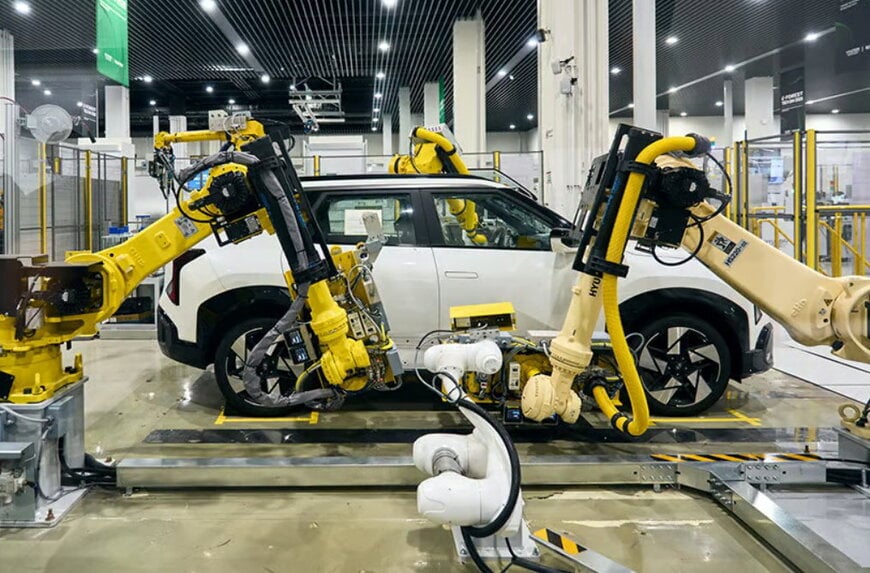
E-FOREST TECH DAY 2026 takes place from October 19 to 21 at the Hyundai Motor and Kia Uiwang Research Institute, presenting manufacturing solutions and automation architectures designed for software-defined factories across global automotive production facilities.
Core Technology and System Architecture
The core architecture relies on a unified industrial data collection and management framework integrated with a shared software development environment. This technical structure standardises interface protocols across disparate machinery, enabling modular deployment of digital twin simulations and domain-specific artificial intelligence agents. The digital twin subsystem models physical floor equipment inside virtual environments to execute predictive collision and cycle tests prior to line commissioning. Machine-level AI agents query operational databases directly, generate standardised equipment manuals, and automate diagnostics. Quality assurance relies on a proprietary tunnel-type vision inspection system that executes three-dimensional simulation sweeps to detect dimensional and surface anomalies on finished assemblies.
Deployment and Implementation
Systems undergo testing and pre-commissioning at the Uiwang Research Institute facility before rollout across domestic and overseas assembly lines. Implementation follows a staged architectural framework where foundational software-defined factory systems integrate directly into existing programmable logic controllers and legacy shop-floor execution environments. Hyundai Motor Group, Kia, and tier-one automation partners coordinate development through joint technical seminars, ensuring communication protocols remain uniform across physical robotics, additive manufacturing hardware, and facility energy management networks.
Industry Applications
Automotive vehicle manufacturing serves as the primary technical sector for these deployments. Core applications include automated final-stage exterior paint inspection, mold-free additive manufacturing for low-volume structural parts, and automated tooling reconfiguration. These systems stabilise overall takt times, mitigate equipment downtime through virtual line validation, and isolate defect propagation early in the physical assembly phase.
Operational Impact and Performance Metrics
The architectural transition replaces isolated proprietary third-party vision systems with a single standardized inspection protocol, reducing maintenance overhead and data latency across multi-site production networks. Digital twin validation eliminates physical trial runs, mitigating the risk of tooling collisions and component scrap during retooling. Process energy management solutions monitor machine idle states to minimise electrical load variance, while mold-free additive processes shorten prototype tooling iterations.
"We will keep working to expand the use of these new technologies in our production plants and put them into practice on the factory floor." – Hyun Chul Cho, Vice President and Head of E-FOREST Strategy Group, Hyundai Motor Group
Edited by Evgeny Churilov, Induportals Media - Adapted by AI.
www.hyundaimotorgroup.com
