
www.auto-innovations.net
03
'26
Written on Modified on
Integrated Extra-Low-Voltage Drive Architecture for Battery-Powered Automated Guided Vehicles
Siemens introduced the Sinamics E210 converter and Simotics E-1EE1 servomotors to solve integration and safety challenges in mobile robotics.
www.siemens.com
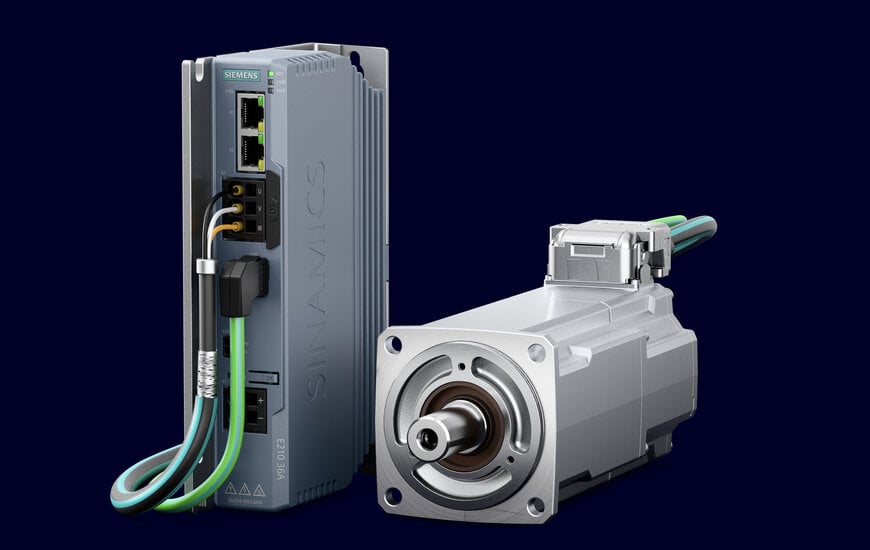
Battery-powered intralogistics platforms require compact drive hardware capable of operating directly from onboard DC sources while maintaining strict functional safety and motion precision. Addressing these operational demands, Siemens has introduced an integrated extra-low-voltage drive system consisting of the Sinamics E210 converter and Simotics E-1EE1 servomotors, designed specifically for automated guided vehicles, autonomous mobile robots, and driverless transport platforms.
Industrial Mobile Robotics Drive System Architecture
Automated guided vehicles and autonomous mobile robots operate under severe spatial, thermal, and electrical constraints. Conventional motion setups frequently rely on multi-component drive configurations requiring intermediate DC-DC converters to interface standard servo drives with 24 V or 48 V industrial battery packs. This approach introduces conversion losses, adds wiring complexity, and increases failure points across vehicle chassis.
The Sinamics E210 converter eliminates intermediate voltage conversion hardware by connecting directly to 24 V and 48 V direct-current power supplies. As a regenerative converter, the unit returns kinetic energy to the battery system during deceleration phases, improving overall vehicle operating range and electrical efficiency. The drive controls main traction and steering wheel assemblies as well as secondary axes, including mechanical lifting mechanisms and integrated auxiliary tooling.
Deterministic Communication and Functional Safety Integration
Mobile robotics deployed across modern warehouses and manufacturing plants must adhere to strict functional safety standards to prevent collisions in shared human-robot work zones. The Sinamics E210 incorporates native functional safety support over industrial Ethernet through PROFIsafe alongside PROFINET IRT (Isochronous Real-Time) communication.
Deterministic network cycle times ensure tightly synchronized multi-axis coordination for differential and omnidirectional kinematic steering configurations. Engineering commissioning is handled natively within the Siemens TIA Portal environment and the Simove modular framework. This integration permits machine builders to standardize kinematic parameter sets, vehicle control algorithms, and safety monitoring profiles within a unified software environment, reducing development cycles for custom automated guided vehicle chassis.
Servomotor Dynamics and Dual-Channel Feedback Mechanism
Dynamic positioning across variable payload states requires matched electromechanical characteristics. The Simotics E-1EE1 servomotors expand the manufacturer portfolio into higher torque and output envelopes across shaft heights 40 to 63, engineered specifically for 24 V and 48 V extra-low-voltage applications.
Position and velocity control are managed through an integrated 14-bit absolute BiSS-C encoder. Featuring an internal dual-channel architecture, the feedback system supports functional safety implementations up to Safety Integrity Level 2 (SIL 2). Mechanical integration options include selectable planetary and angled gearboxes, optional electromechanical holding brakes for vertical load retention, and modular cabling connections suited for tight turning radii inside vehicle bodies. Automatic motor parameterization is achieved through an integrated electronic nameplate, allowing the drive converter to self-configure winding constants, rated currents, and thermal profiles upon power-up.
Operational Deployment in Automated Intralogistics
The matched drive combination targets production logistics, material handling hubs, and automotive manufacturing cells where autonomous transport fleets operate continuously. By consolidating power conversion, functional safety communication, and multi-axis motion control into an extra-low-voltage footprint, vehicle manufacturers minimize enclosure dimensions while simplifying hardware compliance certification.
Additional Context:
This section details technical specifications and competitive benchmarking not included in the original product announcement.
Low-voltage mobile automation historically relied on CANopen-based distributed drives or specialized micro-drives operating on bus standards such as EtherCAT. In automated guided vehicle designs, integrating disparate motor drives with programmable logic controllers frequently introduced engineering overhead when mapping safety functions, such as Safe Torque Off (STO) and Safely-Limited Speed (SLS) under IEC 61800-5-2.
Industrial extra-low-voltage drive solutions operate within the protective extra-low-voltage limits specified by IEC 60364-4-41, which reduces insulation and touch-hazard mitigation requirements during vehicle maintenance. Comparative low-voltage mobile drive systems typically deliver continuous output power between 100 W and 1.5 kW per axis, operating across standard nominal DC voltages of 24 V and 48 V. The adoption of industrial Ethernet protocols with integrated safety layers—such as PROFINET IRT paired with PROFIsafe—addresses the rising industrial requirement for standardized fleet diagnostics, real-time trajectory updates, and centralized safety supervisory control without dedicated hardwired safety relays.
Edited by Natania Lyngdoh, Induportals editor, with AI assistance.
www.siemens.com
