
www.auto-innovations.net
18
'26
Written on Modified on
Automotive Ethernet Switches for Software-Defined Zonal Networks
Microchip Technology introduces the LAN9324x and LAN9322x automotive Time-Sensitive Networking switch families to enable self-managed, dynamic zonal-to-compute vehicle architectures.
www.microchip.com
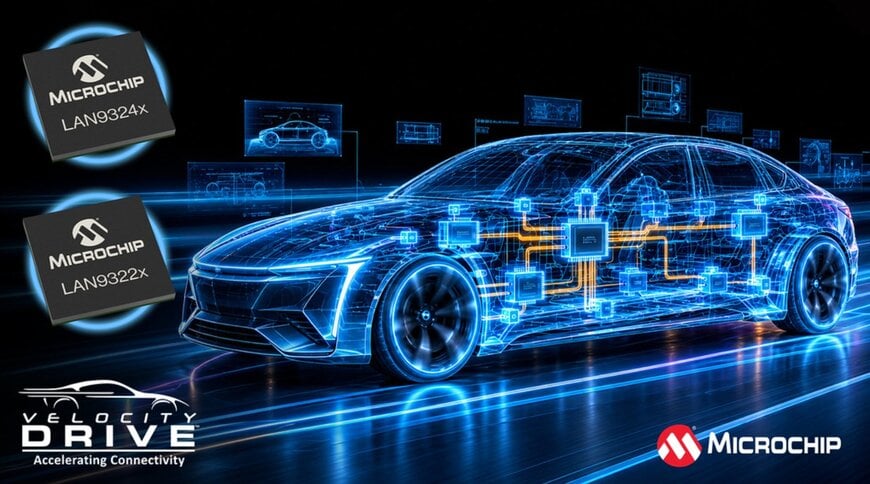
As automotive electrical and electronic architectures transition from distributed electronic control units toward centralized compute platforms and zonal networking, in-vehicle networks face escalating demands for deterministic data transport, functional safety, and cybersecurity. Legacy automotive switches frequently require OEMs and Tier-1 suppliers to develop and maintain proprietary, device-specific management software, creating long-term maintenance overhead and limiting architectural adaptability when vehicle functions are updated over the air. Resolving these networking bottlenecks requires turnkey, automotive-qualified Ethernet switch silicon capable of autonomous self-management, standards-based dynamic reconfiguration, and integrated physical-layer connectivity across varied zonal bandwidth tiers.
Scalable Zonal Architecture and Self-Managed Software
To address multi-tier in-vehicle network requirements without software fragmentation, Microchip Technology announced sampling of its LAN9324x and LAN9322x automotive-qualified Ethernet Time-Sensitive Networking (TSN) switch families. Sharing a unified hardware architecture and common software stack, the LAN9322x series targets compact edge and zonal nodes, whereas the LAN9324x series scales port density and switching throughput for high-bandwidth zonal aggregation, central compute modules, and vehicle gateways. Across both families, devices scale up to 18 external ports and 30 Gbps of total switching capacity. Drop-in device configurations integrate 10BASE-T1S, 100BASE-T1, and 1000BASE-T1 physical layer transceivers (PHYs) alongside SerDes interfaces spanning 10 Mbps to 10 Gbps, enabling hardware designers to match port counts and interface speeds to specific vehicle zones.
Rather than requiring custom low-level switch firmware development, the LAN932xx switches operate as fully self-managed devices running the VelocityDRIVE Software Platform. VelocityDRIVE implements standards-based network management utilizing IETF and IEEE YANG data models over CORECONF for local or remote configuration, telemetry monitoring, and software reuse across compatible switch silicon. Beyond static initialization, the architecture supports dynamic runtime reconfiguration, allowing vehicle networks to modify routing, bandwidth allocation, and security policies in real time to accommodate evolving functional safety and cybersecurity states.
Functional Safety, Hardware Security, and Supply Chain Resilience
Modern software-defined vehicles require deterministic packet delivery and hardware-enforced isolation to protect safety-critical control loops from network faults or external intrusion. The LAN932xx switch families comply with ISO 26262 ASIL B functional safety standards and integrate IEEE 802.1AE Media Access Control Security (MACsec) encryption across every port.
Internal compute and security functions are partitioned across dedicated processor subsystems. A dual-core Arm Cortex-R52+ processor operating in lockstep with on-chip SRAM manages real-time switching and safety tasks, complemented by an isolated Arm Cortex-M33 embedded Hardware Security Module (eHSM). To detect and mitigate anomalous network traffic at wire speed, an integrated Deep Packet Inspection (DPI) engine performs granular packet filtering and intrusion detection. Qualified to AEC-Q100 Grade 2 specifications, the devices operate across an ambient temperature range of minus 40 degrees Celsius to plus 105 degrees Celsius with a maximum junction temperature of 150 degrees Celsius. To mitigate automotive supply chain disruptions, Microchip supports the product line with geographically diverse wafer fabrication facilities and multiple back-end assembly and test sites. Development is supported by evaluation boards, reference designs, and the VelocityDRIVE Software Platform for YANG and CORECONF network validation.
Additional Context
This section details technical specifications and competitive benchmarking not included in the original product announcement.
In automotive Ethernet architectures governed by IEEE 802.1DG (TSN Profile for Automotive In-Vehicle Ethernet Communications), deterministic traffic scheduling relies on IEEE 802.1AS-2020 generalized Precision Time Protocol (gPTP) for sub-microsecond clock synchronization and IEEE 802.1Qbv time-aware shapers to prevent best-effort infotainment or diagnostic traffic from delaying safety-critical powertrain and chassis control frames. Utilizing YANG data modeling paired with CORECONF (CoAP Management Interface, defined under IETF RFC 9254) represents a shift away from heavy enterprise network management protocols like NETCONF over SSH or SNMP; CORECONF uses concise binary Concise Binary Object Representation (CBOR) payloads over Constrained Application Protocol (CoAP), minimizing memory footprint and configuration latency on resource-constrained automotive microcontrollers. Furthermore, integrating multi-drop 10BASE-T1S (IEEE 802.3cg) PHYs with Physical Layer Collision Avoidance (PLCA) directly into the zonal switch eliminates external protocol gateways, allowing low-speed edge sensors and actuators to connect directly onto the unified automotive Ethernet backbone.
Within the automotive TSN Ethernet switch semiconductor market, Microchip's LAN9324x and LAN9322x families benchmark directly against multi-gigabit automotive switch portfolios from NXP Semiconductors (such as the SJA1110 and S32J high-performance Ethernet switch families), Marvell Technology (Brightlane 88Q5072 and 88Q5152 switches), Broadcom (BCM8956x and BCM8957x series), and Infineon Technologies (AURIX-coupled Ethernet switching solutions). While competing high-port-count switches often require external host microcontrollers to run complex Layer-2/Layer-3 management stacks and proprietary APIs, Microchip differentiates the LAN932xx family by pairing lockstep Cortex-R52+ cores and an isolated Cortex-M33 eHSM with turnkey, standards-based YANG/CORECONF self-management. This reduces Tier-1 software integration overhead and streamlines over-the-air network reconfiguration in software-defined vehicle architectures.
Edited by Romila DSilva, Induportals Editor, with AI assistance.
www.microchip.com
