
www.auto-innovations.net
23
'25
Written on Modified on
ETAS signs VDA MoU to establish European open-source software ecosystem
Within the Eclipse SDV Working Group, ETAS plays a key role in the S-CORE project, which serves as a foundation for a future open-source core stack.
www.etas.com
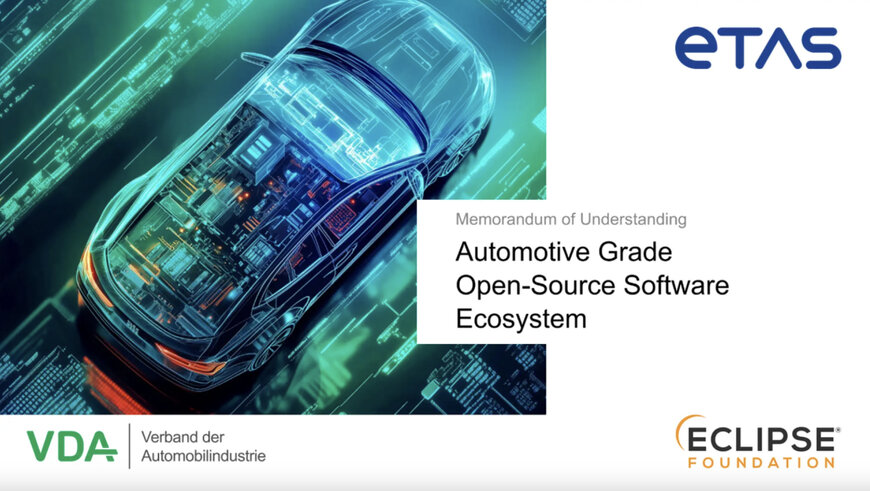
ETAS has signed the VDA Memorandum of Understanding (MoU) to establish a European open-source software ecosystem for the automotive industry and is fully supporting the S-CORE (Eclipse Safe Open Vehicle Core) project. As a founding member of Eclipse S-CORE and the Eclipse Working Group Software-defined Vehicle, ETAS is actively contributing its extensive expertise to the development and implementation of this initiative.
The automotive industry faces major challenges: vehicle software complexity continues to increase, while innovation cycles must accelerate, and costs must be reduced. In addition, there are high demands for functional safety and cybersecurity throughout the entire product lifecycle. Much of the vehicle software is non-differentiating, serving as middleware that forms the backbone for communication, authentication, and interfaces between operating systems and applications.
To address these challenges efficiently, leading companies from the automotive sector are joining forces under the MoU with the goal of creating a shared, open software ecosystem based on a secure core stack. This approach enables reduced development efforts, faster time-to-market for innovations, and strengthens Europe’s competitiveness in the global arena.
ETAS as an active driver of the S-CORE project
Within the Eclipse SDV Working Group, ETAS plays a key role in the S-CORE project, which serves as a foundation for a future open-source core stack. ETAS contributes its many years of experience in process and architecture definition, software development, integration, and technical support. Special focus is placed on meeting standards for functional safety (ISO 26262) and cybersecurity.
The initiative pursues an ambitious goal: to establish an open software ecosystem based on a code-first approach. Central to this is developing a process that enables qualification of open-source software according to ISO 26262 requirements for functional safety. Another key aspect is fostering open and collaborative partnerships between automakers, suppliers, and technology partners. Furthermore, by creating standardized software components and toolchains, a common basis for development will be established.
Last but not least, the initiative places great importance on ensuring maintenance and further development of software throughout the entire vehicle lifecycle to guarantee long-term innovation capability and security.
Important milestones have already been achieved: The initial toolchain as well as a first version of the core stack have been established; processes for secure open-source development have been defined and externally audited. By the end of 2025, an initial public implementation of key modules is planned; from 2026 onwards, full release for series projects is scheduled.
