
ZF’s Braking Evolution: Bringing a Comprehensive Brake-by-Wire Portfolio to Market
From purely electric to hybrid systems, ZF’s Brake-by-Wire solutions enhance safety, sustainability, and flexibility — paving the way for Level 4 automated driving.
www.zf.com
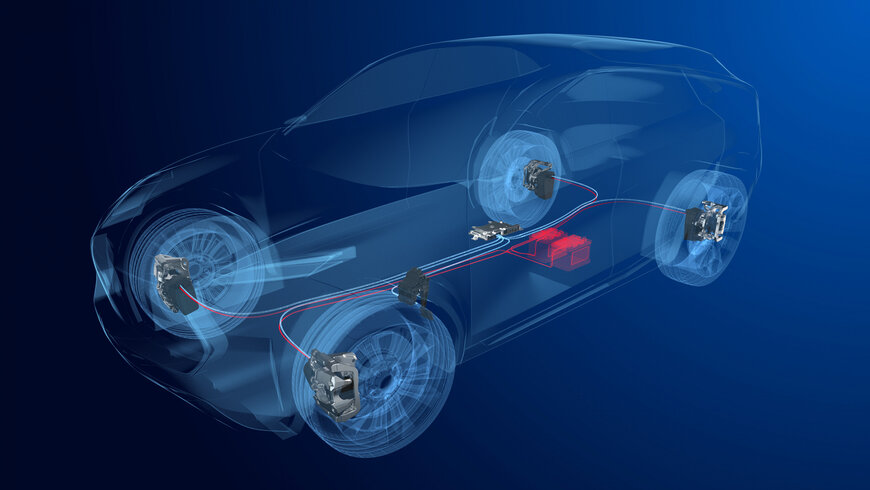
To arrive safely at your destination, you must not only accelerate but also decelerate and stop at the right moment. Ideally, the vehicle should also brake on its own if necessary, for example, when a digital emergency brake system brings a vehicle to a standstill independently if the driver is not paying attention. However, today’s braking systems no longer consist solely of hoses, pumps and mechanics, but must also be software-controlled and electrically operated. "Particularly in view of the advances in highly automated driving assistance features, electrified drives and chassis networking, there is no way around Brake-by-Wire in the long term," says Philippe Gasnier, Head of Research and Development at the Division ZF Chassis Solutions. "With our comprehensive portfolio of braking technology, we can provide vehicle manufacturers with optimum support today to realise the model platforms of tomorrow." OEMs have a flexible choice of purely electric, purely hydraulic or hybrid brake-by-wire systems, depending on market and customer requirements.
Brake-by-Wire "dry": Purely electric braking power
With a so-called "dry" BbW brake system, no brake fluid is required. The pressure with which the brake shoes grip the brake disc is no longer generated by fluids in the hydraulic system, but by electric motors located directly on the wheel. The brake signals from the pedal to the actuator are also transmitted purely electrically. The electro-mechanical brake (EMB) is therefore more responsive and enables optimised recuperation in vehicles with an electric drive, as well as lower maintenance costs. Dry by-Wire solutions have advantages over traditional hydraulic brakes, particularly in highly dynamic manoeuvres such as simultaneous braking and steering. "Modern vehicles are becoming heavier and heavier, so it is all the more important that the ideal brake pressure is built up in the shortest possible time. And this is exactly what our by-Wire systems master," summarises Danny Milot, Head of Engineering Product Line Braking.
In addition, BbW reduces the so-called residual drag torque, which occurs in conventional brake systems due to minimal contact between the brake pads and the brake discs, to almost zero ("true zero drag"). This results in even fewer particulate emissions due to brake pad abrasion. This lower resistance when driving also helps avoid energy losses when recuperating in cars with electric drives, resulting in additional range in battery electric vehicles, for example.
For manufacturers, BbW systems reduce costs and effort. Because fewer parts are required, logistics are streamlined and assembly is also simpler and faster. "Demand for such dry systems has risen sharply in recent years, particularly in the Asian market," says Gasnier. "This shows that we are on the right track with our innovations."
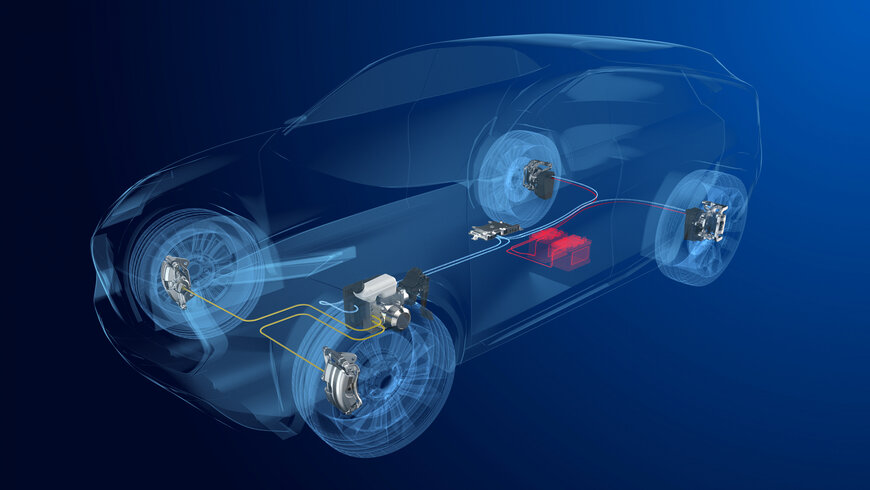
In a so-called "hybrid" system, a dry brake is mounted on one vehicle axle and a hydraulic brake on the other axle. This combination is particularly suitable for the heavy-duty light and pick-up trucks that are widely used on the American market.
Brake-by-Wire "hybrid": The best of both worlds
While the Asian market is increasingly relying on dry by-Wire brakes, so-called "hybrid" solutions are becoming established in the USA. The rear axle is usually equipped with a dry system, while a conventional hydraulic brake is used on the front axle.
This application is particularly suitable for the heavy-duty light and pick-up trucks that are widely used on the American market. For this type of vehicle, the high clamping forces required to park the vehicle on the rear axle cannot be handled by an electric parking brake (EPB) but can be handled by the electromechanical brake from the ZF portfolio. In a hybrid system, the EMB is used both as a service brake and as a parking brake. The combination of a fully integrated electro-hydraulic brake control system and an EMB eliminates the need to use a vacuum brake booster. This makes the application less complex compared to purely hydraulic systems and allows more flexibility in the development of the chassis without sacrificing the safety and performance benefits of Brake-by-Wire. In January 2025, ZF announced its first major order from a global OEM for such a hybrid system.
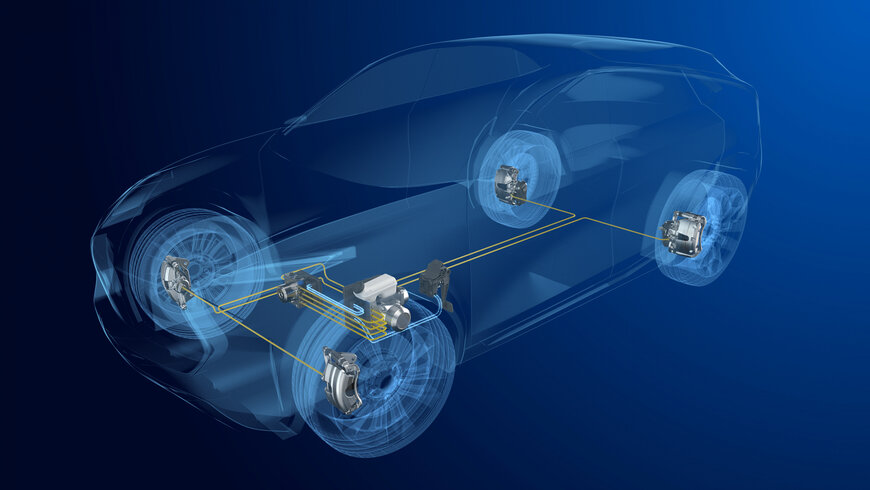
The Integrated Brake Control (IBC) is a vacuum-independent, fully integrated electro-hydraulic brake actuation control. It functions as a stability control (ESC), brake booster and, if required, also as a central electronic control unit (ECU) for all relevant driving safety and driving dynamics programs.
Integrated Brake Control: Highly integrated brake control for all vehicle types
ZF's Integrated Brake Control (IBC) is responsible for controlling the brake system for this major order. On the market since 2018, the electrohydraulic brake actuation control system has already proven itself globally in numerous series production orders. Compact, lightweight and flexibly suitable for all vehicle types and drive types from electric city runabouts to full-blown performance crossovers, it offers first-class performance in terms of responsiveness and deceleration. It functions as a stability control (ESC), brake booster and, if required, a central electronic control unit (ECU) for all relevant driving safety and driving dynamics programs. And not just for ZF software, but also for third-party providers. This could eliminate the need for separate ECUs in the vehicle.
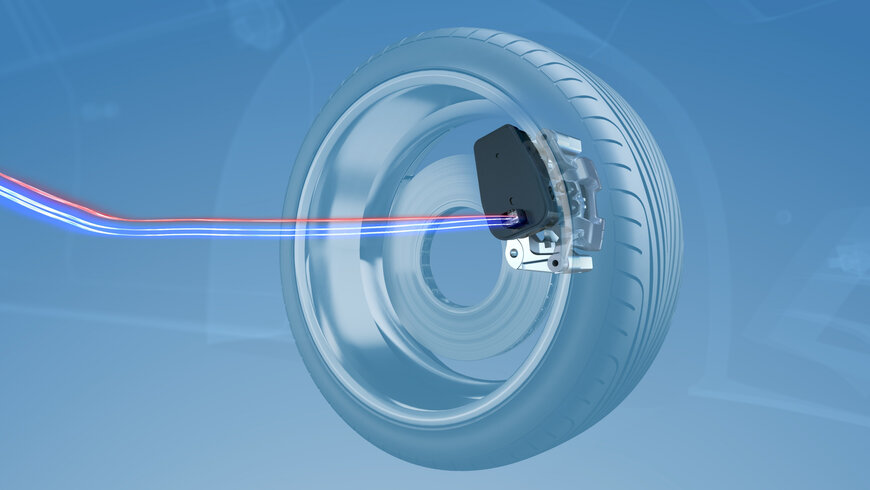
ZF's electromechanical brakes offer first-class performance for automatic emergency braking, full energy recuperation and redundant fallback options through to fully automated driving for passenger cars and light commercial vehicles.
"The combination of IBC and our Brake-by-Wire systems guarantees our customers a future-proof solution for controlling braking and driving dynamics," summarises Gasnier. "And together with our Brake-by-Wire systems, we can offer our customers a solution that is comparatively easy to integrate, even with innovative platform architectures and increasing requirements."
www.zf.com
