
The Tyranny of Linearity: How Technikol Is Redefining Race Car Steering Control
A true progressive-ratio steering rack challenges one of motorsport’s last mechanical compromises.
technikol.bg
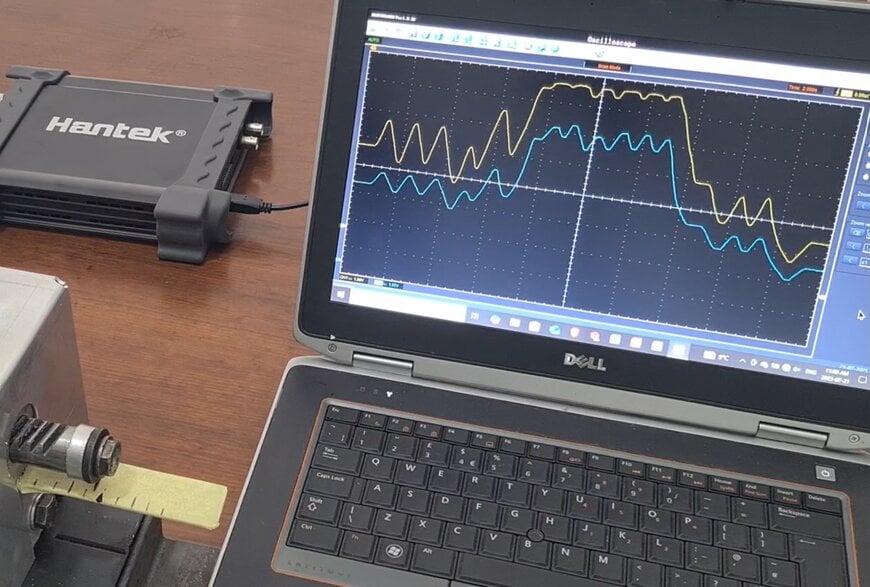
In modern motorsport, almost every performance-critical system can be finely optimized. Suspension geometry, aerodynamics, power delivery, braking systems, and even energy recovery strategies are endlessly adjustable. Yet at the heart of vehicle control, one fundamental component has remained largely unchanged: the steering system.
Even at the highest levels of racing, including Formula 1, steering relies on a conventional rack-and-pinion design that enforces a fixed, linear relationship between steering-wheel input and rack movement. It is robust and predictable—but fundamentally restrictive. The question engineers have long accepted, rather than challenged, is whether steering behavior itself can be optimized in the same way as every other system on the car.
The cost of linear steering
A fixed steering ratio forces engineers into a difficult compromise:
- Short (quick) racks improve responsiveness in tight corners but make the car excessively sensitive and unstable at high speeds above 300 km/h.
- Long (slow) racks provide stability on fast straights but blunt driver response in hairpins and increase lock-to-lock steering input.
The result is a “least-worst” solution: a steering-wheel range that satisfies safety and stability requirements but often looks awkward and uncomfortable for drivers in low-speed corners. Even in Formula 1, drivers are frequently forced into large steering-wheel rotations at hairpins because engineers cannot reduce the total steering range without making the car dangerously twitchy at top speed.
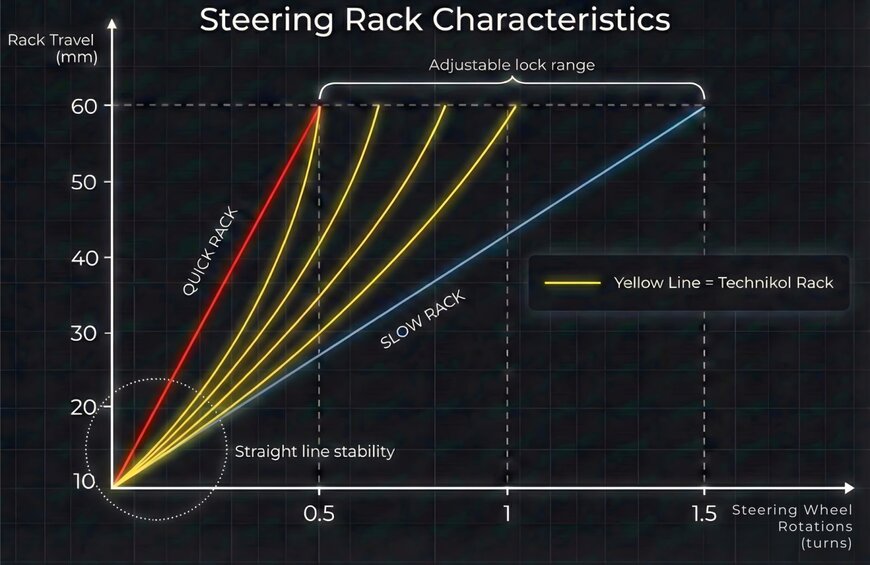
What is missing is not steering precision, but steering adaptability: a variable ratio that is stable and insensitive near center for high-speed control, and progressively more responsive as steering angle increases.
Why existing solutions fall short
So-called “progressive steering” systems already exist in passenger vehicles, but they have never gained traction in elite motorsport. These solutions typically rely on:
- Complex electronic intervention
- Rear-wheel steering overlays
- Nonlinear or radical rack tooth profiles
While effective in road cars, such systems introduce weight, complexity, latency, or regulatory challenges that make them unattractive—or outright impractical—for high-level racing. As a result, they are rarely used where steering optimization would matter most.
A mechanical breakthrough from Technikol
Technikol, a private automotive engineering venture, claims to have solved this long-standing problem with a true progressive-ratio steering rack—based not on electronics, but on pure mechanical design.
Instead of enforcing a fixed linear relationship, Technikol’s system introduces a smoothly varying, sinusoidal steering ratio that changes continuously from the center position toward full lock. The rack is engineered to behave like a traditional slow rack near zero steering angle, delivering the stability required at extreme speeds. As steering input increases, the rack output progressively accelerates, allowing the wheels to reach full steering angle with significantly less steering-wheel rotation.
Crucially, this progression is fully adjustable across the entire steering range.
Unprecedented freedom for engineers
The key innovation is not only the variable ratio itself, but the freedom it gives engineers. Within a single rack configuration, teams can tune:
- Total lock-to-lock steering angle
- The rate of progression from center to full lock
- The balance between stability and responsiveness
- Driver-specific steering characteristics
All of this can be achieved without changing the physical rack, enabling rapid adaptation to different tracks, conditions, or driver preferences.
Despite this flexibility, the design remains mechanically simple. It is compatible with both hydraulic and electric power assistance, adds minimal weight compared to a conventional rack, and is robust enough for the demands of professional racing.
Racing revolution or mass-market disruption?
Technikol’s prototype is now available for evaluation, with provisional patents in progress. That opens a broader debate about the technology’s future.
Could this system redefine steering performance in series like Formula 1, where gains are measured in hundredths of a second? Or might its greatest impact come from outside traditional motorsport—perhaps adopted by a new generation of automotive manufacturers seeking a decisive handling advantage?
What is clear is that Technikol’s work challenges a long-accepted assumption in vehicle dynamics. In an industry increasingly dominated by software and electronics, this innovation is a reminder that true mechanical ingenuity still has the power to unlock entirely new performance envelopes.
www.technikol.com
