
www.auto-innovations.net
05
'26
Written on Modified on
High-Current DC Relays for E-Mobility Safety
OMRON Electronic Components Europe has introduced a high-current DC relay to support safe isolation in EV charging, renewable energy and e-mobility systems.
components.omron.com
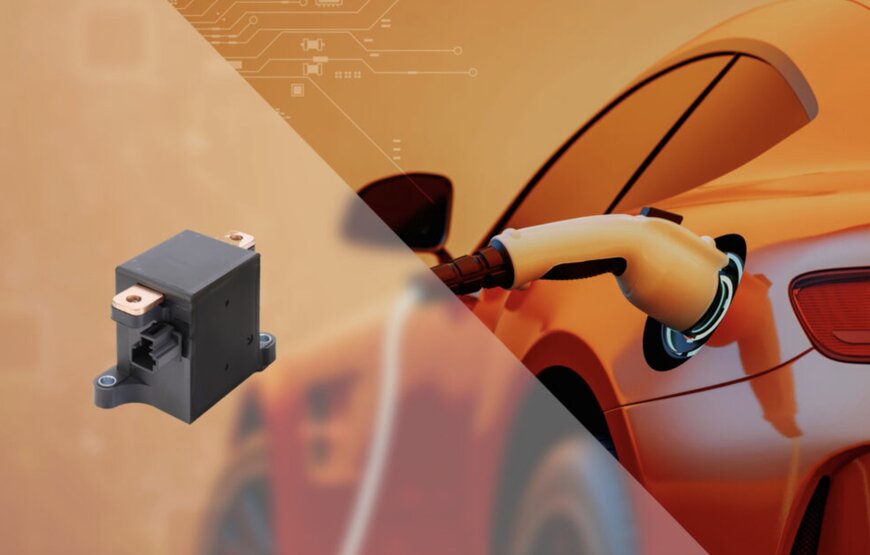
OMRON Electronic Components Europe has expanded its DC power relay portfolio with a high-current, high-voltage solution designed to provide safety isolation and robust switching performance in demanding e-mobility and energy applications.
Application context and performance requirements
Electric-vehicle charging infrastructure, renewable energy systems, and e-mobility platforms such as autonomous guided vehicles require DC switching devices that can combine high current capability, compact form factors, and reliable isolation. These applications are characterised by high fault currents, vibration, and increasingly dense power electronics layouts, placing pressure on conventional contactors in terms of size, efficiency, and lifetime.
The newly introduced relay targets these constraints by offering higher current handling within the footprint of existing devices in the same series, supporting safer operation and simplified system design.
Electrical characteristics and efficiency
The relay is rated for 250 A at 500 VDC, extending the switching capability beyond earlier variants in the series. When closed, the contact resistance is specified at 15 mΩ, limiting conduction losses during continuous operation. Coil power consumption is specified at 4 W, reducing auxiliary energy demand and thermal dissipation compared with larger electromechanical contactors.
The combination of higher switching current and low internal losses enables designers to increase power density while maintaining electrical efficiency, particularly relevant in space-constrained EV chargers and mobile platforms.
Compact design and mechanical robustness
Despite its increased electrical rating, the relay maintains the same external dimensions as other devices in the G9EK screw-terminal family, measuring 47.7 mm × 86 mm × 64.2 mm. This allows direct substitution without redesigning mounting layouts or enclosures.
Mechanically, the internal contact and terminal structure has been optimised to withstand shocks up to 100 g, supporting use in environments subject to vibration and mechanical stress. The terminal design also reduces magnetic repulsive forces generated by large currents, particularly during abnormal conditions such as short circuits, contributing to longer service life and stable operation.
Fault tolerance and safety margins
For safety-critical applications, the relay supports interruption currents up to 1000 A at 400 V and can withstand voltage impulses up to 4000 V. These characteristics provide additional safety margin in systems where transient overcurrents or voltage spikes may occur.
The gasless internal design simplifies the relay architecture while supporting safe operation and aligning with carbon-neutral design objectives. Fast response times—50 ms operate and 30 ms release—support rapid isolation when required, while mechanical endurance is specified at 200,000 operations.
Relevance for e-mobility and energy systems
By combining high DC switching capacity, compact dimensions, and enhanced mechanical resilience, the relay addresses key requirements in EV charging stations, renewable energy converters, and mobile electric platforms. Its performance profile allows it to function as a space-saving alternative to high-current contactors, particularly where efficiency, reliability, and safety isolation are critical.
Overall, the introduction reflects ongoing efforts to adapt electromechanical switching components to the higher power densities and robustness demands of modern DC energy and e-mobility systems.
www.components.omron.com
