
www.auto-innovations.net
15
'26
Written on Modified on
Predictive Powertrain Control and Heavy-Duty Truck ADAS
MAN Truck & Bus integrates PredictiveDrive with MAN EfficientCruise and EBA Advanced to reduce heavy-duty fleet energy consumption and prevent road collisions.
www.man.eu
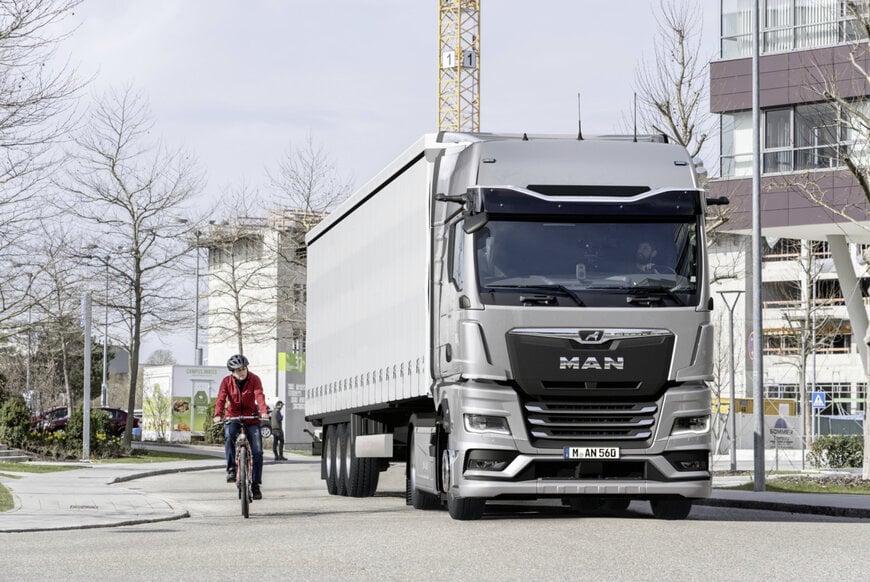
Commercial transport operators face simultaneous regulatory pressures to lower carbon dioxide emissions, prevent urban collisions with vulnerable road users, and eliminate unscheduled fleet downtime across long-haul logistics, regional distribution, and off-highway forestry sectors. To address these operational demands, MAN Truck & Bus presented its model year 2026 vehicle architecture at IAA Transportation 2026, which took place in Hanover, Germany, from September 15 to 20, 2026, introducing enhanced predictive powertrain control, active safety sensors, and over-the-air connectivity across its TGL to TGX series.
Topographical Cruise Control and Energy Recuperation
In heavy-duty commercial vehicle operations, manual speed adjustments and delayed gear shifts ahead of elevation changes or traffic bottlenecks result in kinetic energy losses and elevated fuel consumption. Conventional GPS-assisted cruise control systems primarily evaluate vertical road gradients on motorways, leaving drivers to manually intervene when approaching urban or interurban infrastructure.
To automate longitudinal control across complex routing profiles, MAN Truck & Bus updated its MAN EfficientCruise terrain-responsive cruise control with the PredictiveDrive function for both internal combustion engine and battery-electric drivetrains. Utilizing high-resolution three-dimensional digital maps, the GPS-based system evaluates the selected navigation route up to 3 km ahead. In addition to calculating gradients and descents, the control algorithm processes road curvature, junctions, roundabouts, and posted speed limits. Ahead of deceleration zones, the system coordinates the retarder or electric motor recuperation with the service brake to reduce vehicle velocity, then accelerates back to the permitted speed once the restriction is cleared.
Consistent deployment of MAN EfficientCruise with PredictiveDrive lowers fuel or electrical energy consumption by approximately 5 per cent compared to manual driving, with reductions reaching up to 9 per cent for heavy-duty truck configurations operating in demanding topography. Frederik Zohm, Executive Board Member for Research and Development at MAN Truck & Bus, stated that every litre of fuel saved counts both for customer cost-effectiveness and for reducing carbon dioxide emissions during vehicle operation, noting that model year 2026 combines intelligent functions such as PredictiveDrive with updated assistance systems to increase operational efficiency and safety.
Active Collision Mitigation and Driver Monitoring
Urban distribution and mixed-traffic environments present substantial collision risks between heavy commercial vehicles, stationary obstacles, and vulnerable road users such as cyclists and pedestrians. Furthermore, European Union safety frameworks require increasingly stringent autonomous intervention thresholds and continuous monitoring of driver attentiveness.
The updated MAN Emergency Brake Assist, designated EBA Advanced, complies with European Union legal mandates scheduled to take effect in September 2028. Operating across a velocity range from 1 km/h up to the maximum vehicle speed, EBA Advanced executes autonomous full braking to achieve a maximum speed reduction of up to 100 km/h. The sensor fusion architecture expands detection parameters to account for oncoming traffic during turning manoeuvres and prevents lateral collisions with stationary vehicles protruding into the active driving lane. Within the European Union, the system cannot be permanently disabled; manual deactivation by the driver automatically resets to active status after 15 minutes.
EBA Advanced interfaces directly with the MAN Driver Monitoring System, which tracks gaze direction, steering input, and lane-keeping accuracy to identify fatigue or distraction. When reduced driver attentiveness is detected, the system modifies the intervention threshold of EBA Advanced to initiate emergency braking earlier in critical situations. For low-speed urban manoeuvring, FrontDetection Plus monitors the immediate frontal blind spot, triggering automatic braking or preventing vehicle departure if pedestrians or cyclists are present. Lateral safety is managed by an upgraded turning assistant capable of autonomous braking intervention, alongside a side-area monitoring system featuring an exit warning for road users approaching from the rear. Additionally, the OptiView digital mirror replacement system adds a configuration pairing digital side cameras with a conventional front mirror.
Off-Road Combination Stability and Powertrain Control
Operating heavy tractor-trailer combinations on unpaved logging tracks, mountain gradients, and low-friction surfaces introduces the risk of jack-knifing, where trailer momentum forces the towing vehicle off its trajectory during braking or cornering.
To stabilize articulated combinations under low-traction conditions, MAN Truck & Bus introduced an electronic trailer stability brake for both diesel and battery-electric trucks. Once engaged by the driver, the system regulates braking pressure automatically to keep the combination aligned, while also offering pedal-controlled and manually controlled operating modes. For diesel drivetrains in off-highway applications, traction management is supported by pushbutton or driving-programme activation of the off-road reduction gear. Furthermore, a split adjustment function for the power take-off allows operators to configure multiple speed ranges directly from the cab workstation, eliminating the need for workshop reprogramming.
Over-the-Air Telematics and Charging Infrastructure
Maintaining accurate digital topography for predictive cruise control and traffic sign recognition previously required physical workshop visits, reducing fleet utilization. Through the Connected Maps service, map databases update automatically over the air, maintaining PredictiveDrive accuracy as road infrastructure changes. For diesel fleets, operational availability is further protected by an electronic fuel theft protection system that continuously monitors tank levels to trigger visual and acoustic alarms upon detecting tampering. For battery-electric fleets, the MAN Charge&Go network adds 50 truck-validated charging locations across Europe, including sites in the Czech Republic, Slovakia, Hungary, and Portugal, supported by centralized billing and real-time tracking via the RIO Fleet Monitor and MAN Driver App.
Additional Context:
This section details technical specifications and competitive benchmarking not included in the original product announcement.
Independent industry context indicates that the enhancements to heavy-duty driver assistance systems align with the European Union General Safety Regulation (EU 2019/2144) and UNECE Regulation No. 131 (02 series of amendments). Under the EU General Safety Regulation framework, Advanced Driver Distraction Warning (ADDW) systems became mandatory for all newly registered commercial vehicles in the European Union in July 2026, requiring interior camera or sensor tracking to issue visual, acoustic, or haptic alerts when a driver's gaze leaves the primary roadway for more than 3.5 seconds at speeds above 50 km/h, or 6 seconds between 20 km/h and 50 km/h. Meanwhile, the revised UNECE Regulation No. 131 governing Advanced Emergency Braking Systems (AEBS) for heavy commercial vehicles (categories N2 and N3) establishes stricter deceleration demands and mandates collision avoidance with moving pedestrians and cyclists across wider speed differentials.
In the segment of map-based predictive powertrain control for heavy-duty commercial vehicles, established industry benchmarks include Daimler Truck's Predictive Powertrain Control (PPC) and Volvo Trucks' I-See system. Like MAN EfficientCruise with PredictiveDrive, both benchmark architectures combine GPS positioning with three-dimensional digital road topography to optimize gear selection, ecoroll coasting, and interurban deceleration ahead of curves and roundabouts. In documented manufacturer testing, Daimler Truck's PPC is rated to reduce fuel consumption by up to 5 per cent on cross-country and interurban routes, matching the 5 per cent baseline efficiency gain specified by MAN Truck & Bus for standard operating profiles, while MAN specifies an upper reduction limit of 9 per cent specifically in severe topographical applications.
Edited by Sucithra Mani, Induportals editor – adapted by AI.
www.mantruckandbus.com
