
www.auto-innovations.net
12
'26
Written on Modified on
XR In-Car Gaming Enters Automotive Series Production
Valeo integrates its extended reality gaming technology into Renault Korea’s new Filante to expand digital supply chain capabilities in passenger experiences.
www.valeo.com
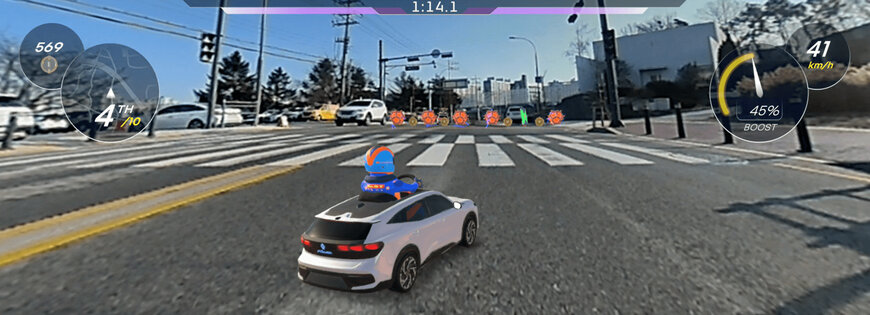
Valeo has begun series production of an extended reality (XR) gaming system in partnership with Renault Korea, embedding the technology as a built-in feature of the newly launched Renault Filante crossover. The integration marks a transition from concept demonstration to production-ready application of XR as part of a vehicle’s digital ecosystem, targeting enhanced passenger engagement while leveraging sensor and software architectures already present in modern cars.
Innovation and integration in the automotive data ecosystem
Valeo’s XR gaming system, derived from its earlier “Valeo Racer” concept initially shown at South by Southwest in 2024, uses advanced perception sensors, compute hardware and real-time environmental data to merge virtual gameplay with live road context. The feature is designed to utilize existing vehicle cameras and sensor feeds alongside perception and software intelligence to create motion-synchronized extended reality experiences for passengers without adding dedicated hardware.
By using real-time vehicle data as a backdrop for interactive content, the system also aims to mitigate motion sickness an issue common in non-synchronized in-car video applications by aligning virtual motion with the vehicle’s actual movements.
Series production and vehicle application
The Renault Filante, produced in Busan, South Korea, serves as the launch platform for Valeo’s production-ready XR gaming feature. Developed as part of Renault’s broader international growth strategy, the Filante combines hybrid propulsion, connected cabin systems and premium interior design with a focus on digital user experiences, making it suitable for integrating novel software-driven functions.
Valeo’s implementation illustrates how software-defined vehicle architecture can unlock new value beyond traditional infotainment. By reusing installed perception hardware and middleware, the company aims to deliver scalable, cost-efficient innovations that maintain automotive safety and comfort standards.
Technical positioning in the market
This production release reinforces the trend of vehicles evolving into updatable digital platforms where immersive passenger features coexist with core safety and driving systems. The XR gaming integration leverages data from advanced driver assistance systems (ADAS) and real-time sensors, reflecting a broader push within the automotive data ecosystem toward modular software applications capable of differentiating vehicles through enriched user experiences.
While in-car entertainment systems have long existed, this XR approach distinguishes itself through synchronous fusion of live vehicle data and virtual elements a technical combination not widely deployed in series production to date.
Applications and use cases
Intended primarily for passenger entertainment, the XR experience can run on connected screens or mobile devices inside the vehicle, offering interactive gaming during travel. By aligning gameplay with actual motion and surroundings, the system also opens avenues for future in-vehicle applications that tie entertainment with navigational and real-world context data.
In summary, the entry of Valeo’s XR gaming technology into series production underscores how automotive suppliers and OEMs are extending their focus beyond conventional vehicle functions into immersive digital services that enhance the passenger experience and expand the digital supply chain in connected mobility.
www.valeo.com
