
www.auto-innovations.net
17
'26
Written on Modified on
NVIDIA Advances Level 4 Autonomy With Global Drive Hyperion Adoption
Automakers like BYD and Nissan are leveraging the NVIDIA DRIVE Hyperion platform to accelerate the global deployment of safe, scalable, and fully autonomous vehicle fleets.
www.nvidia.com
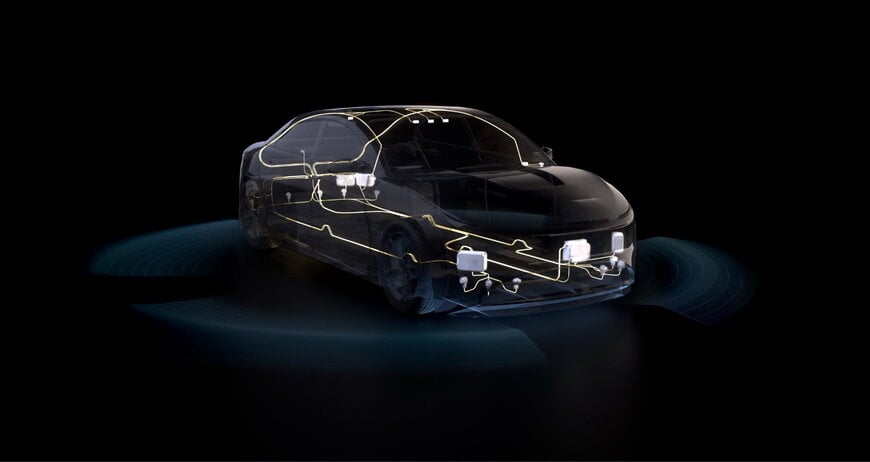
NVIDIA is distancing itself from the competitive landscape of autonomous vehicle (AV) development by shifting from basic pattern-matching AI to a "reasoning-based" architectural stack. While many developers struggle with the "long tail" of unpredictable road hazards, NVIDIA’s latest expansion of the DRIVE Hyperion platform — now adopted by global giants like BYD, Geely, and Nissan — standardizes the hardware and software required to achieve scalable Level 4 autonomy. By integrating the NVIDIA Halos OS safety architecture with the newly released Alpamayo 1.5 reasoning models, NVIDIA provides a transparent, steerable alternative to the "black box" AI systems used by many competitors, allowing manufacturers to accelerate validation cycles and deploy safer robotaxi and consumer fleets globally.
A Standardized Architecture for Global Autonomous Deployment
The primary hurdle for global automakers has been the lack of a unified reference architecture that can scale across different vehicle types and regions. NVIDIA DRIVE Hyperion solves this by consolidating compute, sensors, and networking into a production-ready system. This standardization is driving rapid momentum among mobility providers like Uber, which plans to launch a DRIVE Hyperion-powered autonomous fleet across 28 cities by 2028. By utilizing the NVIDIA DRIVE AGX Thor system-on-a-chip, partners such as Isuzu and TIER IV are also extending these capabilities to public infrastructure, specifically for autonomous bus development. This full-stack approach ensures that as one vehicle learns from a complex scenario, the entire global fleet benefits from that data, a level of efficiency that fragmented proprietary systems cannot match.
Advancing Safety Through Reasoning and Transparent AI
At the core of NVIDIA’s technological differentiation is the transition to reasoning-based driving via the Alpamayo 1.5 model. Unlike traditional AV models that simply predict the next likely move, Alpamayo 1.5 processes video, motion history, and natural language prompts to output driving trajectories accompanied by "reasoning traces." This allows developers to understand why a vehicle made a specific decision and to steer its behavior using text-based constraints. This transparency is critical for Level 4 operations, where vehicles must navigate rare or unpredictable events without human intervention. To support this, the Halos OS provides a three-layer safety foundation built on ASIL D-certified foundations, ensuring that these high-level AI decisions always operate within rigorous automotive-grade guardrails.
High-Fidelity Simulation with Omniverse NuRec
To maintain its lead in the AV toolchain market, NVIDIA is utilizing its Omniverse NuRec technology to solve the manual bottleneck of simulation worldbuilding. Using 3D Gaussian Splatting, NuRec transforms real-world sensor data into interactive, high-fidelity digital twins. This enables developers to stress-test reasoning behaviors in a virtual environment that perfectly mirrors reality, significantly reducing the cost and time of physical road testing. With integration from industry leaders like dSPACE and research institutions like Mcity, NVIDIA has created an ecosystem where simulation is no longer just a visual tool, but a verifiable physics-based laboratory for perfecting autonomous logic.
Edited by an industrial journalist, Evgeny Churilov.
www.nvidia.com
