
www.auto-innovations.net
18
'26
Written on Modified on
TIER IV & Isuzu Deploy Level 4 Autonomous Buses
Autonomous transit integrates AI computing, redundancy systems, and open-source software to support scalable, high-capacity public transport operations.
www.isuzu.co.jp
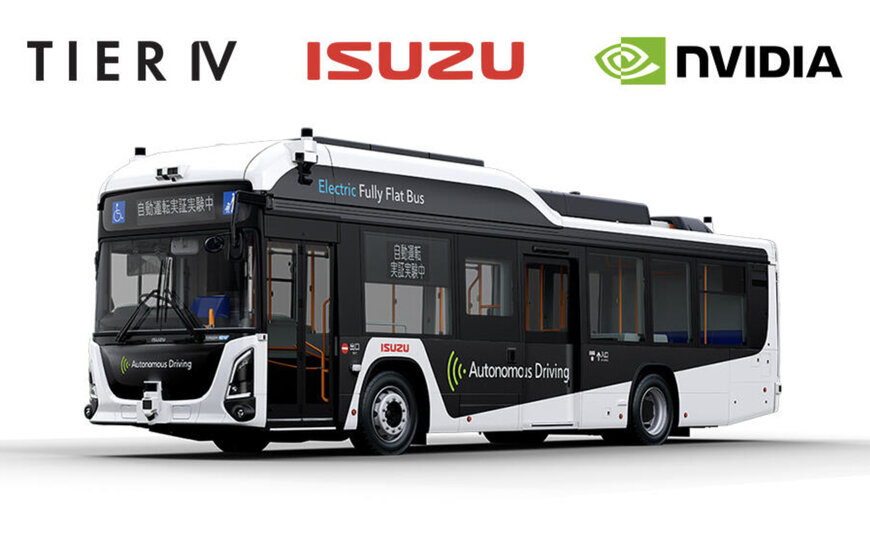
Public transport and smart mobility systems are evolving toward higher levels of automation, with TIER IV, Inc. and Isuzu Motors Limited deploying Level 4 autonomous buses powered by the NVIDIA DRIVE Hyperion computing platform. Integrated into Isuzu’s ERGA electric and diesel bus models, the solution combines AI-based processing, software-defined vehicle architecture, and redundancy mechanisms to enable fully autonomous operation in controlled environments.
The deployment, presented during NVIDIA GTC 2026 held from March 16–19 in San Jose, California, reflects a technical approach aimed at addressing operational challenges such as driver shortages while maintaining safety and performance requirements for public transit systems.
Integration of AI computing and autonomous driving software
The autonomous buses are built on the NVIDIA DRIVE Hyperion platform, incorporating the DRIVE AGX Thor system-on-chip to deliver the computational performance required for real-time perception, decision-making, and vehicle control. This architecture supports fail-operational capabilities through system redundancy, ensuring continued operation in the event of component-level faults.
The vehicles run on TIER IV’s Level 4 autonomous driving software stack based on Autoware, an open-source platform designed for scalable deployment and customization. This combination allows integration of sensor data from cameras, radar, and other onboard systems, enabling the buses to operate without human intervention under predefined conditions.
Application in high-capacity public transit
The system is designed for urban and regional public transport networks, where predictable routes and controlled environments support Level 4 automation. By deploying autonomous functionality in both electric and diesel variants of the ERGA platform, the solution offers flexibility for different fleet requirements and infrastructure constraints.
In practice, such autonomous buses can support continuous operation with reduced dependency on drivers, contributing to improved service availability in regions experiencing workforce shortages. The integration of AI-driven control systems also enables consistent driving behavior, which may improve passenger safety and optimize energy consumption in electric variants.
Technical positioning and scalability
The use of an open-source software framework combined with high-performance AI hardware differentiates this deployment from earlier autonomous bus implementations that relied on more limited processing capabilities or proprietary systems. The DRIVE AGX Thor platform is designed to handle multiple concurrent workloads, including perception, planning, and control, within a unified architecture.
This approach supports scalability across fleets, allowing operators to deploy standardized systems while adapting software configurations to specific routes or regulatory environments. The inclusion of redundancy at both hardware and software levels addresses safety requirements for public transport applications, where system reliability is critical.
Compared with other autonomous bus solutions currently under development, systems based on high-performance centralized computing platforms aim to reduce system complexity by consolidating multiple electronic control units into a single architecture. This can simplify maintenance and enable over-the-air software updates, which are essential for continuous improvement of autonomous driving functions.
Advancing autonomous public transport deployment
By combining vehicle engineering, open-source autonomous software, and AI computing infrastructure, the deployment demonstrates how Level 4 autonomous buses can be implemented in real-world public transport scenarios. The integration of these technologies provides a framework for expanding autonomous transit systems while maintaining operational safety and efficiency.
Edited by Industrial Journalist, Natania Lyngdoh — Adapted by AI.
www.isuzu.com
