
www.auto-innovations.net
09
'26
Written on Modified on
Electric heavy-duty truck for urban food logistics
Manner deploys a MAN eTGX electric truck for inter-factory logistics between Vienna and Wolkersdorf to reduce emissions and support sustainable transport operations.
www.man.eu
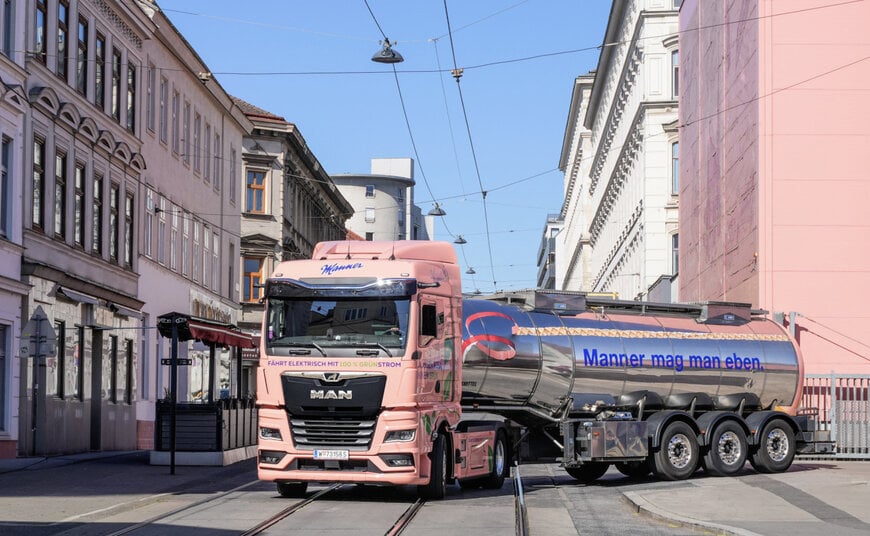
Manner has introduced a battery-electric heavy-duty truck into its logistics operations to support emission-free transport between production facilities in Vienna and Wolkersdorf. The vehicle is used for regular shuttle operations transporting raw materials for food production and forms part of the company’s broader logistics decarbonization strategy.
Electric truck deployment in inter-factory transport
The MAN eTGX 20.449 4x2 electric truck is deployed in daily transport operations between Manner production sites. The vehicle transports raw materials including nougat and chocolate mass used in food manufacturing processes.
The electric truck is also being evaluated for additional regional transport applications beyond internal factory logistics. Depending on vehicle configuration, route profile and transport load, the eTGX can achieve a range of up to 570 kilometres on a single battery charge.
The deployment focuses on predictable logistics routes where charging cycles and operational planning can be optimized for electric mobility applications.
Battery-electric driveline for urban logistics operations
The eTGX is designed for urban and regional heavy-duty transport applications requiring low-emission operation and reduced noise levels. In shuttle-based logistics environments, battery-electric drivetrains can support high operational efficiency due to recurring route structures and centralized charging infrastructure.
By replacing conventional combustion-engine transport vehicles, the company aims to reduce operational CO₂ emissions and lower noise pollution along urban transport corridors between manufacturing locations.
Renewable energy integration for fleet charging
The electric truck is powered primarily using electricity from renewable energy sources, including purchased green electricity and electricity generated by the company’s photovoltaic installation at its Wolkersdorf facility. This integration of renewable energy into transport operations supports broader industrial decarbonization strategies and reduces indirect emissions associated with fleet charging infrastructure.
Expansion of zero-emission transport fleet
The logistics electrification project forms part of a broader fleet transformation program. Funding has already been approved for an additional battery-electric articulated truck and a 7.5-ton electric truck intended for urban delivery operations supplying the company’s retail location at Stephansplatz in Vienna.
The expansion reflects increasing adoption of battery-electric commercial vehicles within regional logistics and last-mile transport applications.
Heavy-duty electrification and logistics sustainability
The deployment highlights the growing role of electric heavy-duty vehicles in industrial logistics environments where transport routes are predictable and charging infrastructure can be integrated into operational workflows. In addition to reducing direct emissions, electric drivetrains contribute to lower acoustic emissions in densely populated urban environments and support sustainability targets across industrial supply chains.
The vehicle’s distinctive exterior design also functions as a visible demonstration of the company’s transition toward lower-emission logistics operations.
Additional Context: technical specifications and competitive benchmarking not included in the original announcement
In the heavy-duty electric truck segment, manufacturers including Volvo Trucks, Mercedes-Benz Trucks, Scania and Renault Trucks offer comparable battery-electric platforms for regional and urban logistics applications. Key benchmarking parameters include driving range, battery capacity, charging performance, payload capability and total cost of ownership.
Electric heavy-duty trucks are increasingly being deployed in hub-to-hub transport, factory shuttle operations and urban distribution routes where predictable driving cycles support optimized charging strategies. Fleet operators also evaluate infrastructure requirements, renewable energy integration and regulatory incentives when transitioning to electric commercial vehicle fleets.
The presented deployment is differentiated primarily through the integration of renewable-energy-based charging, inter-factory food logistics operations, planned fleet electrification expansion and the use of a heavy-duty electric platform with operational ranges suitable for regional transport applications.
Edited by Maria Brueva, Induportals editor – adapted by AI.
www.man.com
