
www.auto-innovations.net
03
'26
Written on Modified on
Electric Turntable Ladder Truck for Urban Firefighting
Rosenbauer unveiled a battery-electric aerial ladder vehicle on a MAN chassis, targeting low-emission emergency response in urban, industrial, and airport environments.
www.man.eu
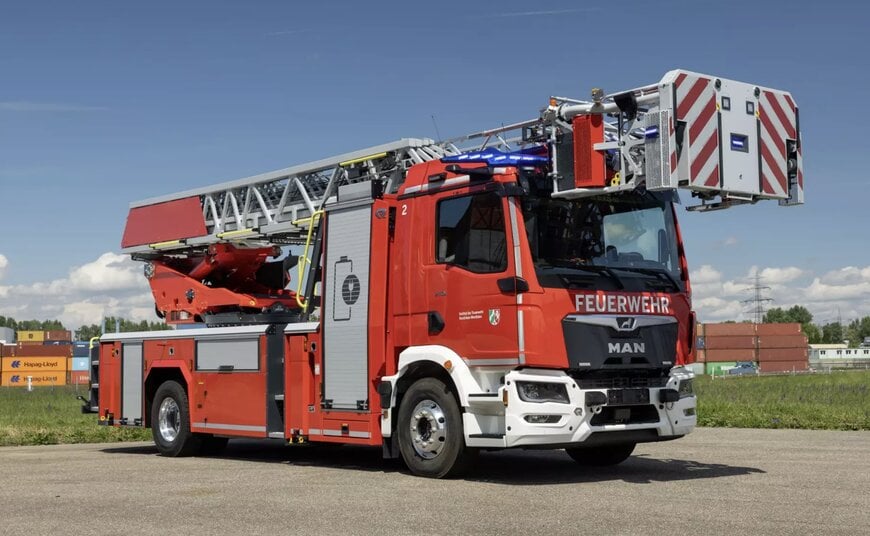
Rosenbauer and MAN Truck & Bus presented an electric turntable ladder truck based on the Rosenbauer L32A-XS aerial platform and the newly introduced MAN eTGM electric chassis at INTERSCHUTZ 2026 (June 1 to June 6) in Hanover, Germany. The vehicle was also handed over to the Institute of Fire Service North Rhine-Westphalia (IdF NRW), which plans to integrate the platform into training and operational activities.
Electric Fire Apparatus Designed for European Standards Compliance
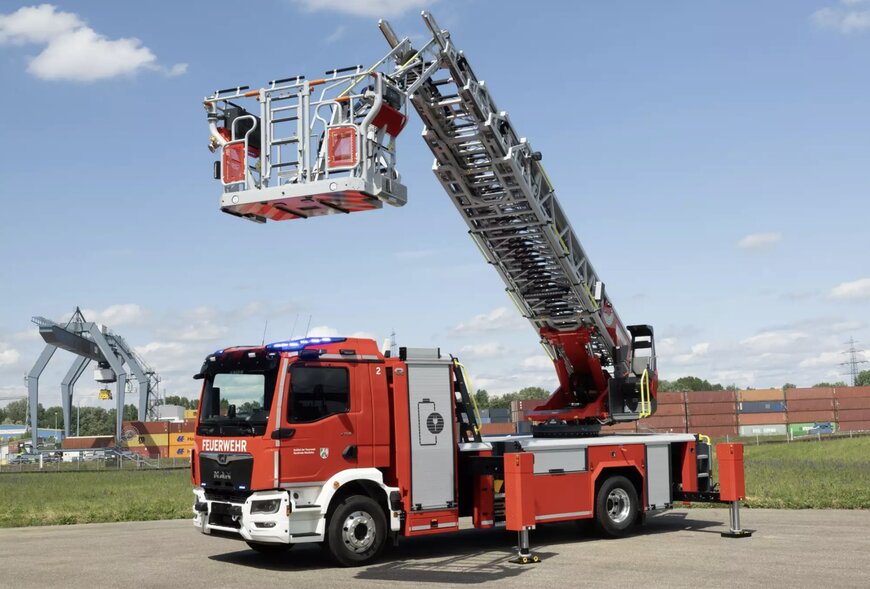
The new vehicle combines a fully electric chassis with an electrically operated aerial ladder system. With a gross vehicle weight below 16 tonnes and a rear axle load under 10 tonnes, it falls within weight limits commonly applied to fire service access areas in Germany. The platform complies with DIN EN 14043 requirements for fully automatic turntable ladders in class 23/12, enabling rescue operations at a height of 23 metres and a horizontal outreach of 12 metres.
The development addresses a key challenge in emergency vehicle electrification: maintaining operational capability while meeting strict weight and performance requirements. The configuration is intended for municipal fire brigades, industrial emergency response teams, airport firefighting units, and training facilities, including applications where low-noise operation is advantageous.
Electric Drivetrain and Energy Storage System
The MAN eTGM platform uses the MAN eCD210 central electric drive system, combining an electric motor with a MAN TipMatic two-speed transmission. The system delivers a continuous output of 210 kW and 800 Nm of torque. Power for the ladder system is supplied through a mechanical power take-off (mPTO), allowing the aerial platform to operate without a separate combustion-powered auxiliary drive.
Energy is stored in two lithium-ion battery packs providing a gross capacity of 178 kWh, with 160 kWh available for use. According to the manufacturers, the configuration supports approximately ten urban emergency deployments of around eight kilometres each between charging cycles, or roughly four deployments of 20 kilometres in rural operating environments.
Fast-charging capability allows direct-current charging at up to 250 kW, reducing charging time from 5% to 80% state of charge to approximately 33 minutes.
Aerial Ladder System for Confined Urban Environments
The L32A-XS aerial ladder incorporates Rosenbauer's XS operating concept, which is designed for deployment in narrow streets and densely built-up areas. The system enables precise movement of the ladder assembly with a reduced operating radius and allows stepless elevation of the rescue basket along building facades.
A tilting basket arm extends accessibility around obstacles and improves access to elevated openings such as windows and balconies. Hydraulic systems are designed to minimize setup times, while horizontal-vertical stabilizers and a 3D load measurement system monitor operational stability during deployment.
The rescue basket supports loads of up to 500 kg, equivalent to five occupants. A fully opening front section facilitates the transport of wheelchair users, while integrated provisions for stretcher mounting support rescue operations involving injured individuals.
Firefighting and Rescue Capabilities
The vehicle is equipped with six storage compartments featuring roller-shutter closures and LED lighting extending from the stabilization system to the rescue basket. An integrated water supply system and attachable water monitor allow the basket to be used for firefighting operations in addition to rescue activities.
These capabilities enable the platform to perform multiple emergency response functions without requiring additional specialized vehicles, supporting operational flexibility for urban fire departments and industrial facilities.
Modular Electric Vehicle Architecture
The MAN eTGM is based on the manufacturer's battery-electric commercial vehicle platform, which shares components with the lighter MAN eTGL and the larger MAN eTGS and eTGX vehicle families. Common systems include the high-voltage architecture, thermal management systems, and battery technology.
The chassis can be configured with two or four battery packs, providing a maximum gross battery capacity of 356 kWh. MAN states that the platform can achieve ranges of up to 480 kilometres depending on vehicle configuration and duty cycle. Regenerative braking is designed to improve efficiency in stop-and-go operating conditions common in municipal and emergency vehicle applications.
The chassis also incorporates body-builder interfaces, optimized wheelbase configurations, and a standard mechanical power take-off, supporting integration with specialized equipment such as aerial ladders, municipal service bodies, and other emergency response systems.
Additional Context
This section details technical specifications and competitive benchmarking not included in the original news release.
Several manufacturers, including Rosenbauer, Volvo Trucks, Scania, and Magirus, have introduced battery-electric fire apparatus platforms. However, most currently deployed electric fire trucks are pumpers, rescue vehicles, or municipal support vehicles rather than aerial ladder units.
A key benchmark for aerial ladder vehicles is compliance with EN 14043 performance requirements while remaining within axle-load restrictions that permit access to urban fire service operating zones. The reported configuration of less than 16 tonnes gross vehicle weight and less than 10 tonnes rear axle load places the vehicle among the lightest battery-electric turntable ladder platforms disclosed to date.
From an energy perspective, the vehicle's 178 kWh battery capacity is lower than many heavy-duty electric municipal vehicles, which frequently exceed 250 kWh. The reduced battery size helps control vehicle weight while still supporting the duty cycles typically associated with emergency response operations, where rapid deployment, short travel distances, and extended stationary equipment operation are common.
The use of a mechanical power take-off driven directly from the electric drivetrain also distinguishes the architecture from alternative approaches that rely on separate hydraulic or auxiliary electric systems for aerial platform operation. This configuration can simplify power transmission while reducing the number of independent energy systems that require maintenance within the vehicle.
Edited by Aishwarya Mambet, Induportals Editor, with AI assistance.
www.man.com
