
www.auto-innovations.net
10
'26
Written on Modified on
Integration of Optical Transceivers for Automotive Multigigabit Camera Systems
Hinge Technology and KD collaborate to deploy a 10 Gb/s fiber-optic backbone for high-resolution in-vehicle camera networks.
www.hinge-tech.com
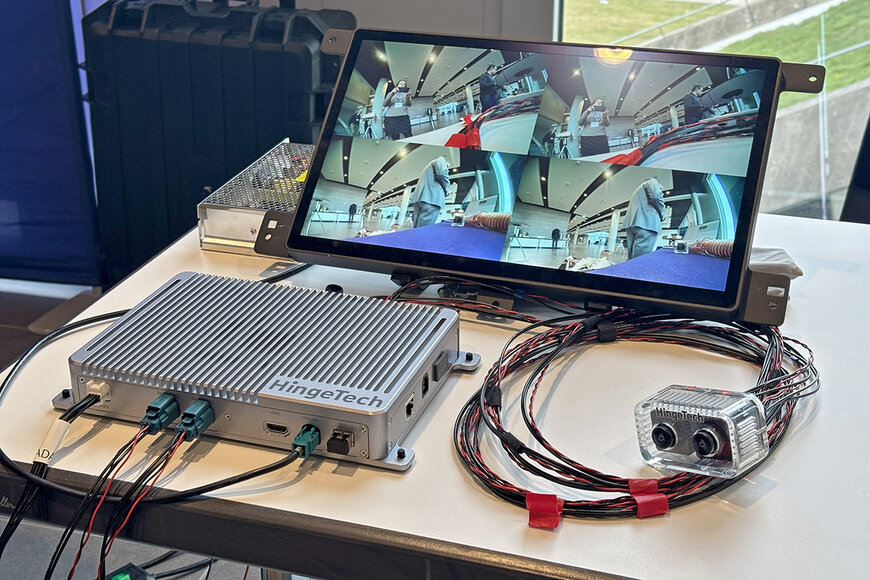
Hinge Technology and KD are collaborating to implement 10 Gb/s optical data transmission for advanced vehicle electronics. The partnership integrates optoelectronic transceivers into a multi-camera system operating over a fiber-optic backbone, addressing the high-bandwidth requirements of software-defined vehicles (SDVs) and robotics.
Industrial Challenge and Cooperative Roles
Next-generation automotive architectures require high-resolution sensor data processing with low latency and high electromagnetic compatibility (EMC). To meet these operational demands, Hinge Technology, a specialist in vehicle electronics architecture, integrates the physical layer technology provided by semiconductor developer KD. This cooperation combines KD’s expertise in IEEE Std 802.3cz compliant optical communication with Hinge Technology's system-level engineering for electronic control units (ECUs) and sensor networks.
Technical Solution and System Architecture
The technical solution relies on the KD7251 single-chip optoelectronic transceiver, which combines optical and electronic functions to transmit data over OM3 multimode glass optical fiber. The hardware implements nGBASE-AU physical layers, supporting data rates of up to 10 Gb/s alongside backward compatibility for lower-speed sensor integration. The module meets ASIL-B functional safety requirements and operates across extended automotive temperature ranges.
Deployment and Integration Testing
The integrated system underwent validation during a live hardware demonstration. The deployment utilized a multi-camera architecture where two 10 Gb/s optical cameras connected to dual ECUs. Data was transmitted across the fiber-optic backbone between the processing units. One ECU aggregated four high-resolution video streams to execute functions such as image stitching and display output. The test environment also incorporated a 1 Gb/s optical link to benchmark latency and image quality differences between gigabit and multigigabit transmission protocols.
Applications and Expected Impact
The deployment of this optical architecture ensures lossless transmission of video streams and real-time data exchange without electromagnetic interference. By aggregating multiple camera inputs through a centralized 10 Gb/s backbone, automotive engineers can optimize data links for both zonal and centralized architectures. Beyond the automotive sector, this scalable optical platform provides reliable high-bandwidth connectivity applicable to mobile industrial robotics.
Edited by Lekshman Ramdas, Induportals editor – adapted by AI.
www.hinge-tech.com
