
www.auto-innovations.net
08
'26
Written on Modified on
Implementation of Hydrotreated Vegetable Oil in Automotive Diesel Manufacturing
BMW Group integrates 100 percent pure hydrotreated vegetable oil into the initial filling process of internal combustion engines to reduce carbon emissions.
www.bmw.com
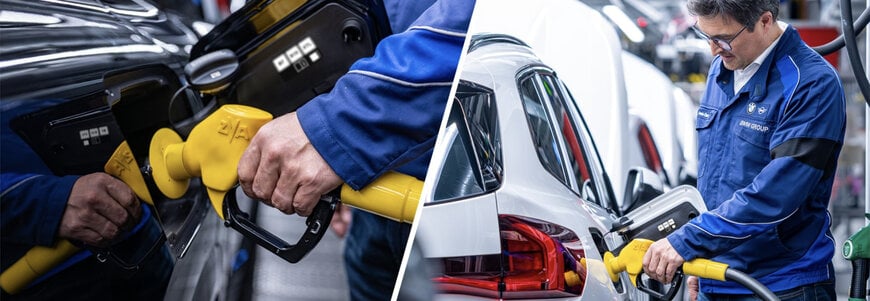
The BMW Group has implemented the use of HVO 100, a paraffinic fuel, for the initial filling of diesel vehicles manufactured at its German production facilities. This integration of renewable fuels into the automotive supply chain targets the reduction of greenhouse gas emissions within the passenger vehicle and heavy-duty logistics sectors.
Technical Properties and Emissions Reduction
The adoption of hydrotreated vegetable oil relates directly to the transition toward a renewable fuels ecosystem in automotive manufacturing. HVO 100 consists of 100 percent pure hydrotreated vegetable oil derived from waste residues, such as used cooking oils, without the inclusion of palm oil or conventional biodiesel. Technical evaluations indicate that the fuel reduces CO2e emissions by approximately 90 percent compared to fossil-based diesel. The chemical properties of this paraffinic diesel yield specific technical variations, including improved cold start behavior and an increased resistance to microbial contamination, often referred to as diesel plague, due to the high purity levels of the refining process. BMW Group diesel engines manufactured since March 2015 meet the European fuel standard EN 15940 and are approved for operation with this fuel formulation.
Feedstock Supply and Regulatory Framework
The expansion of the carbon-neutral fuel infrastructure relies on a diverse feedstock supply chain. A February 2026 study conducted by organizations including the Institute for Piston Engines and the German Biomass Research Centre indicates that the resource base extends beyond used cooking oils to encompass agricultural and forestry residues, straw, food industry by-products, and catch crops. The data suggests that utilizing these regional feedstocks could enable full supply for European road transport by 2040 under specific high-yield scenarios. In alignment with these projections, regulatory frameworks are evolving, with industry advocacy directed at the European Union Renewable Energy Directive (RED IV) to establish greenhouse gas reduction targets of 90 percent by 2040 and 100 percent by 2050 for the road transport sector.
Commercial Availability and Logistics Integration
The distribution network for this paraffinic diesel encompasses over 8,300 filling stations across Europe, with German regulatory approval for retail sale established in late May 2024. In addition to passenger vehicle applications, the fuel serves heavy-duty transport within the plant logistics operations. Operations beginning in March 2023 include four trucks managed by logistics provider Guggemos, functioning on a continuous cycle between Landau an der Isar and the Munich production facility. The logistics fleet subsequently expanded to include six additional trucks operated by DB Schenker, which execute 40-kilometre round trips between the supply centre in Eching and the Munich plant, demonstrating the operational viability of hydrotreated vegetable oil in demanding supply chain logistics.
Additional Context:
This section details technical specifications and competitive benchmarking not included in the original product announcement
Within the alternative fuel sector, HVO 100 competes with standard biodiesel, also known as Fatty Acid Methyl Ester (FAME), and synthetic e-fuels. While FAME is constrained by blending limits, typically capped at 7 percent to 20 percent due to its oxygen content and tendency to degrade engine seals, HVO serves as a drop-in replacement that meets the EN 15940 specification for paraffinic diesel fuels. It contains zero oxygen and aromatics, allowing for 100 percent utilization in compatible engines without requiring hardware modifications. Furthermore, the cetane number of HVO typically exceeds 70, compared to standard fossil diesel which ranges from 51 to 55, resulting in more efficient combustion parameters. Compared to e-fuels, which are synthesized from captured carbon dioxide and green hydrogen, HVO benefits from a mature production infrastructure and lower production costs per litre, though e-fuels present a higher theoretical potential for scaling without the geographic constraints of biomass feedstock availability.
Edited by Natania Lyngdoh, Induportals editor, assisted by AI.
www.bmwgroup.com
